RHS Director Looks Back, Ahead On 1776-2026 Ties
Editor’s note: The following article was written by Eric Wilson, executive director of the Rockbridge Historical Society and co-chair of Rockbridge250; it is the second in a three-part News-Gazette series focusing on how local and national commemorations of American independence and identity evolved from 1776 to 1976 to 2026.
In the beginning, there was July 4. Its revolutionary force immediately sparked a new tradition, which we now time-stamp to 1776, of course. By 1826, those origins would be broadly commemorated for the first time in the Early Republic, supercharged by the uncanny, mythologized deaths of Jefferson and Adams 50 years to the day of the signing of the Declaration of Independence. The year 1876 brought another momentous Centennial, with an international exposition that returned to Philadelphia, hoping to further engineer a still-fragile sense of reunion after the Civil War. Observances in 1926 were an unqualified, comprehensively forgotten flop.
Today, talk of the 1976 Bicentennial tends to conjure other vividly recalled origin stories, not just of America’s founding, but our own lived memories. As I con- tinue to canvass and record local memories from 50 years ago, that landmark year has been regularly remembered in warm, often gauzy terms. Many folks recall the doubling down on patriotic bunting, fireworks, and barbeques. Others smile when sharing pictures of church pageants in colonial costume; or the wagon trains and mini-Conestogas that look to an even more distant past; or childhood school projects excavated from their parents’ or their own attics. The Rockbridge Historical Society Museum has fielded a new run of both contemporary and historic souvenirs and ephemera: both kitschy keepsakes and items more meaningfully handed on through families, to forge their own genealogical legacies.
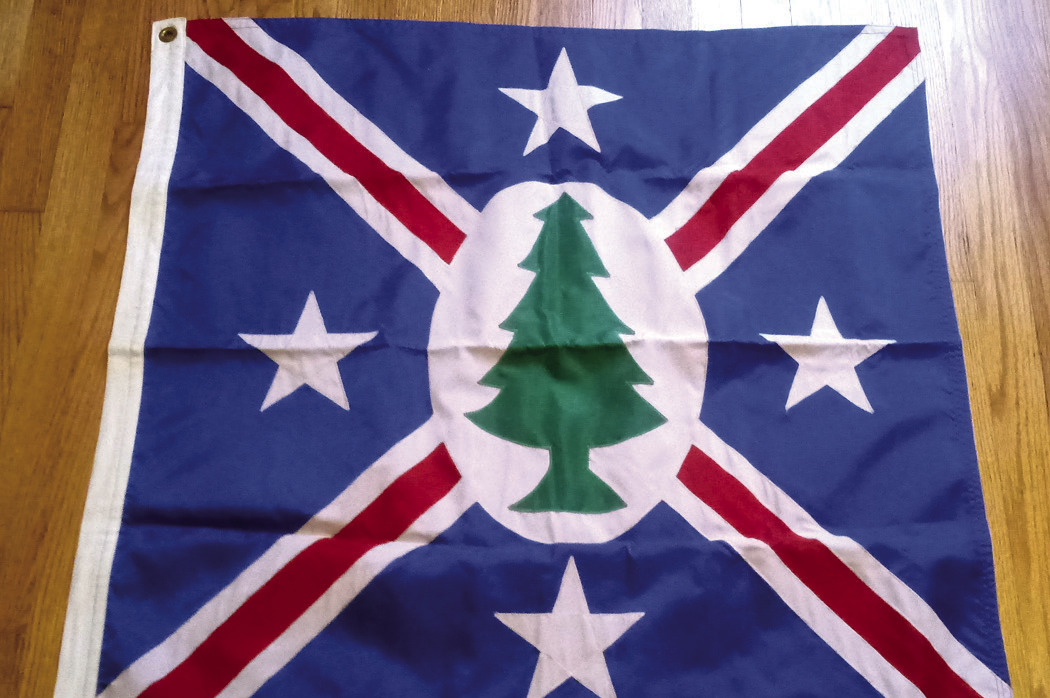
W&L PROFESSOR David Dickens designed this proposed Bicentennial city flag for Lexington, but it was eventually shelved. (RHS Collections)
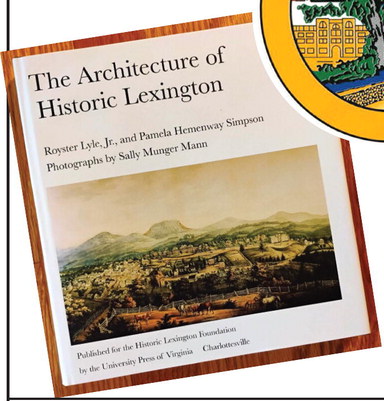
THE 1977 “Architecture of Historic Lexington” by Pam Simpson, Royster Lyle and Sally Munger Mann remains an important resource for those interested in Lexington history.
And now here we are, in the stretch run of 2026, having cleared our own “BigBicentennial+ 50”: a helpful moniker that’s proved easier for people to get their heads and tongues around than “Semiquincentennial.”
As summer fades, it’s a good time to keep thinking not only about what we’ve experienced in this year’s collective commemorations, but what memories and takeaways we want to last, for whom, and why. After we wrap our biggest celebrations, do we actually want a “hangover,” of sorts? Not post-party exhaustion or delirium. But rather, some positive takeaways we can proudly look back on, and even integrate into our everyday lives?, And if that’s a goal worth reaching for, have we “saved enough powder” (to summon another Revolutionary era metaphor) to continue our collective commitments? Should we keep advancing our own local “Spirit of ‘26” for two more years, when January 2028 brings the twin-250th birthdays of Rockbridge and Lexington?
As a point of comparison, it’s instructive to look back to the Bicentennial, to discover and reflect on what’s actually stayed with us. In 1789, “We The People” voiced our nation’s even more essential sequel: the Constitution’s “dream deferred” that didn’t arrive until over a decade after Jefferson drafted the Declaration, and African American preacher Lemuel Haynes’ sermon called for “Liberty Further Extended” for more racial and civic inclusion, that same year. How can those past precedents, and those of 1976, now help us to move forward in the ever evolving “American Experiment”?
Bicentennial Hangovers
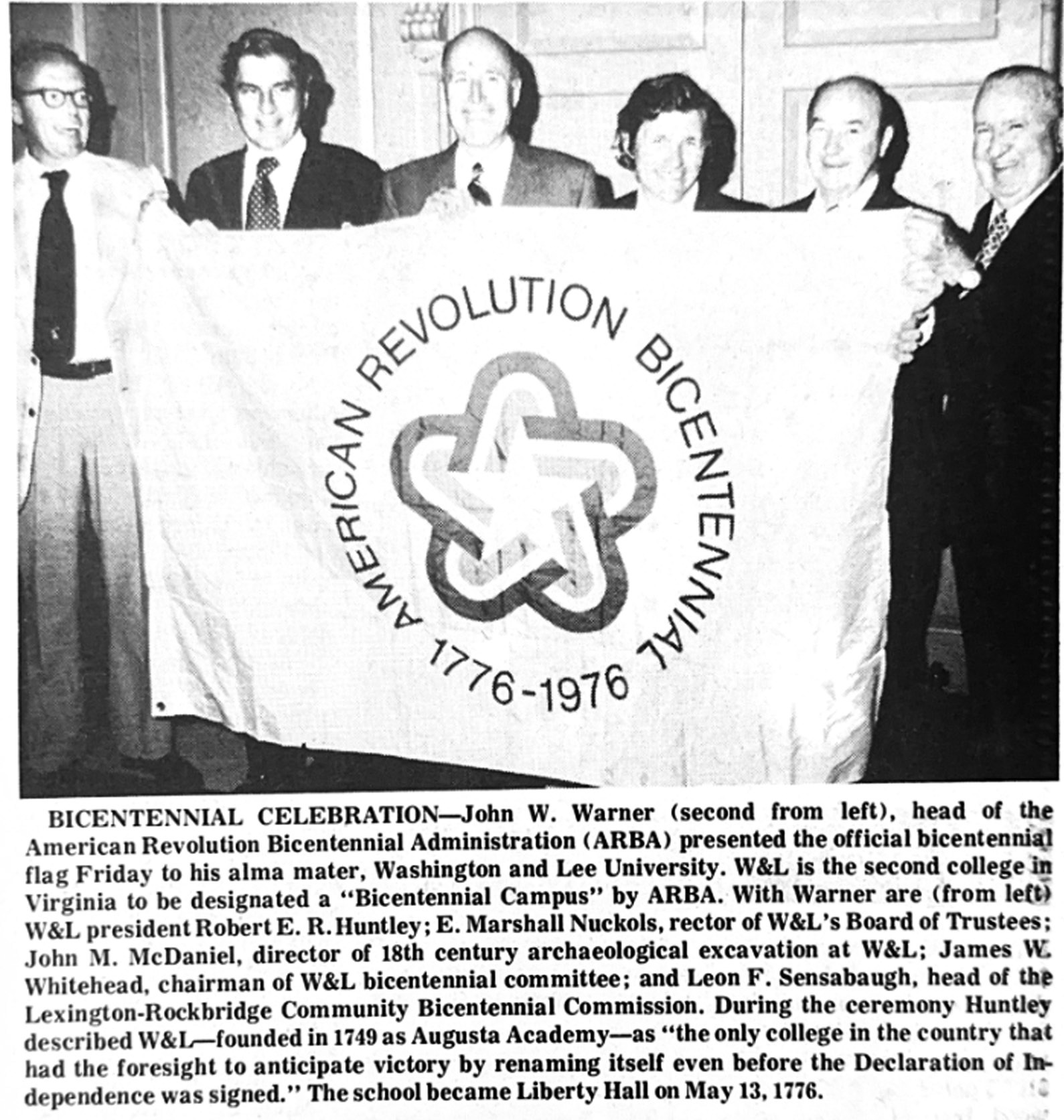
Let’s start with one statistic that always stuns me, marking the growth and appeal of public history at large. According to the American Association of State and Local History, nearly 40% of the historical societies and sites operating today, across the nation, were established in the mid-to-late 1970s. In other words, the Bicentennial became a powerful, durable engine for an American appetite for local history. In 1974, for one local tie-in, President Nixon appointed John Warner (W&L ’49, then-secretary of the Navy, and Virginia’s future U.S. senator) to sort out the swampy commemorative mess that had beset Washington’s bureaucratic efforts. Check out his 1975 pep talk for the freshly retooled enterprise, holding court in the National Archives, at tinyurl.com/ WarnerBicentennial-PSA.
Still today, every day, we continue to enjoy many of those investments. The burial of now invisible electric wires under Lexington’s Main Street – part of its historic charm – was spurred and partially funded by federal appropriations from Congress for civic beautification. Those national plans, collaborations, and feuds would gradually be managed and executed across the decade following the birth of the American Revolution Bicentennial Commission on July 4, 1966.
In 1976, the TransAmerican Bikecentennial Trail marked its arrival here with bicycle-logoed signs of the still-popular, recreational US-76, rolling right through our county and city. That same year, the Rockbridge Community Festival first set up shop on our own stretch of “Main Street America,” soon followed by the annual July 4th flock of children in the festive bike parade that’s now wheeled down that same pathway for the last 40 years.
In passing the baton to 2026, a statewide “Bike76 Grant” currently has the Rockbridge Historical Society partnering with Lexington and Rockbridge schools, inviting students to create and decorate a pair of commemorative benches to be installed along the route. That’s a rather different and more spirited kind of “hangover,” as its continued, communal momentum – and its seats for welcome pause and reflection – will support visiting cyclists, residents, and schoolchildren for another 50-plus years to come.
Picturing Our Histories Keeping our focus on the downtown grid first plotted out in 1778, the Lexington Historic District was approved and listed on the National Register of Historic Places in 1972, grounding this growing civic wave in local efforts for historic preservation. A flanking and still widelyowned complement followed with the 1977 publication of Pam Simpson, Royster Lyle, and Sally Munger Mann’s landmark book, “The Architecture of Historic Lexington.” Then as now, government officials, nonprofits, and private citizens joined together on a wide range of concrete, sustainable projects. Rockbridge250 and VA250 still jointly aim to do so, with a long lens directed towards the Yorktown “coda” of 1781, which was supported by our own local militia and Revolutionary soldiers.
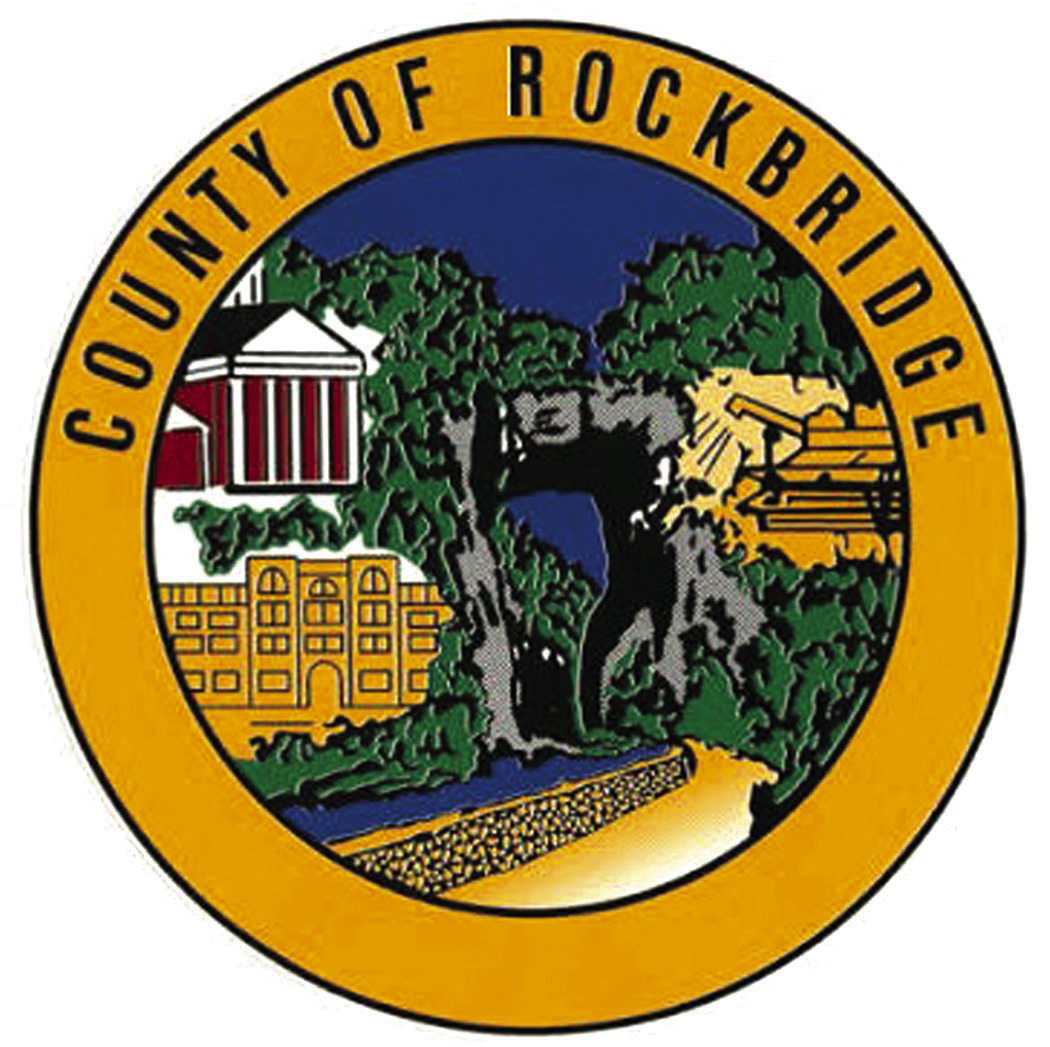
For its part, like many other jurisdictions across the country, Rockbridge County seized the timely opportunity to adopt a new jurisdictional seal. It staged a community-wide design contest, with the winning design by Manson Massie announced by the Board of Supervisors on July 25, 1977. It still appears on county letterhead, webpages, and car decals, compressing the signature visual cues of VMI’s Barracks, the W&L Colonnade, Natural Bridge, and Cyrus Mc-Cormick’s reaper.
Fifty years on, the county’s newly circulated marketing logo now counterpoints those figures with more environmentally framed imagery: fronting House Mountain, the Maury River, a westward looking sunset, and the inviting motto, “Naturally Connected.”
And as often here – and generally, at such moments of civic stock-taking – there’s a flag to consider. In 1973-1974, advancescouting the emerging Bicentennial terrain, local professor David Dickens developed a formal proposal for a new city flag for Lexington. (Many here will remember Dickens’ home on Nelson and McLaughlin streets, consistently and colorfully festooned with a rotating range of international flags.) In his deep dive into Anglo-American and Revolutionary-era flag histories, Dickens drew from various symbolic vocabularies and traditions to create a “new constellation” (echoing the open-ended phrase in Congress’ original Flag Act of 1777, when first adopting “The Stars and Stripes”).
With extensive explanatory notes now held in RHS’ Collections at W&L, Dickens offered drawings and a fabricated prototype that tweaked traditional color shades, squared its sides, and centered a more symmetrical if still-diagonal cross. Instead of gesturing to 13 revolutionary states, the flag framed four stars to signal locally tied Generals Washington, Lee, Jackson and Marshall. A frequently centered symbol identifying Revolutionary War regiments, an evergreen tree at the vertex, feels like a Christmastide outlier, but naturally points to our Valley landscape.
The Lexington-Rockbridge Bicentennial Commission worked with the chamber of commerce to canvass community responses. But while the city’s preliminary resolution was to approve the design, a series of concerns about its visually inverted echoes of the Confederate battle flag – including those written by the Lexington Woman’s Club and local NAACP chapter – shelved the initiative. You can now see the unique artifact at the RHS Museum, along with a range of other patriotic symbols which demonstrate how our terms of public memory, and range of cultural heritage, continue to move through their own cycles of history.
What Comes Next?
So once again, what do we do next?
Come 2027, The News-Gazette will publish a coda for this retrospective trilogy, forecasting other long-term plans, and noting new contributions from community members and organizations as our local commemorative momentum reboots.
Plans continue to develop for a musical series to be held at different community sites, spanning four centuries of “Liberty Songs,” ranging from patriotic Yankee Doodles and Scots-Irish hymns praising religious freedom; tracking through spirituals, gospel, and the ‘Soundtrack of the Civil Rights Era’; while also celebrating the evolution of revolutionary American musical forms such as jazz, blues, and our own Appalachian bluegrass.
In our schools, buoyed by curricular tendencies to frontload early American histories in the fall, newly implemented state Social Studies standards will be able to take advantage of a national sweep of families’ “semiquincetennial summer travel.” Just as the 1970s brought important updates to U.S. and Virginia history textbooks – along with the growth of academic programs in Indigenous, African American, and Women’s Studies – both K-12 and undergraduate teachers and students are now in a particularly timely position to explore those new adaptations and inclusions.
Just this past Monday, eighth grade students at Lylburn Downing took a field trip to Richmond to explore four centuries of American art and iconography at the Virginia Museum of Fine Arts. They also enjoyed a scavenger hunt through the Virginia Museum of History and Culture’s pioneering exhibit, “The World in Our Commonwealth,” that illuminates six centuries of immigration before and since Jamestown. A traveling version of that exhibition will be hosted at the RHS Museum next April and May: our fourth such partnering effort with the VMHC in 2026-2027 to strengthen the longstanding and diverse ties between our local, regional, and state histories.
For lifelong learners, RHS’ monthly series of “Revolutionary Books & Films” continues through 2028, inviting you to a series of communal conversations while reading your way through the pages that chronicle two-and-a-half centuries of American Evolution. At home, you can keep binge-watching the slew of new screenings released over the past year: patiently progressing through Ken Burns’ latest 12-hour documentary epic, “The American Revolution;” streaming “Young Washington” after its July 4 studio release; or even revisiting other nostalgic flashbacks to favorite 70s films.
With questions or suggestions on what’s to come, or how you can volunteer in those efforts, contact Director@RockbridgeHistory. org.