According to a survey by SafeWise published this year, our area is one of the safest places to live in the state of Virginia, with Buena Vista and Lexington ranking in the top ten. The Lexington and Buena Vista police departments and the Rockbridge County sheriff’s office keep our communities safe. These men and women, committed to serving and protecting, put their physical, mental and emotional well-being on the line for us all, but they are more than just their uniforms. These are people, with their own lives and stories. Why did they choose this line of work? What motivates them to keep going? How do they cope with the stress?
And what can we, as citizens, do to help with some of the common issues our local law enforcement officers grapple with to keep our localities the safest places to live in Virginia? In this interview series, we'll look behind the badge to see people, just like you and me, who choose to serve our communities in ways that make us safer and improve our quality of life.
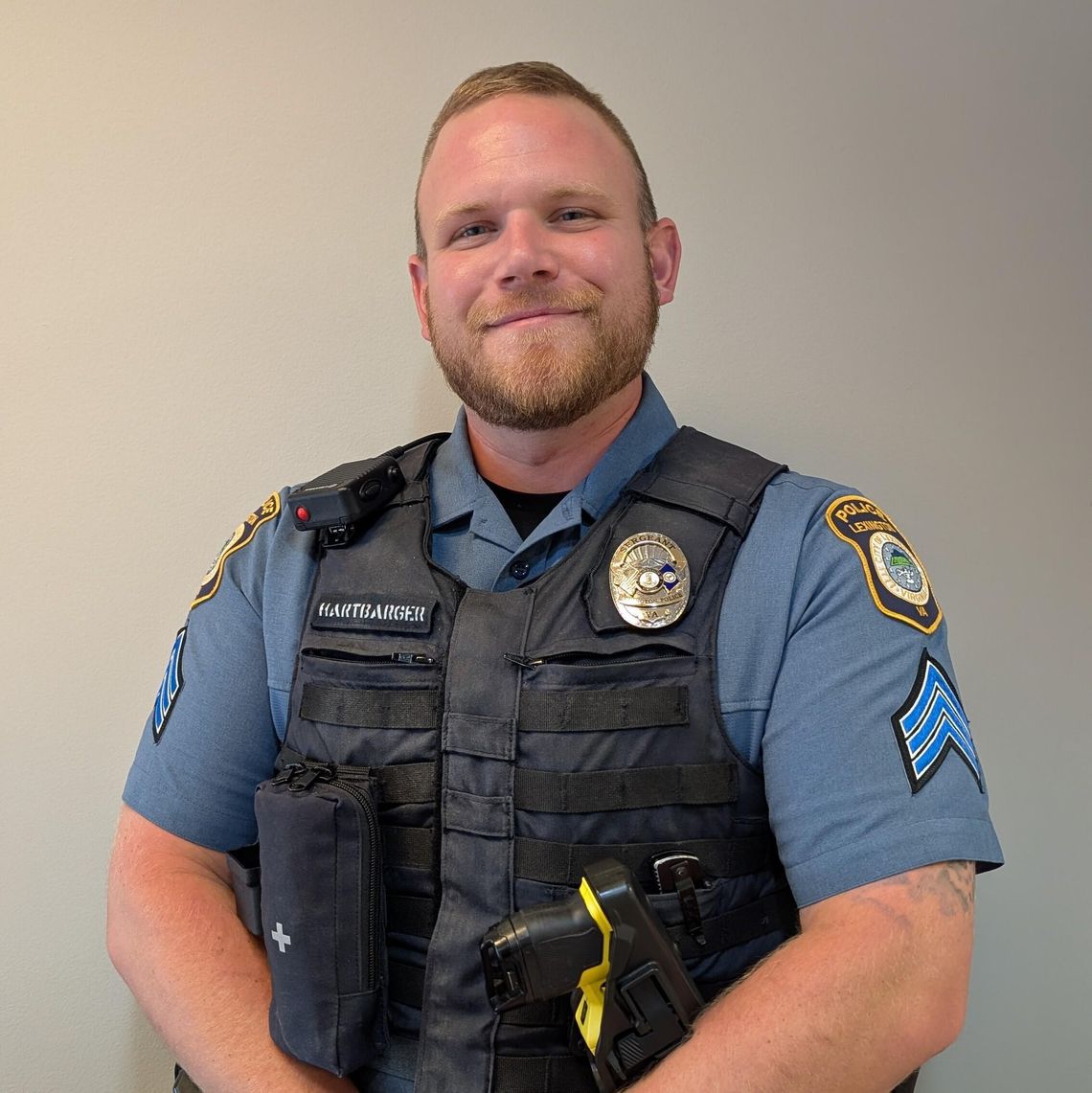
This week's interview is with Sergeant Shain Hartbarger. He's a patrol sergeant with the Lexington Police Department. Shain will be celebrating his 9th year in law enforcement career in December and his favorite foods are either his mom's chicken and dumplings or a nice thick steak with potatoes and veggies.
Did you always want to be in law enforcement? If not, what was your original career path?
I did. There're multiple reasons. So first, far as [my] upbringing and everything, I believe there is a sense of right and wrong. I believe, in this position, there is a sense of upholding what is right. My grandma always told me growing up, 'You should always want to do what's right.' As a kid you kind of cringe at that, but as I've gotten older, the more I appreciated her saying. It's true for me. I love the city of Lexington, love the community. I grew up here. I always wanted to give back to the community and the best way I could see that is by being part of the team that makes a difference in the community.
Second part of that is I have a vague memory of [an incident]. When I was a very small I was with my parents at the Stanton mall. Being a wanderer, while they were looking at a washing machine, apparently I wandered off, and, who found me was, I believe, it was. a Stanton police officer [who] found me walking by myself and returned me to my parents.
What motivated you to become a police officer?
I spent a lot of time talking with a criminal justice professor at Dabney S. Lancaster Community College. He was a former law enforcement [officer], I believe, in Pennsylvania. [I remember] speaking with him and really doing a lot of research, you know, into the position. To me, it was a respectful position. When I first started college, I had decided I wanted to be … a physical therapist just because at 18 I was thinking about money. But you know after taking a few of those classes, I didn't like it per se and I took a couple of criminology classes and actually I rather enjoyed it, liked learning about it. Law enforcement, you know, it relates a lot to like psychology, sociology. I found this really interesting. So after dipping my feet in it and talking to the professor, I said, 'I think this is definitely the route for me.'
Describe your journey from academy to where you are now.
I began the Police Academy in January of 2018. I was hired in in the middle of December, so I spent two weeks, you know, riding with officers that were working. [Then I] went through the academy. Everything went well up until the end of, I think it was, 24 weeks. The last block of instruction is a week-long training called ‘officer survival.’ Well, coincidentally enough, I failed … on officer survival. So, I came back and the process when you fail a block of instruction is you go back to the following academy class and retake just that block of instruction. So, it was about another four or five months, you know? I was here working in the office, read policy, I got to ride with some officers too, work different shifts, spend a lot of time with the officers and corporals, learned a lot, really focused my time in the gym and everything, just maintained a lot of focus for when I did go back. So I went back through officer survival. I passed everything on my first try and, I mean, I got to come home a day or two earlier than everybody else because I was done. I began field training, from mid-October until December, and I remember I got my letter that I was released from field training, which is where you ride with another officer, on Christmas day. I was told that that was my Christmas present. I began solo patrol after that. A few years later I was promoted to acting corporal before being fully promoted to corporal. I did a few years of that and got promoted to sergeant maybe two years ago.
What has been your favorite position, role or location?
I really enjoyed my time as a corporal. The corporals are the designated field trainers of the up-and-coming recruit officers. Before you are released from a solo patrol officer, you're called a recruit officer. So our corporals are our field trainers. I taught defensive tactics, intermediate weapons, at the police academy. Getting to know some of our recruits, you know, working with them hand-in-hand, while at the academy and then getting to field train them later on. My very first officer … he had his first four weeks of field training with me and then he went off with two other FTOs, and then I think he finished field training with four weeks with me. Just seeing the … growth and development that he got between his first four weeks and his last four weeks and then, you know, getting to write his recommendation for release from field training was just a very rewarding experience for me. It's the same way with all of the recruit officers, watching them develop into an up-and-coming police officer within the department.
Name a few of your daily tasks:
When I come in in the mornings, I like to sit down with the night shift. Both shifts get together, it's not what you call a roll call meeting or anything, but we sit down and we'll debrief what happened the previous night. If there's anything that is carrying over that we might hear about, they give us a rundown of it. I talk to our guys and then their guys before they head out, you know, what we've got working for the day, if there is anything planned specifically.
After that, I check emails. That's usually when I grab a cup of coffee. After that we head over to the city schools, Lylburn Downing and Waddell, just have a presence there, getting to talk to the kids, wave at them as they come in and say, 'Hey, I hope you have a good day!' We don't have an SRO position but, you know, we're trying to make sure we do have a presence in the school so the kids get comfortable with us, get familiar with the faces. After all the school drop-off traffic is done, we'll patrol around the city. We'll walk downtown, stop in and talk to some businesses, we'll walk around in the neighborhoods, a lot of patrolling around, trying to engage with the community, you know, going by parks and playgrounds and stuff. After school is let out, similar to what we do in the mornings is we'll go out if we need to assist with the crossing guard duties. We'll always do that morning or afternoon as needed, just being present as kids are getting picked up by their parents or, you know, walking home after school.
Those are the biggest two things – other than school traffic – a lot of patrolling and walking. As a sergeant, my guys I oversee them, you know, just keep a log of what we're doing every day and if they have any questions they always ask me. It's a full day. Then, same as the way we started the day, when the relief shift comes in, we'll sit down together and we'll debrief our day and pass anything along that they may have going on, anything that they have to work on.
Community policing is very important and I think that's been a trend for several years now, especially in an area like Lexington or Buena Vista, very small communities, almost everybody knows one another. So, getting to know an officer, building a rapport with them is important. You can build a trust with them just by getting to know them and you don't get to know them unless you see them. Otherwise, you know, there's a cop driving around with his windows rolled up – that's just a Lexington cop, that's just a sheriff's department deputy, that's a Buena Vista police officer. But if one of us is walking downtown, they say, 'Hey, that's Cpl. Kegley. That's Cpl. Nick. That's Sgt. Hartbarger, I know him. We talked in the coffee shop.' That's just getting to know them like that. The more they see you, I guess the better they get to know you. It just builds trust and really humanizes the badge, I think.
In your position, what is the hardest part of your job?
I think most police officers would agree – sometimes the things we see and do, we see people and we talk to people at their worst times. It's all about having to make the best [of the] situation, and strive to resolve any issues to the best of your ability that you can, and trying to leave them in a better place than you found them in.
What is the best part? What motivates you to keep doing your job?
Community engagement. I really like engaging in community policing. It is very rewarding. Like I said earlier, I do love the city and I love being able to give back to it, you know, getting to talk to people and just doing my part in trying to make the community safe, whether it be with traffic enforcement or code enforcement. I enjoy talking to people and getting to know people, especially tourists when they come in and they ask for the best place to eat or some fun things to do around here, what are some good places to see. I really enjoy that aspect.
What do you do to unwind? Do you have any hobbies/unique skills or talents?
I don't know if I would call anything [I do] unique. I think I'm a pretty simple man outside of work. When I'm not working I like to read, I like to watch movies, play video games. I play softball. I play football – it's a first responder football league, full contact. I've been doing that for a few years. Going to the gym. I try to stay active as much as I can. Just doing something physically rather than, you know, just sitting and staring at a TV. Go hiking, go walking, something just to be active, to be able to unwind. Probably my favorite thing to do is just to sit outside and read, especially when the weather's nice.
Based on your professional experience, what is a common call type or complaint you handle in your position? What actions are taken in response and what programs are in place?
That's the interesting thing. I wouldn't necessarily say there's like one common thing, you know? One day is a lot different from the next. Me and the guys on shift, we can each be on a call by ourselves and just go from call to call to call all day with barely even seeing each other. Other days, you know, we'll be out and about and we don't have a call for service all day. It varies, depending on the day. Obviously, weekends are busier. If I did have to say a common call, it's usually minor motor vehicle accidents, especially the city streets [that] are very narrow and some one-way streets. Fortunately they're usually just minor fender-benders.
It is something that has to be kept track of, specifically where the most accidents happen, why are they happening? Is it a speed-related issue? Is it a street issue? It's really just trying to accumulate data, to try and find a solution. For a while one of the most common accents we had were tractor-trailers turning onto Main Street from Nelson. They would knock down the traffic light there. So the solution between us and Public Works was putting up a large sign that says 'wide right turn.' There used to be a 10-minute parking space right there at the corner and they moved that down the street. That was a big one that was addressed. If it comes down to doing traffic control, you know, with a lot of the construction in town, if we have to we'll put traffic vests on and direct traffic to alleviate some of the congestion.
How can we educate the public on their role in crime prevention in our community?
I would encourage engagement – collaboration with your neighbors. If you want to implement a community watch, if you see something, say something, you know? A lot of people will just say, 'I'm just gonna mind my own business' but, you know, like Grandma would say, 'You're better safe than sorry.' It's better to call someone or even if you're calling your neighbors, like 'there's a weird car that's been going through, did you see that?' or 'there's a random door-to-door salesman going around.' Just communication, weather with your neighbors [or] with us. I would much rather get called and it turn out to be nothing than something else going on.