The First 50 Years Of W&L
First Students Graduated From Liberty Hall In 1785
Editor’s note: We continue this week with the series about the first half century of Washington and Lee University’s history that was written by Larry Spurgeon. Part 3 covers the incorporation of Liberty Hall Academy and the last years of William Graham’s leadership. Expanded versions of each of these installments can be found on our website.
1782 was a momentous year for Liberty Hall. The reassembled trustees petitioned the Virginia legislature to incorporate, boasting “the extensive fertile country around the place, the fine air, and pure water.” Additional benefits were a “valuable Library of well chosen books, and a considerable Mathematical and Philosophical Apparatus.”
The legislature passed an act in October making the school a “body politic and corporate.” The act listed William Graham as rector along with 19 trustees, among them Revolutionary War officers John Bowyer, Samuel McDowell and Andrew Moore. Moore served in both houses of Congress, and was the first United States senator west of the Blue Ridge Mountains.
Graham and two adjoining landowners, Joseph Walker and William Alexander, deeded 20 acres to the trustees for a new school building in 1782. Graham sold 10 acres from his farm for 20 pounds, “solely for the use and Benefit” of the academy.
In January 1783, the trustees resolved that prayers be held for students at the beginning and end of the class day. Cards, dice, and unlawful games were prohibited, students were precluded from being in a tavern at unreasonable hours. Swearing, lying, and profane language were outlawed. Each student was to “rise up with a decent bow when the Rector Tutor or any Gentleman comes in or goes out.” A student monitor was charged with recording “transgressions of these Rules,” and delivering the list to the rector each Friday evening.
A motion to relocate the academy failed, and it was decided the school should remain at the same site. Trustees authorized the building of a “frame house 30 feet by 20 and 10 feet in the pitch for the immediate use of the Students,” as soon as possible. Later the scale was adjusted to 24 by 16 feet, with an 8-foot pitch.
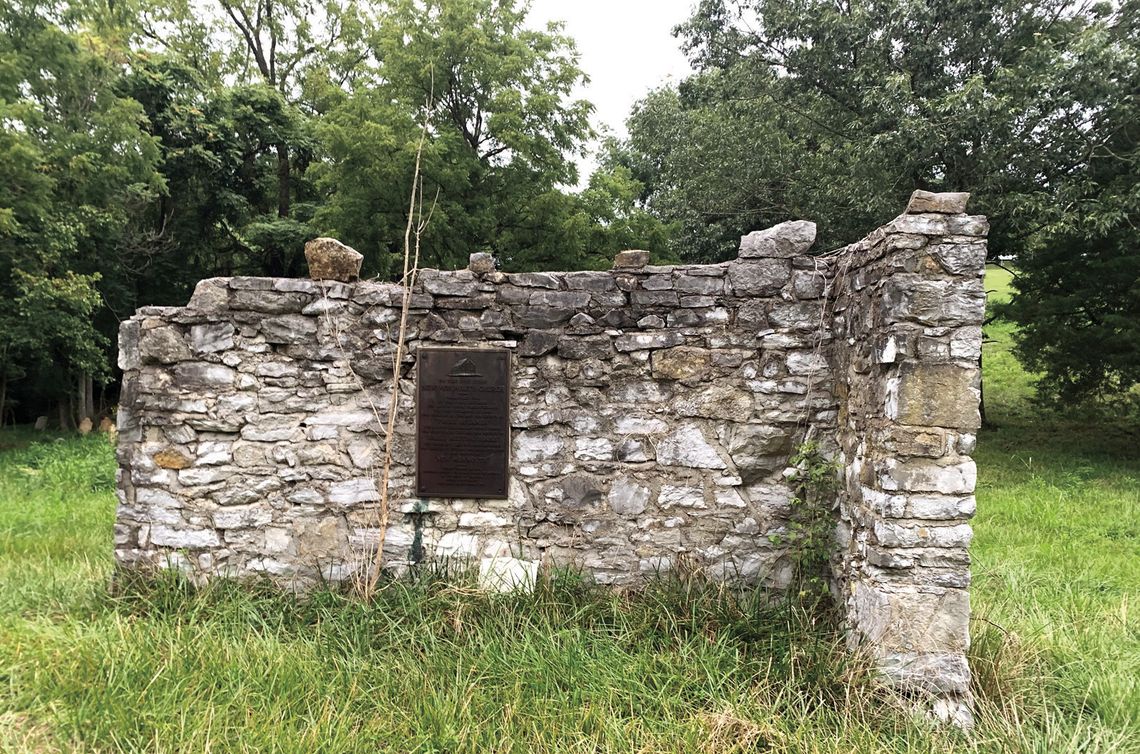
Most of the teaching was by tutors under Graham’s supervision. Graham resigned from Timber Ridge Presbyterian Church, and, for a time, discontinued preaching at Hall’s Meeting House. He soon resumed his association at Hall’s and encouraged the construction of a new stone church, named Monmouth. The ruins can be seen along U.S. 60 a few miles northwest of Lexington.
Graham w as a r espected t eacher, b ut s tern. A ccording t o Dr. Alexander discipline was “rigidly exact,” and no student “whatever might be his age or standing in society, was permitted to deny the authority of the principal.” He was known for administering “severe corporal punishment upon young men as large or larger than himself; and no one ever resisted his authority with impunity.”
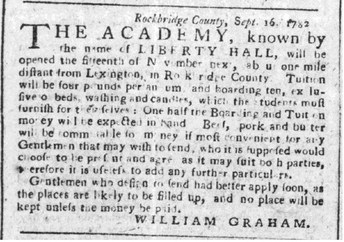
ABOVE, the ruins of Monmouth Presbyterian Church (formerly Hall’s Meeting House), can be found two miles west of Lexington, at the intersection of U.S. 60 and Beatty Hollow. William Graham, the first rector of Liberty Hall Academy, taught at Hall’s Meeting House and encouraged the construction of a new stone church, named Monmouth. AT LEFT, this advertisement for Liberty Hall Academy appeared in The Virginia Gazette Oct. 5, 1782.
His preaching style was “warm,” meaning impassioned, and he did not read his sermons, unusual for the time, and left behind no written work. Edward Graham believed that it was in part due to a tremor in his hand and fingers. Graham was not a great reader, having little use for books, often only perusing the table of contents.
Dr. Alexander admired Graham, but admitted that he had “formidable opposers who had taken up strong prejudices against him.” He was criticized after the war for “meddling with politics,” and for his opposition to the Constitution adopted in Philadelphia in 1787. Graham was known for satire and sarcasm, and his aloofness set his enemies “at defiance.”
Commencement for the first graduating class was held in September 1785. Twelve “young gentlemen alumni” received a Bachelor of Arts degree. After “various performances of the students the Degrees were conferred by the Rector.” Each student was required to pay the rector 20 shillings before he signed their diplomas. Eight graduates became Presbyterian ministers.
On the last day of 1790 Graham informed the trustees “the house used for tuition hitherto was providentially burned a few days since.” For the duration of the school session the students would meet “in the house left to the use of the Acdmy. by John Mairs.” To accommodate students in the future, Graham and two trustees were instructed to prepare a plan for a new school building.
In 1792, the trustees approved a recommendation from the Synod that Presbyterian principles should be taught - part of a plan to establish seminaries. Hampden-Sidney trustees urged the Presbytery to choose that school for the seminary, and to transfer Graham. Liberty Hall trustees filed a counterpetition, conceding that Hampden-Sidney had more students and money, but Liberty Hall had a quality program, with 300 books, scientific apparatus, and many outstanding graduates. The Synod left it up to Graham and he chose to remain at Liberty Hall. A contract was approved for a “stone house three stories high, 30 by 38 feet in the clear, with 12 rooms.” -An enduring legacy of Liberty Hall is that a free man of color, John Chavis, was a student in the 1790s. A building on campus is named for him, but there has been a mystery about the details.
During the Revolutionary War he served in the 5th and 7th Virginia regiments. He was a recipient of the Leslie scholarship for “pious youth” at Princeton in 1792, though Princeton has no record of him being formally admitted as a student. Princeton believes he was privately tutored by President John Witherspoon, a legendary academic and signer of the Declaration of Independence.
Chavis was recorded in the Liberty Hall steward book in summer 1795 for paying rent. When he registered as a “free Negro” in 1802 in Rockbridge County, the judge noted that Chavis went through a “regular course of Accademical studies.”
Why Chavis came to Lexington after Princeton is not known, but Witherspoon died in 1794, and Liberty Hall was at that time a seminary. The Rev. Samuel Stanhope Smith – the man who recruited William Graham to Virginia – succeeded Witherspoon as president of Princeton in 1795, and may have recommended Chavis to Graham for training as a minister. Chavis became the first Black Presbyterian minister, at least in Virginia, and was later a legendary teacher of Black and white students in North Carolina. -Finances for Liberty Hall were an ongoing concern, and in October 1795 the board agreed to petition the Virginia Assembly for assistance.
Meanwhile, Graham had been thinking about retirement, and purchased 6,000 acres on the Ohio River, with visions of creating a new community. He sold his Rockbridge land in 1796 and submitted a letter of resignation to the trustees. In September, Graham asked the Lexington Presbytery to be “dismissed from his pastoral charge.”
The trustees provided Graham a belated response acknowledging that the “business of education is extremely irksome.” They had hoped to reward the officers of Liberty Hall, and despite the “embarrassed state of our affairs” they were pleased the seminary was “eminently useful in diffusing knowledge.” They credited Graham’s “distinguished talents” and “disinterested zeal,” and believed he had “the grateful esteem of every good man.”
In December 1796, Samuel Houston was sent to visit the Virginia legislature “in order to do anything in his power for the interest of the Institution.”
The academy was in desperate straits. And then, in what must have seemed like an act of providence, word came that President Washington was looking to donate stock for an educational institution. That story will be told in Part 4.
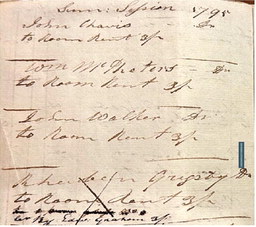
EDWARD GRAHAM’S steward book for Liberty Hall shows John Chavis paying rent in summer 1795. John Walker, Reuben Grigsby, and William McPheeters were prominent Rockbridge citizens. (image courtesy of W&L Special Collections)