Rockbridge Declares Drought Emergency As Farms Suffer
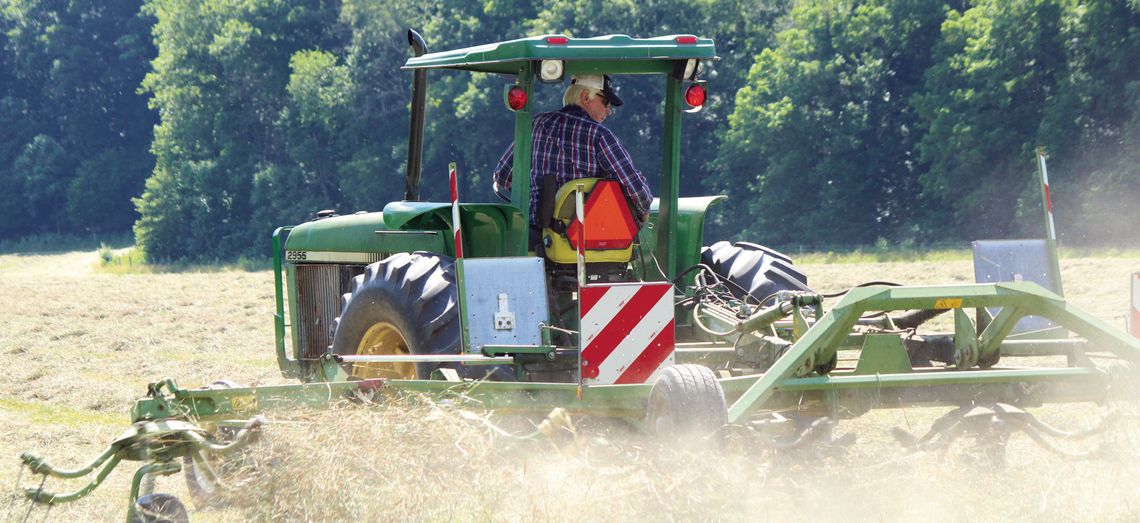
The sun beats down as Russell Williams steps up into his tractor. It’s a dry day at his farm east of Lexington, and its time to ted the hay.
The mechanical “tedder” that Williams pulls along behind his tractor uses rotating tines to stir up the cut hay, bringing wet grass to the top so that it can dry in the sun.
Drying shouldn’t be a problem in the wake of the most severe springtime drought Rockbridge County has seen in decades — it’s everything else that’s become more difficult.
“In all my years, I don’t remember it being this dry this early,” said Williams, who’s been farming in Rockbridge County since 1996.
Just days after Williams spoke these words, the Rockbridge County Board of Supervisors approved a resolution Monday to declare a drought emergency and ask the governor of Virginia to designate the county as an “agricultural disaster area.” The declaration made official what farmers have known all spring: rain isn’t falling, and it’s hurting agricultural production.
While some rain did fall in Rockbridge County on Monday and Tuesday, Virginia Cooperative Extension agent Tom Stanley said the precipitation will have a minimal impact on broader, long-term drought concerns for the season.
“The recent rains, while certainly welcome, have not been significant,” he said.
A History of Drought
Stanley said Rockbridge County has experienced drought conditions for part of every year since 2023.
“The past three autumns, we have been — for one period of time or another — been in severe drought,” Stanley said.
This isn’t the first time the Board of Supervisors has approved a drought declaration, said Chairman David McDaniel.
“We’ve done this the last couple years, and I think it’s beneficial to our farmers to do it again,” McDaniel said at the Board meeting Monday evening.
But farmers said this year’s drought is different. It’s only the second time in 20 years that parts of Rockbridge County have received an “extreme dought” designation from the United States Department of Agriculture. And it’s the first time since 2002 that it’s happened this early in the year.
“This has been the most severe springtime drought I’ve seen,” said Shepherd Rouse, who’s been growing grapes at Rockbridge Vineyard & Brewery since the late 1980s.
The USDA’s Drought Monitor takes into account factors like rainfall and the water level in waterways and reservoirs. It classifies droughts on a scale from zero to four, where D0 is the least severe dry spell and D4 is an “exceptional drought” The extreme drought classification, or D3, has been applied to the northeast corner of Rockbridge County and covers about 11% of its total area. The rest of the county is in a severe drought (D2).
Rockbridge County’s problems are part of a bigger trend statewide. Approximately 33% of Virginia is in an extreme drought, and a press release from Gov. Abigail Spanberger called it the “driest period recorded since 1941.”
Hay and Pasture
In Rockbridge County, growing hay and pasturing livestock are the most common uses for agricultural land.
It’s a yearly cycle: farmers let their cattle graze through the summer and into the fall, then gradually transition to feeding hay during the winter months. Farmers can still get some benefit out of their pastures in the winter too, but good growth during the late summer months is crucial.
“Whatever grass growth we get in August, September,” Stanley said, “we rely on the echo of that grass growth allowing us to graze our livestock into November and December and even January.”
It’s not just drought that hurts this cycle. In February, Stanley said unusually hard-packed snow lay on the ground for weeks, preventing cattle from doing any grazing at all. And Williams said that in April, uncharacteristically low temperatures led to an overnight freeze that suppressed growth.
A damage report from the Virginia Cooperative Extension cited in the Board of Supervisors resolution found that farmers across the county lost 75% of the yield from their first hay cutting. This has forced livestock farmers to give their animals hay for at least 20 of the last 60 days.
Williams is a little better off, but he said his hayfields are still generating less than 50% of his typical yield.
“When you don’t have moisture, you don’t get growth,” he said. “You don’t have growth, you don’t have feed.”
Williams doesn’t raise many livestock himself and mostly sells his hay to other farmers. He said he’ll be forced to raise prices to make up for the lost yield.
“Hay is very expensive right now, if you can find it,” he said. “If you haven’t found it, you may not find it.”
Farmers who don’t grow their own hay may be forced to turn outside the county to find a supplier, which means incurring additional transport costs.
Livestock
Luke Grant, whose family owns several farms in the northern part of the county, said the dry conditions can also create health problems for animals. Dustier air means Grant’s cattle are more likely to get pink eye. And pneumonia spreads easier in dry weather as well.
Stanley said that if Rockbridge County doesn’t see significant rainfall soon, water sources will begin to dry up. That may force livestock farmers to haul water in from somewhere else, which is an expensive undertaking. Beef cows can drink as much as 30 gallons a day when it’s hot out, Stanley said.
Grant uses both creek water and spring water to hydrate his cows. He said water hasn’t become an issue yet, but creek and spring levels are both looking low.
“I know guys have been hauling water,” Grant said. “I might be one of those guys here soon.”
Sidney Lotts, a fourthgeneration farmer who raises cattle in Natural Bridge, said he’s lucky enough to have several springs on his property that have been historically reliable. But he said he’s still worried.
“That’s always in the back of your head,” Lotts said. “It’s never failed in the last 60, 70 years ... there’s always a chance it could.”
Federal Programs
The USDA offers multiple programs to help farmers during droughts, Stanley said. The Livestock Forage Disaster Program issues direct payments to help livestock farmers in counties like Rockbridge that have reached extreme drought status. Only one part of the county has to have a D3 classification for the entire county to be eligible, he said.
The USDA’s Emergency Livestock Assistance Program also offers funding. But it’s limited to specific purposes, including bringing in hay or feed from outside the area or transporting water.
Grant said that while he’s grateful for USDA assistance, help from the federal government is limited.
“It’s just a drop in the bucket,” he said.
Farmers who grow crops don’t need the same types of programs because they have crop insurance, Stanley said. The federal government offers subsidies to help crop farmers like Williams purchase insurance from private companies.
“If my corn doesn’t grow or ... gets burnt up,” Williams said, “I’ll get some money back”
Orchards and Vineyards The USDA also offers a Noninsured Disaster Assistance Program for growers of fruits, vegetables, mushrooms and other products that aren’t covered by crop insurance. In its resolution, the Board of Supervisors estimated that the April freeze and subsequent drought have cost orchards and vineyards 60 to 80% of their yields.
Rouse said the drought hasn’t been the biggest problem for his vineyard. In fact, it’s helped him in some ways. Grapes do well in dry conditions, and the lack of rain has helped to limit the growth of weeds. But the cold spell in April was less kind, he said.
“On the night of April 20, 21, we had the worst killing frost that we’ve seen in 25 years,” Rouse said. “We lost a lot of our primary shoots.”
After that, the dry weather made it harder for the vines to regrow.
“It’s not threatening to them,” Rouse said, “but it reduces their vigor.”
Looking Ahead
The Board of Supervisors’ drought declaration doesn’t have any immediate impact, Stanley said. But it could help Rockbridge County farmers take advantage of new or ad hoc government programs that become available in the future.
All residents across the state, meanwhile, were asked by Spanberger last week to cut down on water uses like watering lawns and gardens, cleaning cars or pavement and filling pools.
“It is important that we take commonsense steps to meet this challenge,” Spanberger said in her press release. “I’m grateful to Virginians for doing their part.”
According to the National Weather Service forecast, Rockbridge County could experience some additional rain this Friday through Sunday, though the chance of precipitation is 50% or less each day.
But Lotts said that he’s learned to prepare for unexpected weather.
“Mother nature’s always going to throw a curveball,” he said.