Go to main contentsGo to main menu
Thursday, June 25, 2026 at 3:34 PM

The Origins Of W&L, Part II

The Origins Of W&L, Part II
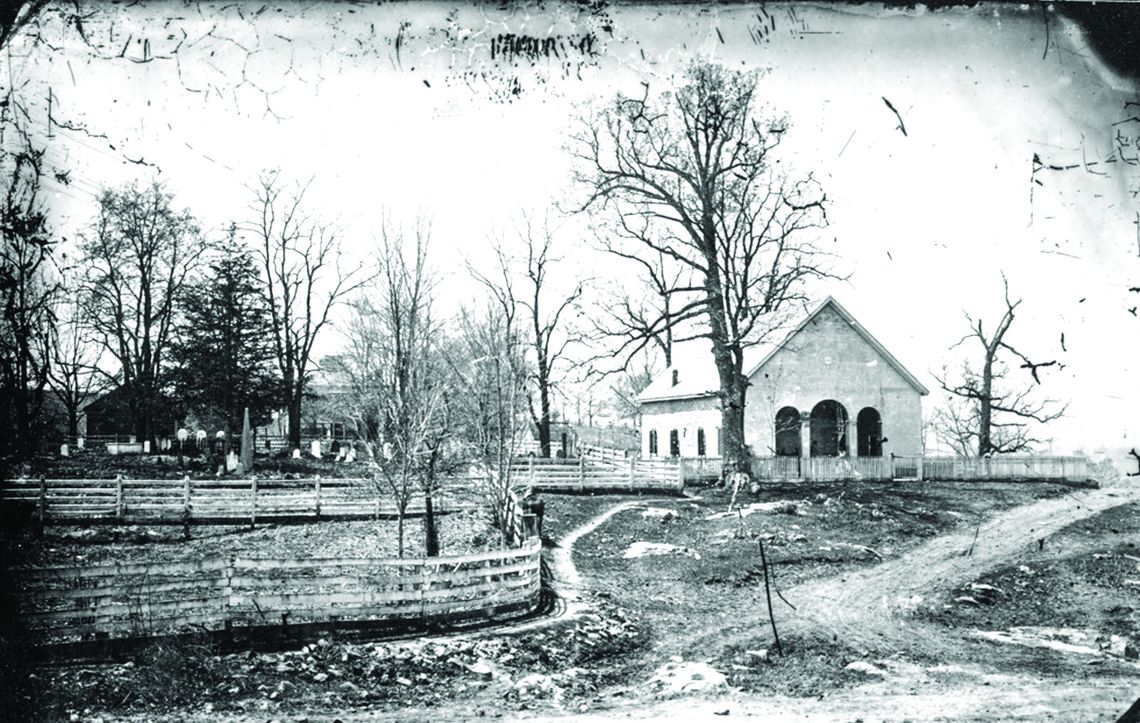
THIS PHOTOGRAPH from the mid-19th century shows the church at Timber Ridge constructed in 1755. Liberty Hall Academy’s buildings near the church were completed in 1776.

The Origins Of W&L, Part II

Presbytery Establishes School In Rockbridge

Editor’s note: This is the second in a series of stories about the first half century of Washington and Lee University’s history written by Larry Spurgeon. This part covers the formation of a Presbyterian school at Timber Ridge and the move to a site northwest of Lexington.

Most early settlers in Rockbridge County were Scots-Irish Presbyterians, and a defining characteristic was support for education – for their sons at least. On the eve of the Revolutionary War the Hanover Presbytery established two schools that would become Washington and Lee University and Hampden-Sydney College.

The subject of a school west of the Blue Ridge was first raised at a Presbytery mee ting in October 1770, when “Mr. Leke” made a motion “concerning a publick School in Augusta.” A year later the Presbytery urged ministers to promote the plan to their congregations. Progress was slow and two years passed until it was decided “to fix the public Seminary for the liberal education of youth, in Staunton, in Augusta.”

Finally, in October 1774, at Cub Creek in Charlotte County, the Presbytery took formal action. Deeming a “School for the liberal education of the youth… to be of great and immediate importance,” it was agreed “to establish and patronize a publick school which shall be confined to the County of Augusta.” Having been unable to find a suitable location in Staunton, William Graham was chosen as interim manager, under the supervision of the Rev. John Brown, using his school at Mount Pleasant as a temporary site.

The choice of William Graham was propitious. For the next two decades he served as rector, overseeing the transformation of a rural grammar school into a college. An anonymous tribute to Graham, published in 1821 by a Richmond religious magazine, detailed his background. Dr. Archibald Alexander later used it for his own memorial to Graham, and attributed authorship to Edward Graham, William’s much younger half-brother. Edward served Washington College for decades, as tutor, steward, professor, library director, and trustee.

William Graham was born in 1746 near Harrisburg, Pa., to Michael Graham and his second wife Susannah Miller, Scots-Irish immigrants. Becoming more serious about religion at 21, Graham attended the College of New Jersey (Princeton). Henry Lee, a Revolutionary War general, and the father of Robert E. Lee, was a classmate.

THE REV. SAMUEL Stanhope Smith (1750-1819) recommended William Graham to the Hanover Presbytery for the interim manager of Augusta Academy. Smith was the founding president of Hampden-Sydney College and president of Princeton from 1795 to 1812.

THE REV. WILLIAM GRAHAM (1746-1799) was named interim manager of the school established by Hanover Presbytery in 1774 at Mount Pleasant in Augusta County. Named the permanent leader the following year, he served the school for more than two decades.

NASSAU HALL at the College of New Jersey, later renamed Princeton, was constructed in 1754. For a few months in 1783 it was the temporary site for the United States Confederation Congress. This drawing was made in 1771.

Graham’s professor and mentor, the Rev. Samuel Stanhope Smith, later the first rector of Hampden-Sydney and president of Princeton, encouraged him to come to Virginia.

Dr. Alexander explained that Graham “accordingly came, and commenced a classical school at a place called Mount Pleasant,” a place that deserved a memorial. The best way to honor Graham, he wrote, was through a “faithful history of this institution & its founder.”

He described Mount Pleasant Academy as “being the germ of Washington College.” It is notable that the great-nephew of Robert Alexander did not equate his school with the formation of W&L.

In April 1775 the Presbyters visited the school “under the direction of Mr. Brown,” and “attended a specimen of the proficiency of the Students, in the Latin and Greek language, and pronouncing grammar in which they were well pleased.”

The Reverend Brown wrote to William Preston in August 1775 that “the times are not favorable to the design of the seminary nor am I apprehensive that it will answer the end expected, for I think the expectation is too high for the Plan that is laid.” The College of New Jersey (Princeton) “will polish a young man & fit him for usefulness better than any seminary that we can expect in Virginia.”

In October 1775, the Presbytery agreed that Graham would “continue to have the care and tuition” of the school, and appointed John Montgomery “late from Prince Town College to be his assistant.”

The Presbytery noted the following spring that “as the Augusta Academy is circumstanced, it is highly necessary now to fix on the Place for its situation, and the Presbytery by whom it will be conducted.”

They chose the Timber Ridge site, for its convenience, and because “they have obtained a Minister, whom we judge qualified.” At the same meeting Graham accepted appointment as minister of both Timber Ridge and Hall’s Meeting House, a few miles west of Lexington, later known as Monmouth.

Two landowners adjacent to the Timber Ridge church, Alexander Stuart and Samuel Houston Jr., father of the famous Sam Houston of Texas, offered to donate 20 acres each, for school buildings, and to provide wood and timber for twenty years.

The Presbytery appointed 23 men as trustees, a who’s who of area leaders, including ministers William Graham, John Brown and James Waddell, and many Virginia Militia officers.

The first meeting of the newly constituted board of trustees was held a week later, and the minutes state that “Pursuant to an Order of the Pby. of Hanover relative to the Academy of Liberty Hall as it is hereafter to be called instead of the Augusta Academy.”

The name Liberty Hall was due to revolutionary fervor. The trustees scheduled a meeting for the end of the month to plan a building for the rector, and a small house for the steward.

The school building and rector’s house were completed in late 1776. A Williamsburg newspaper announced in October that Liberty Hall Academy “is now established for the liberal education of youth.”

The school was to commence Nov. 25, with tuition of four pounds and board at 6 pounds, 10 shillings per year. Tutors would be paid from the tuition, and students were required to provide their own bedding, washing, and candles, though “firewood is gratis.”

It was an ambitious undertaking, but timing was poor. Graham’s meager income from preaching at Timber Ridge and Hall’s Meeting House was paid in “depreciated currency.” To supplement his income, he purchased a 291-acre farm from Joseph Walker bordering the North River. The farm’s eastern border is the west end of campus today.

Graham asked the Hanover Presbytery in 1779 for permission to “remove his family” to his farm. Permission was granted, but the trustees stipulated that Graham was to “visit the Academy once every Week and spend two or three days at it as his circumstances will permit.”

Details about the next three years are spotty because no trustee minutes survive. In 1843, Dr. Alexander visited Lexington one last time, and gave a speech at Washington College. He said Graham found the arrangement to visit Timber Ridge two or three times a week “inconvenient to himself and disadvantageous to the school,” and “after due deliberation, he resolved to relinquish the establishment at Timber Ridge, and to open a school at his own house.” Dr. Alexander was one of the students there, most of whom “had reached the age and stature of men.” Later a frame school building was erected on the site.

Graham’s school must have prospered because in 1782 the trustees drafted an “Act of Incorporation.” With this act, Liberty Hall began the transition from a private academy to a college.

Part III will cover that transition and the first decade of the college.

HANOVER PRESBYTERY minutes for the meeting at Cub Creek in October 1774 detail the formal approval of a school in Augusta County. This act was long considered the birth of Washington and Lee University. (Union Presbyterian Seminary Library, Digital Collections)

THIS AD for Liberty Hall Academy at Timber Ridge appeared in The Virginia Gazette Nov. 8, 1776.


Share
Rate

Subscribe to the N-G Now Newsletter

* indicates required

Intuit Mailchimp