Speakers Share Experiences At Downing MLK Assembly
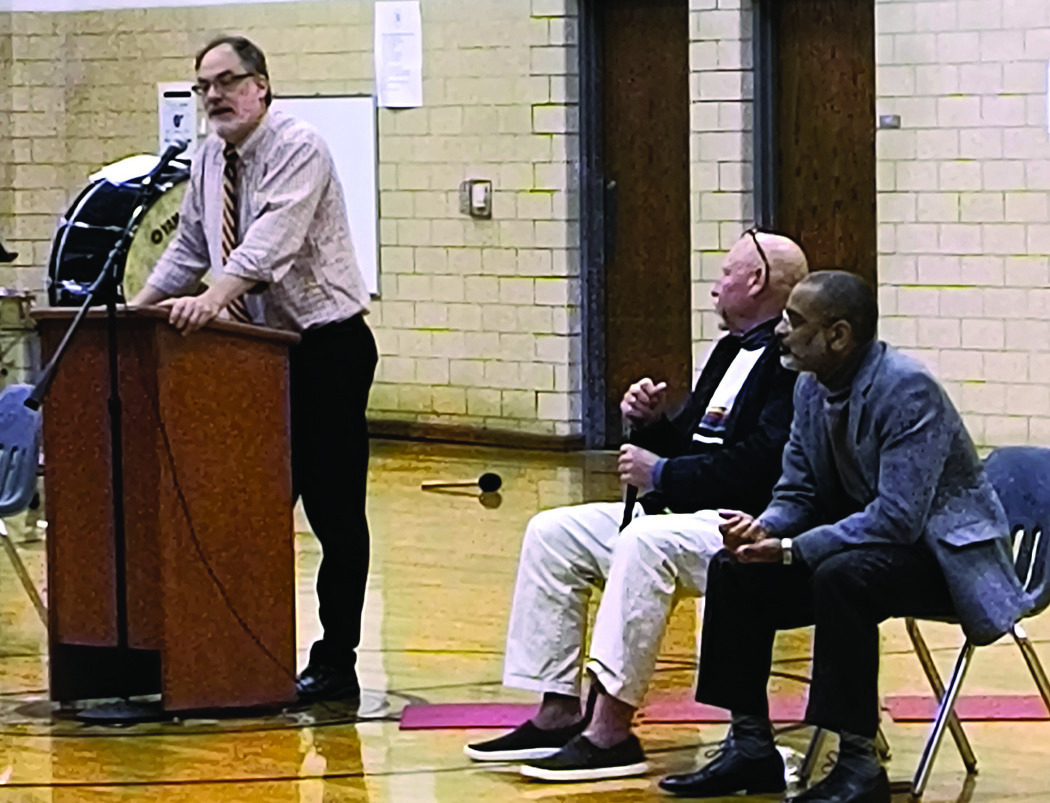
Lylburn Downing Middle School students gathered Wednesday, Jan. 14, for a schoolwide assembly honoring the life and legacy of Dr. Martin Luther King Jr., featuring guest speakers who reflected on King’s influence through personal experience, history, and storytelling.
The assembly, organized by teacher and Rockbridge Historical Society Executive Director Eric Wilson, framed King’s legacy through what Wilson described as “three different ways of understanding” the civil rights leader: as a preacher, an activist, and a human being whose words and actions continue to shape the present.
“This is not just a holiday,” Wilson told students. “The Martin Luther King Jr. holiday is legally a national day of service. How you serve is up to you.”
Wilson provided historical context for King’s work and death, reminding students that King was assassinated in Memphis in 1968 while supporting a strike by sanitation workers demanding safer conditions and dignity. “Leaders aren’t just figures of achievement,” Wilson said. “They’re humans in process.” He urged students to ask themselves, “What is it you see them trying to do all the time?”
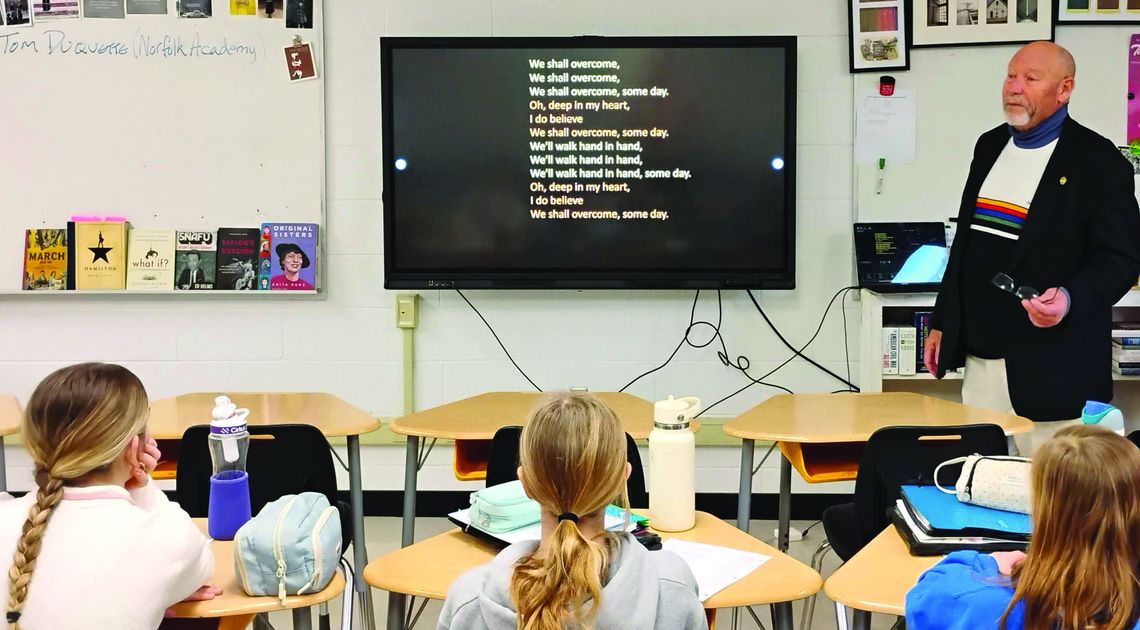
Guest speaker Tom Duquette, a former educator and lacrosse coach, spoke about growing up during the civil rights era and how King’s assassination shaped his understanding of racial injustice.
“I’m a child of the ’60s,” Duquette said. “For me, this is lived history.”
Duquette explained that he grew up in Baltimore in a neighborhood he later learned had been segregated by restrictive housing covenants, though he was unaware of it at the time. He recalled how the country, and his city in particular, erupted in unrest following King’s death.
“I’m not sure that you ever really know anything until it reaches your affective domain — until it gets you in the gut,” he said.
Duquette described the declaration of martial law in Baltimore and the presence of National Guard troops in the streets. Just days after martial law was lifted, he said, his high school lacrosse team traveled into West Baltimore to play a game against a predominantly Black school.
“As we arrived, our bus was pelted with rocks …” Duquette said. “It’s about as terrified as I’ve been in my life.” He knew that playing a contact sport during those volatile times was dangerous, and he described how the hits he took during that game were the hardest he’d ever felt.
The experience, he said, forced him to confront the anger and fear that followed King’s assassination and to begin asking deeper questions about why racial divisions and violence persisted. “That moment pushed me to start reading, to start learning,” he said. “That’s when I began to really engage with King’s ideas and the movement he led.”
Michael Hill, another guest speaker and a professor at Washington and Lee University, shared a more personal account of encountering King’s legacy through discipline, education, and performance as a child.
Hill described being raised by his grandmother, a longtime middle school English teacher who believed strongly in elocution and public speaking. As a child, Hill said, she required him to memorize King’s “I Have a Dream” speech.
“That’s how King entered my life, as words I had to carry in my body,” Hill said.
Hill recalled standing on a platform and reciting the speech at a formerly segregated high school that his father had not been allowed to attend. At the time, he said, he did not fully understand the significance of the words he was delivering, but memorizing and performing the speech left a lasting impression.
Hill later learned that King delivered the speech on Aug. 28, 1963 — the same date as Hill’s birthday, eight years before he was born — a coincidence he said deepened his sense of connection to the history.
Hill emphasized that King’s conception of equality and community came from lived experience rather than abstraction. King, he said, grew up in a neighborhood where wealthier families lived across the street from public housing, requiring daily interaction with people from different backgrounds.
“Radical equality isn’t theory,” Hill told students. “It’s learning to share space and humanity with others.”
Hill urged students to think about King not only as a historical figure or a polished speaker, but as someone whose words were meant to move people to action. “King isn’t important just because of what he said,” he said. “He’s important because of how those words made people feel and what people did afterward.”
The assembly concluded with a performance of “We Shall Overcome” by the school band, a song closely associated with the civil rights movement. Wilson noted that the students prepared the piece in just two days.
At the close of the assembly, students were encouraged to reflect on King’s legacy not only as history, but as a call to service and community in their own lives.