Rockbridge Native Presenting Unique Perspective In Role As VMI Professor
Dr. Mattie Webb, a social and political historian of the United States and southern Africa in the 20th Century, returned to her roots recently when she began a job in August as an assistant professor of history at Virginia Military Institute.
Webb, 33, grew up in Rockbridge County, having attended Central Elementary and Maury River Middle schools through the seventh grade. She’s the daughter of Reggie and Kathy Moss Webb, educators who met in the 1980s when both were teachers and basketball coaches at Natural Bridge High School.
Having specific expertise in South Africa and apartheid with a broad perspective on U.S. foreign policy, Webb is teaching courses on U.S. foreign policy and the U.S. Constitution at VMI. She’s traveled the world and spent a considerable amount of time in South Africa learning about its people and difficult history. Arriving at VMI where her father, a 1975 graduate, worked in admissions years ago, she feels like her life has come full circle. Landing a tenure track position at VMI, she said, “has been a dream come true.”
She can remember coming to the VMI track, when she was in elementary school, to run the mile as part of the president’s physical education fitness tests. She found she was a pretty fast runner, beating even her male classmates. That shouldn’t have been surprising, given the athleticism of her parents. Her dad, a Rockbridge County native who graduated from NBHS in 1975, was a standout basketball player for the Rockets and later played at VMI. Her mom played basketball, field hockey and lacrosse at Bridgewater College.
Another special childhood memory that Webb has of VMI is when she came to Cameron Hall, as a second-grader, to see former President Jimmy Carter receive the first Jonathan M. Daniels ‘61 Humanitarian Award. Carter’s humanitarian achievements during his presidency and post-presidential years were recognized by an award named for a VMI alumnus who gave his life for the cause of Civil Rights.
After witnessing the ceremony and listening to Carter’s speech, the 8-year-old Webb wrote a letter and drew a picture that she mailed to the former president. He responded by writing her an encouraging note that may have planted a seed for her later interest in his presidency and U.S. foreign affairs.
While acknowledging that many view Carter’s 1970s-era presidency as a failure, Webb believes he had an admirable foreign policy, with its focus on human rights. One part of this policy was to take a different approach from his predecessors to South Africa, bringing attention to the utter unfairness of apartheid. She feels this was a “courageous stand” when others, including American businesses that had ties to the country, were content to go
“The more I dug into the sources, the more I realized just how rare it was for a president to stand
on principle at the expense of popularity.” – Matttie Webb along with the status quo. Carter initiated an arms embargo in 1978 and many took note.

VOLUNTEERING with the Anna Foundation, an afterschool running group for rural South African youth.

HERE she is with one of her oral history interviewees who gave her a tour of the many townships of Gqeberha, Eastern Cape, South Africa.

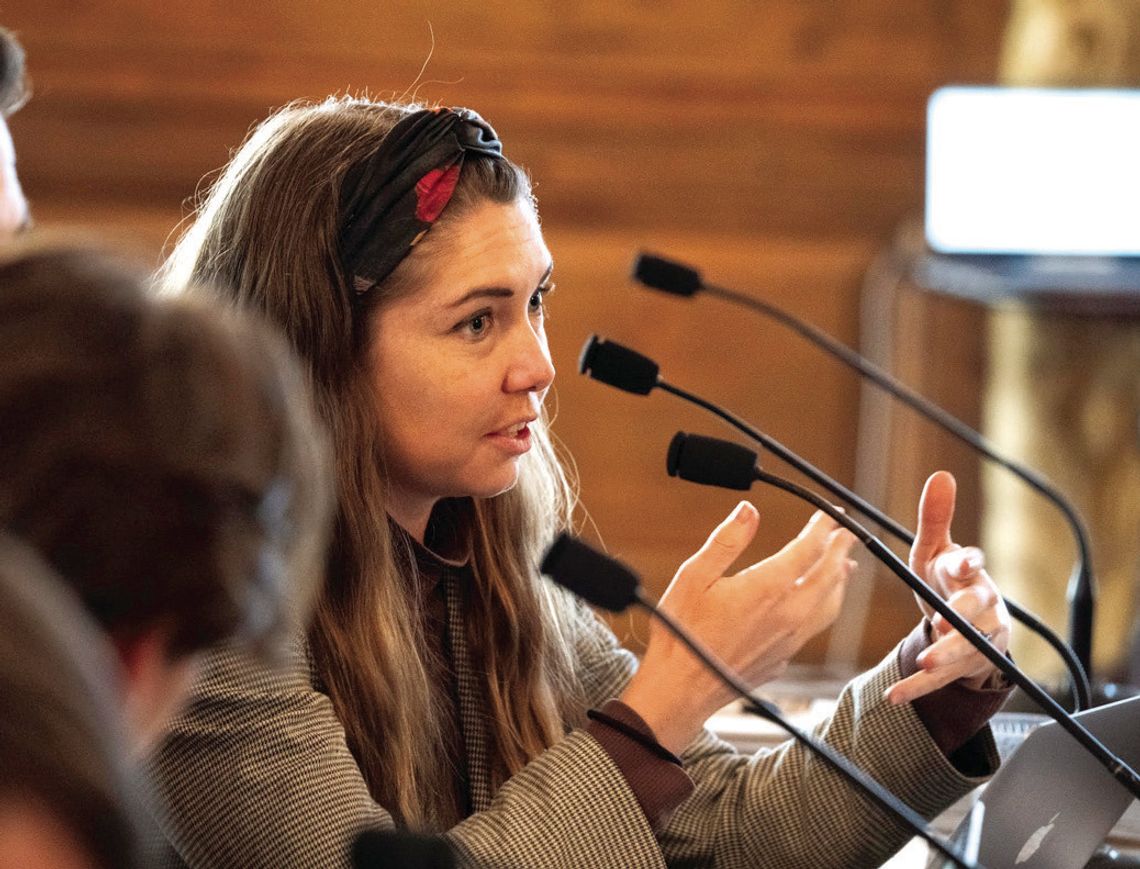
VMI PROFESSOR Dr. Mattie Webb holds up a book while teaching a class of cadets at VMI. (Kelly Nye photo for VMI)

WEBB is seen here at the Constitutional Court, Johan- nesburg, South Africa.

CLAY and Mattie Webb visit Robben Island, off the coast o f Cape Town, South Africa.
She sees Carter’s initiative as the beginning of a movement that led to cultural and economic embargoes that put pressure to bear on whiteminority rule in South Africa. Although it took many years and multiple administrations, apartheid was eventually brought down in the early 1990s. Nelson Mandela, anti-apartheid leader who had been imprisoned for decades, was released and became the country’s first democratically elected president.
Reflecting on Carter’s role in starting the process that ended apartheid in South Africa, Webb said she became curious about “how both morality and principle influence – or often, do not influence – U.S. foreign policy and statecraft.” Such musings led her to pursue the career path she chose.
“My undergraduate capstone course on the Carter years was taught by one of the leading historians of Jimmy Carter, Dr. Nancy Mitchell, who encouraged me to pursue graduate study,” said Webb. “The more I dug into the sources, the more I realized just how rare it was for a president to stand on principle at the expense of popularity. His policy towards southern Africa was steps ahead and I was interested in exploring its impact on South Africans themselves.”
Webb’s athleticism played a part in determining the direction of her pursuits in academia. When she was growing up in the Rockbridge area, she displayed her athletic prowess as a member of the Rockbridge Aquatics Swim team. When her family moved to Crozet in Albemarle County, she switched from swimming to long-distance running. She developed into a star runner on the track and field and cross country teams at Western Albemarle High School and later was a Division I athlete at both North Carolina State University, where she earned her bachelor’s degree in history, and the University of North Carolina, where she earned her master’s degree in global studies.
Taking courses on U.S. foreign policy, she said she was drawn to South Africa and apartheid. She came to admire Carter and the role he played in drawing attention to apartheid in South Africa. “He helped Americans to understand this as a moral issue.” At the time, she didn’t know what career path she would take. She was initially pursuing a minor in Spanish, taking some intensive courses in learning the language. Her first trip abroad was to Chili.
Following a “year of exploration” in which she worked in marketing and coached running at UNC Asheville, Webb ultimately decided she wanted to be a professor, to teach in the classroom and do research. She enrolled at the University of California at Santa Barbara to pursue her doctorate. “It was a good fit,” she said She gained experience on the ground in South Africa when she made her first trip there as a Ph.D. student at UCSB. She spent the entire summer of 2018 there. She talked to the people – the activists, the workers. She conducted interviews for an oral history. “Having this connection helped explain what was going on in more detail. I wanted to understand it from the perspective of South Africans.”
She spent time at both Stellerbaseh University and Rhodes University, the latter of which she still has an affiliation. She tries to go to South Africa once a year and continues to conduct research at Rhodes University.
She spent the past two years at Yale University on a postdoctoral fellowship. She conducted research and taught classes at Yale. She is under contract with Columbia University Press to produce a book based on her doctoral dissertation, “Shopf loor Statecraft: South African Workers & U.S. Multinational Companies During Apartheid.”
The book, according to a description on her website, “offers a new social and political history of the anti-apartheid movement, placing South African workers at the center of global narratives of labor and empire in international relations.”
She remains a committed distance runner. She’s run in multiple marathons, including the Boston Marathon, which she plans to enter again in the spring. Her daily routine is to run 8 to 10 miles, with a long run of about 20 miles once a week.
She has merged her interest in running with her academic research in South Africa, where she volunteers with a local youth running program. She ran South Africa’s historically significant Comrades Ultra-Marathon (an 88K race in KwaZulu Natal) in June 2024. She said she hopes to eventually incorporate the history of Comrades and other global running events into a book project on the role of sport in the fight against apartheid.
One of her objectives as a historian and educator is to bring attention to world affairs to the cadets she teaches.
Even with the demise of apartheid decades ago, South Africa remains mired in difficulties, she acknowledges. She witnesses these circumstances first-hand when she makes her regular visits.
“There’s still inequality, poverty and high rates of crime,” she said. “The country is primarily rural but there are townships where the people are very poor, living in shantytowns not very far from more affluent citizens, some of whom live in mansions.”
Having traveled the world, Webb is glad to be back home, close to her family. Her parents continue to live in Crozet. Her brother, Cyrus, works at the Jefferson Scholars Foundation at the University of Virginia, where he’s the selections coordinator. Webb lives in Lexington with her husband, Clay Gross, who works remotely as an engineer.
Webb obviously draws satisfaction from being able to pursue her career while living in her hometown after so many years away.