Vietnam Veterans Share Their Stories At RHS Event
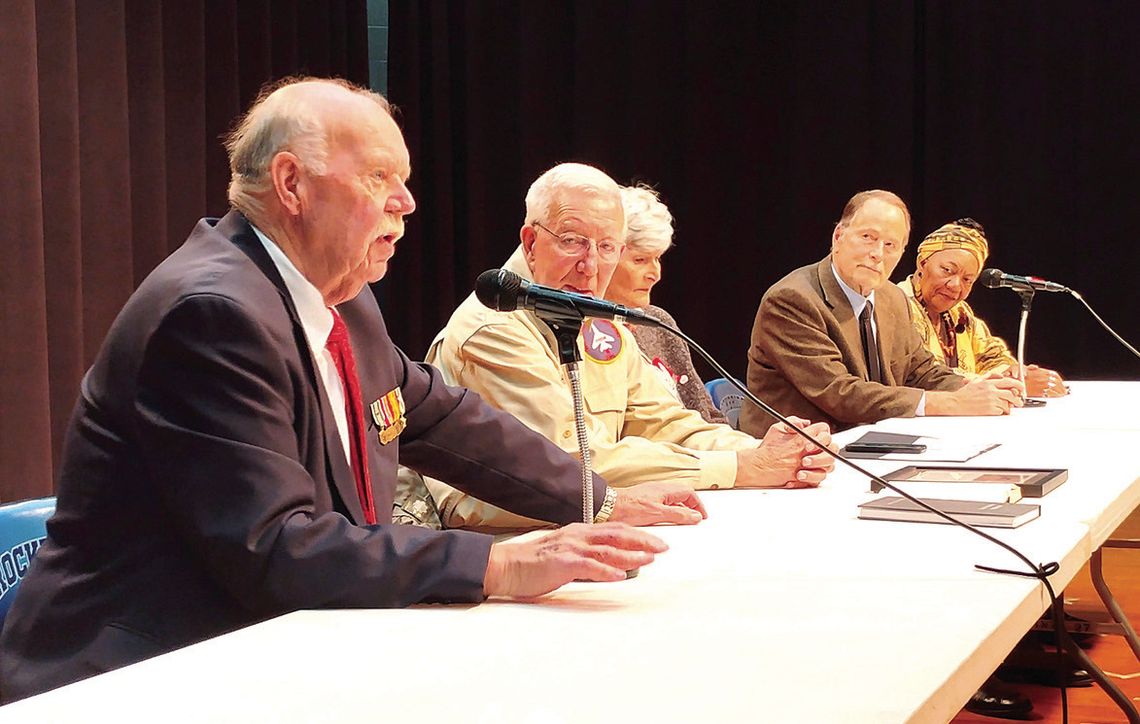
Five Vietnam-era veterans sat on the stage of the Rockbridge County High School auditorium, telling their stories to a small audience on Sunday afternoon, Dec. 7.
Hosted by Eric Wilson, executive director of the Rockbridge Historical Society, as part of the VA250 commemoration and the 50th anniversary of the war’s end, the round table emphasized lived experience over historical abstraction. The stories that emerged were personal, vivid and often left open-ended with ongoing questions about the meaning of it all.
The round table was part of the Rockbridge Historical Society’s look back at the Vietnam War, which continues next week with book and film discussions. (See page B1 for details.)
Before turning the floor over to the veterans last month, moderator Col. Houston Johnson, chair of the Virginia Military In- stitute history department, offered a brief but pointed overview of the Vietnam War, emphasizing its complexity and the long historical currents beneath American involvement.
“Vietnam is a challenging, confounding, complicated piece of history,” Johnson said. “The real answer to almost every question is: it’s more complicated than that.”
Johnson traced the roots of the conflict well beyond the 1960s, describing Vietnam as part of a centuries-long struggle against foreign control, from Chinese domination to French colonial rule, before becoming entangled in Cold War politics. For the United States, he said, Vietnam did not resolve into the clear moral narratives Americans associated with World War II.
“One of the most important outgrowths of that complexity,” Johnson said, “is that the stated political goals of the United States often did not reflect the reality on the ground.”
That disconnect, he argued, placed an enormous burden on the people who served: soldiers, airmen, sailors, and support personnel tasked with carrying out missions shaped by distant political decisions. Unlike conflicts with clearly defined enemies and objectives, Vietnam left many service members operating in moral and strategic ambiguity, a theme echoed repeatedly in the veterans’ stories that followed.
“We were just kids,” said Mike Young, who joined the Army at 19 and served as a military police officer in Saigon. “Sometimes it’s hard to remember why we did what we did. But I can tell you — we were pretty good for kids.”
Young arrived in Vietnam in 1967 and was stationed in Saigon during the Tet Offensive in January 1968, just weeks before he was scheduled to return home.
“Within the first half-hour of Tet, we lost 22 or 23 MPs,” he said. “We later found out we were the only armed force in the city. Everybody else had been sent out to the countryside. They didn’t think the attacks would come in the city. They did.”
His unit was sent to the Phu Tho Racetrack, which they soon learned had been used as a staging area by North Vietnamese and Viet Cong forces.
“There were 12 of us on that squad,” Young said. “They did not get by us. I served with some extremely brave people. Heroes, every one.”
But Young lingered less on combat than on what followed. “When we came home, we thought we had done a very good job,” he said. “What we found out was that nobody really appreciated what we had done.
“There were no greeters in the airports. No thank-yous,” he added. “And we swore — those of us who lived through that — we swore we’d never let that happen again.”
Bob Hopkins, who flew 303 combat missions as an Air Force fighter pilot, offered a sharply different but complementary view of the war. “My job was close air support,” Hopkins said. “When ground troops were surrounded, ambushed, or running out of ammunition — that’s when they called us.”
Hopkins described flying low — sometimes just 50 feet above the ground — to deliver bombs, rockets or napalm with maximum accuracy. “You wanted to be as accurate as possible,” he said. “And you didn’t want to fly over the enemy any more than you had to.”
Despite the violence inherent in the work, Hopkins said he never experienced the psychological distress often associated with Vietnam service. “I didn’t have PTSD,” he said. “My only regret is maybe that I didn’t take out more of the bad guys who were trying to kill our soldiers and Marines.”
Still, some moments stayed with him. He recalled seeing two infantry soldiers emerge from weeks in the jungle, exhausted and filthy, each clutching a single can of boned chicken from a base exchange.
“They were eating it with their fingers like it was Thanksgiving dinner,” Hopkins said. “And that picture has never left me.”
Liz Shupe’s service unfolded far from the battlefield, but she described its emotional toll as no less profound. Shupe joined the American Red Cross after graduating from Mary Baldwin College and eventually served at the 24th Evacuation Hospital in Long Binh, Vietnam.
“I wasn’t an activist. I wasn’t a pacifist. I wasn’t anythingist,” she said. “I just wanted to do what was right.”
Her role was hospital recreation, a title she admitted sounded contradictory. “But humor matters,” she said. “Laughter matters. Being able to make a terrible situation just a little bit better — that matters.”
Her first night in Vietnam, alone in a bunk room, she encountered a rat circling her bed. “I remember looking up and saying, ‘Please, God, get me through this,’” Shupe said. “‘Help me keep my patience so I can do what I’m here to do: make it better for those guys.’” She said the year changed her permanently. “When I left Vietnam, I was a changed woman,” she said. “And the man I thought I would marry told me I was no longer a woman — that I’d lost my femininity.
“Actually, I believe I found it,” she added. “I was more of a woman than I could ever have been without that experience.”
Philip Clayton, a Rockbridge County native and VMI graduate, spoke about serving as an Air Force airlift pilot in the final years of the war, including missions that brought American service members home in caskets.
“One flight changed me dramatically,” Clayton said. “We carried a whole plane load of caskets, flags draped over them. I walked down the aisle in the middle of the night, thinking about who these young men were. Their dreams and their families.”
He later flew similar missions during the Gulf War, including one carrying service members killed when a Scud missile struck a barracks. “This time, there were women in those caskets,” Clayton said. “Young women who would never marry. Never have children. That stayed with me.”
Maria Quillin, who served in both the Army and Navy, spoke about the long tail of war, particularly for families. “My ex-husband was in Vietnam,” she said. “He was exposed to Agent Orange. He had severe PTSD. A car backfiring would put him on the floor. Then our first son couldn’t handle loud noises, fireworks… It follows you home.”
Quillin later served in Kuwait, where she processed deployment records for soldiers headed into combat. “I had their names, their ages, their blood types,” she said. “I was a basket case.” -During the question-andanswer portion of the program, discussion shifted from battlefield experience to memory, recognition, and the meaning of “veteran” itself.
Shupe raised the issue of women who served alongside the military, particularly Red Cross workers, and their exclusion from veteran status.
“When people say ‘veterans,’ I don’t count,” Shupe said. “And yet I was there. I worked beside the military. I worked with wounded soldiers.”
She described how reading “The Women” by Kristin Hannah recently reopened memories she had long set aside, underscoring how Vietnam-era service, especially for women, often went unrecognized for decades.
Panelists emphasized the importance of veteran organizations and community spaces where service members and their families can find support. Wilson urged veterans to seek connection through groups like the American Legion and Veterans of Foreign Wars, particularly as they age.
“We’re proud of our service,” Young said. “Every person at this table is — whether it was military service or Red Cross service. It all mattered.”
‘This Is Our Chance’
The round table was not a standalone event, but part of a broader calendar of public history programs the Rockbridge Historical Society has been building toward the VA250 commemoration and toward Lexington and Rockbridge County’s own 250th anniversaries in the coming years.
Wilson has framed that push as a multi-year effort to widen public engagement with local history, through film screenings, book discussions, exhibits, school outreach, and community-based oral history projects.
RHS has emphasized that VA250 is not solely about the Revolutionary War, but about tracing “two and a half centuries of American evolution,” including the conflicts and cultural reckonings that followed.
Within that framework, Wilson said the Vietnam War occupies a crucial place, both historically and locally. Pairing Vietnam-era programming alongside Revolutionary- era history, he said in a phone call, allows communities to examine American ideals and shortcomings side by side, without turning commemoration into debate. The goal, Wilson emphasized, was not to “litigate” the war, but to recognize that, 50 years after its end, the most urgent work now is listening to the people who lived it.
“This is our chance, 50 years on, to get the stories of people who were young adults at the time,” Wilson said, including not only combat veterans, but medical workers, support staff, and families whose lives were shaped by the war.
Wilson also pointed to the local lens as essential. While national histories of Vietnam are well known, he said, the war’s impact in Rockbridge County is visible in quieter ways — in veterans who went on to become civic leaders, business owners, educators, and advocates. Capturing those transitions from military service to community life, he said, is where local historical organizations can add meaning that broader narratives often miss.
In that context, that Sunday’s Vietnam program also served as a key event in a months-long local commemoration tied to the 50th anniversary of the war’s end in April 1975. RHS last fall hosted a statewide traveling exhibition, “Virginia & the Vietnam War,” created in partnership with the Virginia Museum of History and Culture. The exhibit’s interpretive panels and related displays appeared not only at the RHS museum, but also at the Lexington library, with RHS emphasizing mobility and access as part of its approach to public history.
Organizers described the veterans round table and open-mic session as a deliberate extension of that exhibit: a community-sourced oral-history program meant to “credit and capture” local voices while they are still here to be recorded. RHS has encouraged residents to contribute family records — scrapbooks, letters, memoirs, keepsakes — and to participate in future oral-history recording, with the aim of expanding a local archive alongside the statewide Vietnam oral-history work already being collected and published by VMHC.
The Vietnam programming also fed into RHS’s next set of VA250-themed public events. In mid-December, the group hosted a community screening and discussion of the episode “Things Fall Apart,” regarding the events of 1968, from Ken Burns and Lynn Novick’s documentary series “The Vietnam War.”
What’s Next
As the Vietnam programming unfolded, Wilson said the response reshaped how RHS thinks about commemoration itself. At smaller film discussions and informal gatherings connected to the exhibit, several veterans described the experience as unexpectedly connective, even “healing,” a word Wilson said he did not initially anticipate using.
“I don’t think anybody pretends that puts all the ghosts of history behind you,” Wilson said. “But I’m comfortable using the word honor ... You know, we want to honor that service and sacrifice in an authentic way.”
Rather than a single event, he said, the round table revealed how different formats resonate with different audiences: large public panels for some, smaller conversational settings for others.
That insight, Wilson said, has informed RHS’s next steps. Instead of treating the Vietnam anniversary as a onetime marker, the organization plans to continue collecting oral histories gradually, over the next several years, using a mix of round tables, film series, book discussions, and one-on-one interviews. He described the VA250 window as creating a rare opportunity — not a rush to record stories “before it’s too late,” but an invitation grounded in trust and timing.
As RHS looks ahead to additional VA250 programming — from book and film series to future exhibits on local Black history and other themes — Wilson said the Vietnam round table stands as a model rather than a conclusion.
“This isn’t something we’re ready to put to bed,” he said. “There are too many questions left, and too many stories still worth hearing.”