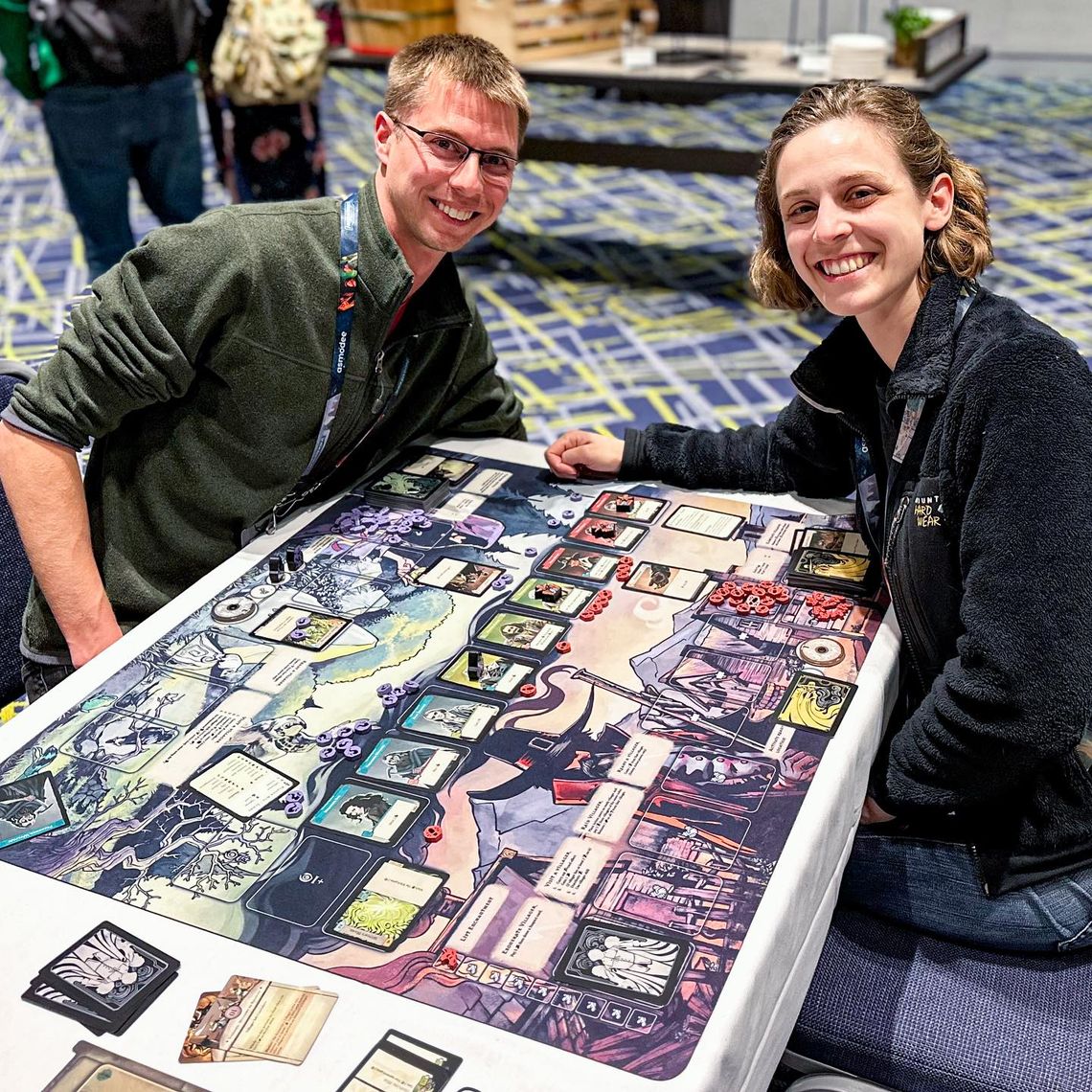
The News-Gazette sat down with Paige Gance and Zander Tallman, the owners of Just Games, to talk about who they are, how they got started, the struggles the business has overcome, and where they hope the business will be in the future. *Every interview in this series has been edited for clarity and length.
Paige Gance, 34, is originally from Connecticut. She graduated from Washington and Lee in 2013 with a double major in journalism and economics. Zander Tallman, 33, is from Michigan. He graduated from Washington and Lee in 2014 with an accounting degree. They lived in Washington, DC but moved back to Lexington in 2018. They enjoy playing board games as well as participating in outdoor activities like disc golf and hiking.
How long have you owned this business?
Gance: We opened in 2018 in September. We started up on South Main Street by the cemetery - the building that's called The Hub. We were there for just about two years and that was a good starting location. It was smaller, a little more out of the way, and then we moved to this spot here on Nelson Street in October of 2020. We were outgrowing our space; we needed more room to carry different lines of products like puzzles.
Tallman: This spot is four times larger; square foot wise, so we needed a lot more space and this is on a prime corner downtown, one of the premier retail spots I think in in all of Lexington.
Gance: We get much more visibility here so folks just find us randomly instead of having to, you know, intentionally search for us and that allows us to connect with a greater portion of the folks who live here and visit.
What turned an idea into action?
Tallman: When I was in grad school I attended a local game store similar to this and that's where I learned to play Magic the Gathering. I loved the community that it offered and in the back of my mind I said ‘one day when I'm retired I want to open a game store like this’ but then the opportunity to do so came up, like three years after that when we were living in DC. We're not super huge city people and the grind, the long hours working and commuting were just dragging. So when Lexington had the Launch Lex program in 2018 we were notified by a friend who lived here and jokingly said ‘this might be a time to open a game store’ and then we thought seriously about it and eventually we went through that program and here we are.
Gance: I will say that I did a lot of research into other programs that were similar, so Lexington wasn't the first town to do [what they] called “Launch Lex” but that grant program was through the state government and other municipalities had taken part in that Grant and so I actually called some of their offices their equivalent main streets and said ‘hey, we're considering doing this but before we make this big life choice we kind of want to see if our plan would be something that you think is viable?'
Tallman: We were also obviously a lot younger at the time and have plenty of educational skills so if it didn't work out in, let's say in two years, it wouldn't have been a huge financial strain and we could have about-faced in gone back or done something else, so that we figured that was the best time to take the leap for attempting to open a small business.
Gance: I was a grad student with a stipend.
Tallman: And I worked for Ernst & Young, the accounting firm, as a staff auditor. I've always wanted to open a small business, it's sort of just been a dream of mine from when I was a little kid but I didn't really know what to open or how to get a small business going. So many of them that I saw were just family businesses that were passed down and so getting started was daunting, but the [game store] in Winston-Salem where I was in grad school I got a little insight about how that one worked and I thought I could do that, especially with my accounting and business educational background.
Gance: We love games and we're basically selling fun and that feels really good and although some folks who come in ask us ‘how'd you come up with this idea?’ it's not a new idea there are a lot of game stores in the country hundreds and hundreds and hundreds. So we did have other models to look at and sort of take what we liked about each one and what we felt would work in Lexington and there's our connection to the place - as students, but also sort of that push of the Launch Lex program. Obviously we didn't really have any cash being in our 20s and so the idea that we could earn some grant money to help us get started was a big incentive to choose Lexington plus our familiarity with the area and some of the people here.
What is your mission and your dream for the business?
Gance: I wouldn't say that we have like a written mission statement but I know that our values are that anyone who walks in the door is going to feel welcomed, they're going to feel like they belong, and they're hopefully going to find something in the store that brings them joy.
Tallman: I like to call myself a non-sales person or a bad salesperson because I really don't like selling somebody something unless I'm pretty certain that I think they're going to like it. Like Paige mentioned, we want everybody to find something that brings them joy but I also want to make sure that we can help them do that if they need it and that we don't steer them in the wrong direction just to make a sale. That's not why we're here.
And then on the event side, we host a lot of events, they're not exactly profitable things but we offer them as a community service, sort of. We want everybody that comes to meet new people that they wouldn't have ever met otherwise or just get out of the house, or turn off their devices for several hours and just enjoy being around other people, or interacting with their game or whatever it is that we're hosting.
The dream: well, I feel like I'm already existing in it so I'm okay with it not being a future thing. We've recently gotten to a stable point with our employee situation. A lot of things that we had to think about regularly are happening more or less automatically or they're taking less time so we're both able to get out of the shop a little bit more which has been helpful for the work-like balance. I don't have any desire to franchise or open another one, so we're going to just continue to put all of our focus and effort into this one. We’ll have many decades to go, hopefully. There will be some form of growth I'm sure at some point. We're sort of in a good place right now with everything and I'm just gonna keep that going without getting complacent.
What are the three main struggles that your business has faced and how did you overcome them?
Tallman: Well the biggest hurdle that I can think of was: just the two of us ran it without any employees for nearly 4 years. So obviously that was a lot of time commitment but we loved it so it didn't feel debilitating. But at some point we did get so big that we needed an employee and that's difficult. Going and figuring out whether you want multiple part-time employees or one full-time employee. How to go about looking for just the right one if we were gonna get one?
Retail isn't generally super flexible. We're open all the time. We have our continual events, we don't like to interrupt them. We ended up having to go through the process again after only a year but having done it once, we felt a little bit better about the second go around. And we also, since then, have two very part-time employees that kind of do odds and ends for us. So we're figuring out the extra employees now too.
Gance: When we first got started neither of us had any retail experience, so we had to figure out how to answer basic questions like ‘where do we order stuff?’ ‘how do we set up all these accounts?’ especially ones that want references from places we already order from, except we're brand new so we don't have any references. There was just a really big learning curve for us at the beginning.
There is a trade association for game stores. That was helpful. We go to that trade show every year and there are peer-to-peer seminars, so other game store owners telling us their tips and tricks and we have learned a lot from that. But yeah, really big learning curve just on all of the nitty gritty details of how to run a business.
We're also in a number of different retail Facebook groups. That's a forum as well, to ask questions or answer them, have conversations, keep your ear to the ground on what is happening in the industry. It's nice to stay connected like that.
I think the third thing would be: wanting to please everybody. So there are lots of games and hobbies, different trading card game lines that we could carry, but we are limited by our space. We are also limited by the population size. It doesn't feel great because we would like to do everything for everyone but at some point we have to understand that there are limits and we don't want to get burnt out or over-commit or overstretch ourselves.
Do you have any tips or advice for someone who legitimately wants to open a business that will last?
Tallman: I think finding either a mentor or somebody who's willing to answer your questions in a fairly responsible time frame that is experienced; because the experience is the one thing you can't make up. We sort of had that. Depending on the industry, I would definitely recommend having somebody who's willing to at least answer your questions, if not help you a little bit more with ideas or specifically how to go about doing a lot of the opening requirements.
Gance: It's just research, talking to other stores. Zander had an extensive conversation with the owner of Labyrinth games and puzzles in Washington DC and she shared a wealth of knowledge with us so there's a lot of camaraderie in the industry. Game stores want each other to succeed, even ones in the same cities. Being a part of that community and going to the trade show every year has been one of the biggest ways that we gain knowledge.
I think you can't be afraid to actually look at the numbers and just figure out, 'what it would actually take to be able to pay yourself?' and 'how long that would take?' So if you open a certain type of business, it's having some understanding of 'what are my costs going to be?' and then 'how much of XYZ would I need to sell in order to take home some money at the end of the day?' So really taking a hard look because running a business is very rewarding. You get to interact with folks and you get a lot of non-monetary good feelings from that but at the end of the day, a business exists to make money so that you can pay yourself as an owner. Just like you would get paid with a regular job. You have to be willing to accept that but I see a lot of business owners that maybe lose sight of the fact that they should be making money, as silly as that sounds. I would just say: you have a plan to make money.