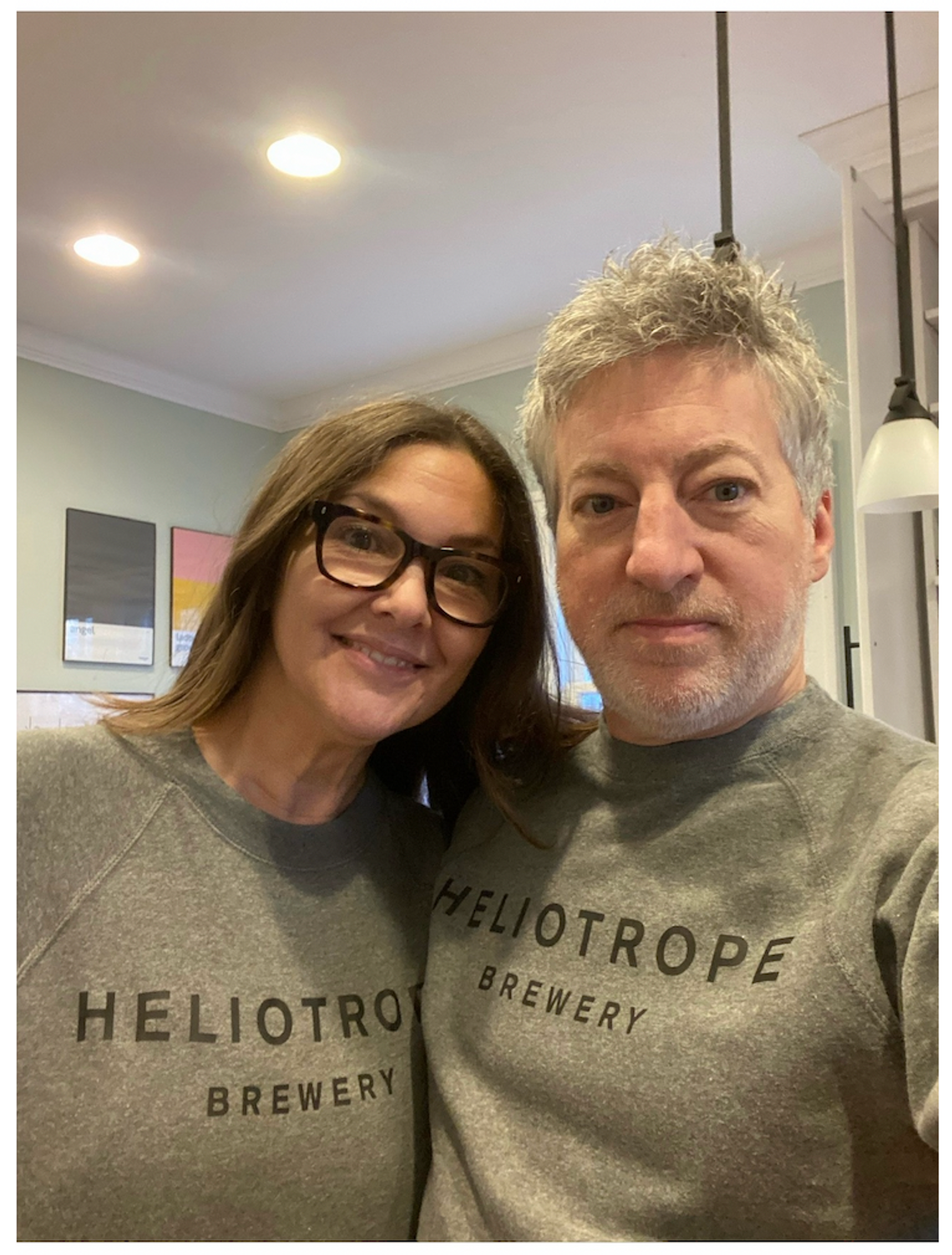
The News-Gazette sat down with Erik Jones, one of the owners of Heliotrope Brewery, to talk about who they are, how they got started, the struggles they’ve overcome, and where they hope their business will be in the future.
Erik Jones is from Portland, OR. He graduated from Washington and Lee University in 1991, after which he moved back to Portland and worked in the arts for "20-25" years, particularly in the symphony and ballet organizations. In 2010, he married Jenefer Davies and together they moved back to Lexington where Davies is a professor at W&L, along with being co-owner of Heliotrope. Jones has experience as a home-brewer and has also enjoyed a side-job as a trekking guide in places like Nepal and Kilimanjaro.
How long have you owned this business?
We opened in December of 2019. It had been in the works for a few years before that. When I went to brewing school, the idea was that I was going to work at a brewery and as part of brewing school I apprenticed at a really large brewery on the west coast. But there were 60 Brewers on the staff and they worked, you know 24/7, around the clock and I think at that point I was about ready to turn 50 and I was like ‘I don't want to be 50 years old and be the 60th person on the list of who gets scheduled for shifts.’ This would be a lot easier to do it ourselves. At that point I was ready to not have a boss so that's why it transitioned from working at somebody else's business to just doing it the way we want to do it and plus it's an opportunity to put her own stamp on things.
What turned an idea into action?
I don't know. Just having a goal and just deciding to do it, you know? It really was as simple as that. But we put a lot of thought into research and training. You know, a lot of people, especially in the brewery world, they'll be home brewers and then they'll just open a brewery. There are plenty of breweries out there that did just fine doing it that way and so I'm not disparaging that but I wanted to leave as little to chance as possible. So I went and worked at a couple breweries to make sure that's what I really wanted to do and then I went to school for it to make sure I really knew what I was doing. Why not stack the deck in your favor as much as you can? We were very methodical about it.
What is your mission and your dream for this business?
Well the second part's easy to answer because we're basically doing what we want to do. I don't want to get any bigger because then it just comes with a whole bunch of headaches. Every horror story out there, especially in the brewery world right now because the brewery world's kind of contracting a little bit, the breweries that don't make it are the ones that kind of get too far out over their skis and try to take on too much and try to grow faster than they actually can. On the beer side, we have a great economy of scale that we're small enough that we can afford to just brew with the best quality ingredients possible. So being small allows us to do that, it also allows us to make food in the kitchen with this stuff that stays local as possible. So on the product size side, that was kind of our goal and our mission. Then just as a business it was really important to us to sort of be a community place and we made a lot of decisions that directly tie into that: we have no televisions in here and that was a very conscious decision. I like going to a bar and watching a baseball game as much as anybody else but that's not what we wanted here. We want people to be able to have a conversation. It's also why we have community tables and we just started, sort of, dipping our toe into the water of having trivia night. We were against that for a long time too because we didn't want people to come in and feel like they couldn't talk because there was something else going on. It's also why I haven't really done a whole lot of live music too, because we just don't really have a space that's conducive to be able to do it and also have conversations at the same time. [Jenny] said she'd been to too many breweries that felt like you're in a fraternity basement, you know? And the industry in general just suffers from being too “dude-centric” anyway, you know? We wanted a place that wasn't just for guys in their 30s with big beards and can tell you every hop that was ever grown. We wanted to be some place where everybody felt comfortable and that's always been our biggest, our most important thing. This place is inclusive whether you like it or not and if you don't like it, you can stay away. The more you normalize stuff like that, I feel like it makes it less controversial. I think just by virtue of who we are, we just want everyone to be happy and get along, you know? So that's kind of what we wanted to bring to the community, as who we are and what we can offer. We're kind of doing what we want to do, you know? I don't want to get any bigger and I don't really want to be any different than we are. I mean, it's hard work but yeah, I like being my own boss for sure.
What are the three main struggles that your business has faced and how did you overcome them?
Um, covid, covid, and covid. Seriously, covid was the number one thing because that happened two or three months after we opened. So we had a couple of great months. I mean, I think if it was gonna happen, it happened at the best time for us I think because we'd been around long enough to sort of have a toe hold but we were new enough that the community really rallied around us, which is great. We also have a product - pizza. When everything switched to ‘to-go’ and like delivery and stuff like that, nothing's better than pizza for that. I always felt really bad for the fine dining restaurants because, I always use a piece of fish as an example, it's like ‘here's your fish that we made 45 minutes ago that was cold.’ Our pizza isn't really made to be eaten fast but it's not a new concept to people. Then the state allowed people to do ‘to-go’ beer sales at that point, which helped out a lot too. So that really kept us going. We also made a really conscious effort to keep all our employees, we didn't lay anybody off which was what we wanted to do just to be good people but it also paid dividends as well, because we got a huge tax credit for that. If covid had happened a month before we opened, that would have been way worse. So we kind of lucked out there. I really credit the community for supporting us and everybody else in town as well. Um, they're always unexpected costs and things you just don't know about. So I would say that's a huge thing. I know there are plenty of stories of people successfully opening with, like, their last dollar but I think the biggest thing there is just to have a reserve fund, sort of a rainy day fund. And we sort of learned that lesson almost the hard way: we realized how seasonal business is based around the school schedules (like when the students leave in the summer and over the holidays), our business gets slower. So it's really important for us. We learned in the spring and fall, when we're super busy, just stash as much as we can away in the bank and that kind of helps us get over like January - super slow for example. Just the sort of the basic stuff they teach you, like making a business plan, stuff like that. Whatever you think something's going to cost, double it you know? Budget for that.
Do you have any tips or advice for someone who legitimately wants to open a business that will last?
I mean this is sort of like a philosophical thing I think. I used to be a marketing director for a ballet company and I think the biggest mistake people make as a marketer is to be like, ‘oh, well I buy things and therefore what would appeal to me is the thing I'm gonna do,’ without realizing that you're not necessarily like your customer base. So you have to be honest. You might have the best idea in the world for something you think would be really cool and you personally would be there every single day, but you need to do your research and find out if there are enough like-minded people in the area. So I think that's the first thing: really do your research into what your customer base is and be honest about it with yourself about whether there really is a demand for what you're going to do. And then be prepared on day one. A lot of times you only get one opportunity to impress somebody and if you're like, ‘we'll figure it out as we go’ and you may never see that person again. And then, it doesn't matter how much planning you do and how much research you do - there's going to be things you have to figure out as you go. So I think being adaptable is super important. Being able to learn things. Something might break that you could spend thousands of dollars to fix or you could figure out how to fix it yourself, or figure out how to live without it, you know? So that sort of adaptability, I think, is super important. You want to be flexible enough to be able to adapt on the fly but also have done enough research ahead of time to put yourself in the best possible position to succeed. Like I said, I think the worst thing you can do is open business with your last dollar and be like, ‘we'll just sort of invent ourselves and figure out who we are as we go’ because you don't usually have enough finances or time to do that.