Go to main contentsGo to main menu
Sunday, December 14, 2025 at 2:51 PM

’85 Floodwaters Hit Baths Fast

’85 Floodwaters Hit Baths Fast
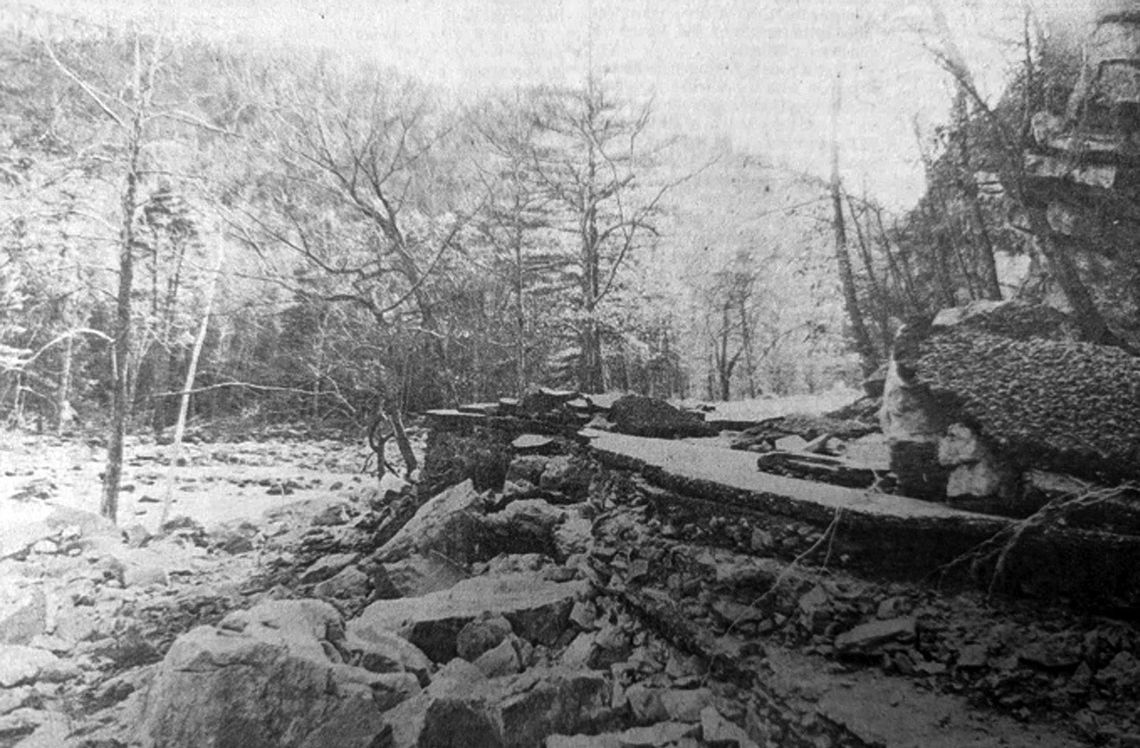
PORTIONS of Va. 39 through Goshen Pass were damaged or washed out by the 1985 flood. A $12 million repair project took eight months to complete and included a new retaining wall and pulloff overlook along this section of the Pass. (N-G file photo)

Editor’s note: This week we continue our “Remembering the Flood of ‘85” series with the following story and one by Anne McClung found on page B4.

Among the areas impacted by the 1985 flood, Goshen Pass and Rockbridge Baths were among the hardest hit, with much of Va. 39 through the pass washing away and trees and rocks being carried by the river causing damage to houses in Rockbridge Baths and damaging the bridge that connected residents on either side of the Maury River.

While it had been raining in Rockbridge County for several days prior to the flood, it was the rain in other areas that served as the biggest contributor to the flooding along the Maury River. Areas to the west of Rockbridge got an additional 7 inches of rain on that Monday, all of which eventually flowed down to the Maury River, adding to what was falling in Rockbridge County.

“A lot of people don’t realize how many square miles Goshen Pass actually drains,” Jerry Wilson, a member of the Rockbridge Baths Volunteer Fire Department, told The News-Gazette earlier this month. “If I’m not mistaken, it’s a couple thousand square miles. All the water comes right down through Goshen Pass, from as far west as Millboro and Deerfield. All that comes right through here and they were getting all that rain.”

Adding to the issue was the fact that the dam at the Goshen Scout Reservation had, at some point that Monday, opened its gates to lower the rising lake in hopes of preventing a breach of the dam, only to then be unable to close them, draining the entirety of Lake Merriweather into the Little Calfpasture River and then the Maury.

Water levels rose quickly in Rockbridge Baths, Wilson and other members of the RBVFD recalled during their monthly meeting on Nov. 3, just ahead of the 40th anniversary of the flood.

“In a matter of 10 minutes, it was 4 foot deep on the [side of my] house,” Wilson said. “That’s what caught most everybody … It overtook us so quick and there was no warning. Everybody knew it had been raining for [several] days, but there was no warning. The river gauges existed, but there was no government warning.”

“I grew up on the river,” Ken Mohler added. “The water goes up and the water goes down and you don’t worry about it. That’s what I told [my wife]. I was a little wrong that time. I went through the ’69 flood and that was pretty bad, but this was a humdinger.”

Jim McGowan, assistant chief at the fire department, noted that several members of the fire department lived on the opposite side of the river from the firehouse and with the bridge washed out, were unable to quickly get to the firehouse in the aftermath of the flood.

“The only way to get to this side of the river was to go to Lexington and to come back to town on Route 39,” he said. wo weeks after the flood, a temporary palette bridge was built by the Army Corps of Engineers to allow easier access to the village for those on the opposite side of the river until a new bridge could be built.

In addition to the main bridge, the swinging bridge behind the post office was also washed away. Several barns along the river were also swept away in the river, including one 45-by-78-foot barn belonging to Mr. and Mrs. H.E. Clemmer.

“All we can find is one piece of our roof,” Mrs. Clemmer told The News-Gazette at the time.

Part of the foundation for the old Rockbridge Baths school building was also washed away in the floodwaters. Several houses sustained damage from the debris, rocks and trees that were washing down the river, and one even shifted off of its foundation.

Kati Brantley, who was a child living near that house at the time, remembers the sound the house made when it shifted.

“It sounded like the world was ending,” she said. “It was almost like thunder. The first time I really got scared was when I heard that house break loose, because it had been loud for days, but that was louder than the already deafening level of loud.”

Part of the reason the river was so loud was the large rocks that were flowing down it and tumbling over each other.

“There’s rocks in places down there and I know they came from up there [in the pass],” Wilson said.

Extensive damage occurred through Goshen Pass, with several parts of the road breaking off and washing away. Mohler recalled that there was an individual who was camping up on Laurel Run who drove his truck out through the Pass and into Rockbridge Baths that night, driving over rocks and at one point crossing a strip of asphalt that, though he didn’t know it at the time, had nothing underneath it. That part of the Pass is where the retaining wall and pullover were installed during the eight-month, $12 million restoration project required to reopen that portion of Va. 39.

Ebenezer United Methodist Church, which had emerged unscathed from both the1936 flood and 1969 flood, suffered extensive damage in 1985 as 4 feet of water washed into the main sanctuary. Mohler recalls seeing the piano from the church floating by one of the guardrails near the village the next day.

While unseasonably warm weather in the days following the flood helped dry things out quickly, it left several inches of mud that needed to be cleaned up. Mohler said he has some old toys that his grandchildren play with today that still smell of the mud from after the flood.

Another effect from the warm weather that Brantley recalled was several children in her school coming down with cases of meningitis, though she never got sick herself.

“It was almost like Covid,” she said. “Everyone was quarantining because we were all getting meningitis.”

She also recalls having to be inoculated against several tropical diseases, including yellow fever.

“What first-world child gets a yellow fever vaccination?” she said. “There was a whole list of shots, and it was like 11 shots that we had to get before we could see other kids.”

THE BRIDGE that spans the Maury River in Rockbridge Baths was damaged during the flood, rendering it impassable. A temporary bridge was installed two weeks after the flood to ease crossing from one side of the river to the other. (N-G file photo)


Share
Rate

Subscribe to the N-G Now Newsletter

* indicates required

Intuit Mailchimp

Lexington News Gazette