‘People Helping People’, Kidd Recalls 40 Years Later
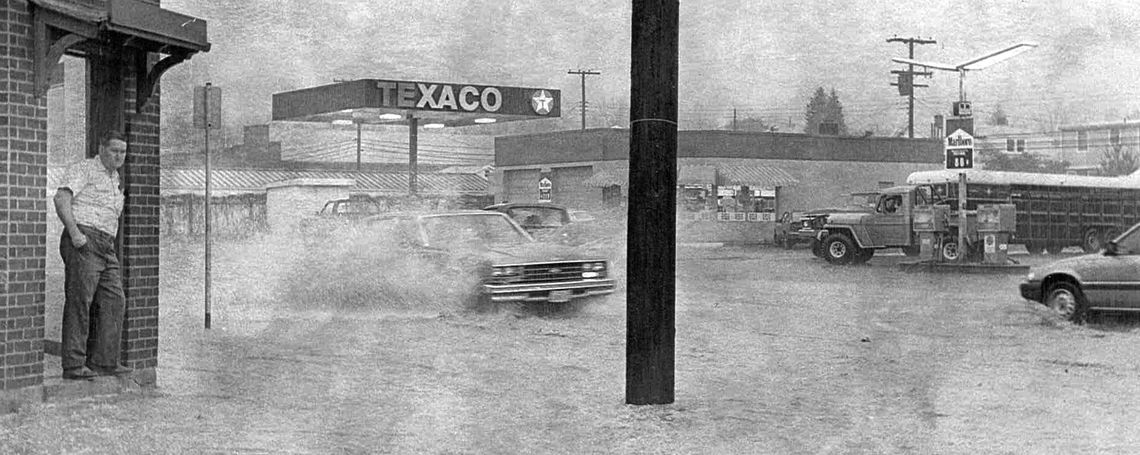
Amid a relentless downpour and rising floodwaters, city officials and volunteers sloshed through the streets of Buena Vista between the Municipal Building and Parry McCluer Middle School, moving voting machines and materials in the early morning hours of Nov. 5, 1985.
City Manager Larry Foster, Mayor Harold Kidd, Voting Registrar Mary Shewey and Superintendent of Schools Dr. James Bradford, also a member of the city’s Electoral Board, were among those participating in the transfer of election gear to higher ground to ensure Buena Vista’s participation in state and local elections that day.
“A lot of people were carrying stuff,”
Area residents share their memories. See pages B6-B7.
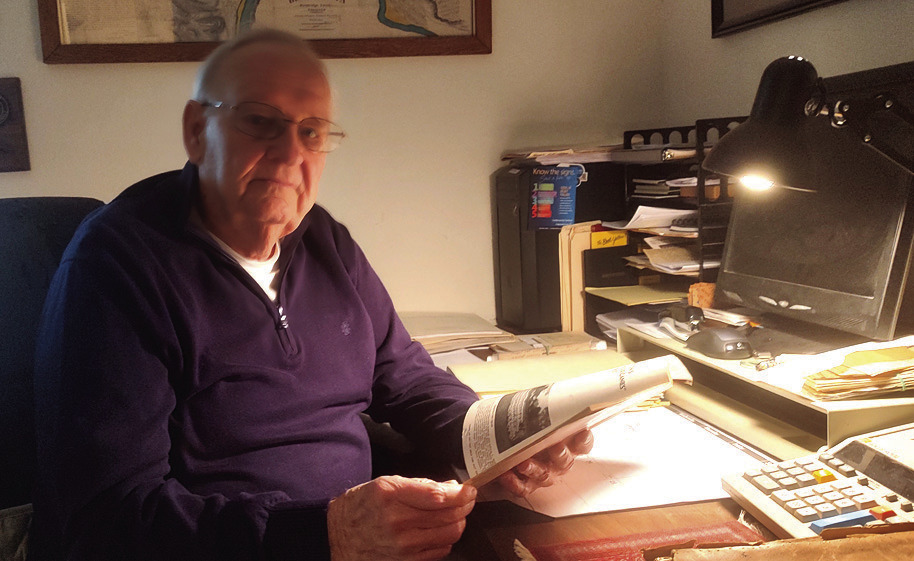
HAROLD KIDD, mayor of Buena Vista during the Election Day Flood of 1985, shares memories of that catastrophic event. (Ed Smith photo)
remembers Kidd. “We had to move it because the water was coming up and coming up pretty fast. I can remember seeing the [Maury] River [behind the Municipal Building], and you could see it was gradually backing up into the city. See, we really had two sources – the river flood and the interior flood [from mountain streams].”
Kidd describes the experience, 40 years later, as “people helping people. We had so many good people joining in. And I know some of them were remembering well 1969 [when flooding also ravaged the city]. That was a terrible time also.”
In 1985, he said, “there were over 100 homes and business that were damaged or destroyed. The city’s wastewater and water delivery systems were severely damaged or destroyed. Of course, we had major cleanup with the help of neighbors, citizens from other communities. I remember people coming in from [elsewhere], Amish people coming in, I think they were from Pennsylvania, VMI cadets were helping. People volunteered, gave equipment. They gave their time and equipment to load trucks.”
Kidd had dual roles in responding to the unfolding catastrophe and its aftermath. As mayor, he helped coordinate the city’s response. As an owner of Carpet Outlet, a downtown business across the street from the Municipal Building, he had to try to safeguard the business’s inventory.
“We had to move all of the furniture and the appliances upstairs [at Carpet Outlet],” he said. “It had big wide steps and a freight elevator. We saved most all of the merchandise. We took everything that we could take up there. We had a paint mixing machine that we didn’t take upstairs. It was turned right upside down – quite a mess. We were more fortunate than a lot of people because we had a place to take things. So many didn’t.”
Tending to his various responsibilities, Kidd recalled, “I was up more than 24 hours. In fact, my wife didn’t know where I was. I was between the courthouse and Carpet Outlet. I was all over the place.”
Asked what he did in his role as mayor, he said, “Get out of the way. Let people do what they had to do and not to interfere with them. [We would] help them, where we could help them. Of course, the city was busy also, doing what they could as far as alleviating the flooding. The drainage system was overpowered. The city employees worked long hours, I can tell you that, in helping the people of the city.”
The polls were successfully transferred to the PMMS auditorium. The election took place as scheduled. City voters elected several constitutional officers and took part in the election of a governor, lieutenant governor and attorney general.
Extensive Damage
The Election Day Flood of 1985 caused extensive damage not only in Buena Vista, Glasgow and other parts of the Rockbridge area but elsewhere in Southwest Virginia and other parts of the state. Roanoke was hit particularly hard, as were Richmond and Lynchburg. According to the National Weather Service, the flood caused $800 million in damages and 22 deaths statewide.
Although property devastation was extensive, a key difference with what many consider the flood of record – the one in 1969 that was caused by the remnants of Hurricane Camille – was that the death toll was much greater in the earlier flood. Around 150 people in Virginia perished in 1969 – most of them in Nelson County but there were 23 deaths in the Rockbridge area.
Remarkably, no lives were lost in the Rockbridge area in 1985 as a result of the flooding. Property damage, however, was in the tens of millions of dollars.
Buena Vista industries that were heavily damaged included Modine Manufacturing, Reeves Brothers, Georgia-Bonded Fibers, REA Magnet Wire, Hermetite, E.R. Moore Co. and Owen-Illinois. REA Magnet Wire announced shortly after the flood that it would not reopen. Reeves announced the next year that it would shut down its Buena Vista operations.
Between 75 and 100 homes in Buena Vista were heavily damaged or destroyed. Dozens of businesses, mostly in the downtown area, were significantly damaged. Peebles Department Store, the anchor retailer for downtown, sustained losses of more than $500,000 in inventory and fixtures. Three days after the flood, company officials announced the store would not reopen.
Buena Vista businesses sustaining heavy damage included Dollar General Store, Cato’s, John H. Dickinson Furniture & Appliances, Shirey and Brown Drug Store, The News & County Press, Lewis’s Grocery, High’s Ice Cream, Kenney’s Restaurant, Aramark Services, a couple of bank buildings and numerous offices.
At Glen Maury Park, floodwaters picked up and swept away the park office and what had been the old Maury River Grocery Store. The store had just that summer reopened as the Community Share Project food pantry, with Gov. Chuck Robb on hand for a ribboncutting ceremony on Labor Day. The fencing surrounding the tennis courts was ripped apart.
In Glasgow, 152 homes and 16 businesses were damaged or destroyed. General Shale had heavy damages. The county’s biggest employer, Burlington Industries’ Lees Carpets plant, came through relatively unscathed, in contrast to the damages it sustained in 1969. A number of county residents were rescued via a boat by members of the Glasgow First Aid Crew. In the Gilmore Mill area south of Natural Bridge, about 14 homes and trailers were damaged by floodwaters of the James River.
Flooding at East Lexington caused extensive damage to the Rockbridge Block Company and Maury River Oil Co. At Jordans Point, four workers trapped by high waters at the wastewater treatment plant were hoisted to safety by a Marine Corps helicopter.
Residents and emergency crews spent a harrowing night in Goshen, according to reporting in The News-Gazette, with communications cut off with the outside world. There was no way to get in or out of town, as roads were blocked by high waters or, in some cases, washed out altogether.
Goshen businesses hardest hit included the Mill Creek Restaurant, Cozy Corner, Stillwater, Burke-Parsons-Bowlby and the Owens-Illinois woodyard. Water inundated Town Hall, the First Aid building and the defunct Goshen school. At the height of the flood, the Va. 42 bridge over the Little Calfpasture River between Goshen and Craigsville was under water.
Large sections of Va. 39 through Goshen Pass along the Maury River were washed out. Large boulders were moved by the floodwaters, reconfiguring the geography of the river and pass.
In Rockbridge Baths, the Va. 39 bridge over the Maury River lost one of its spans to cut off access to the west. The swinging bridge behind the post office was swept away. Homes and summer cabins along the river sustained extensive damage, as did the Ebenezer United Methodist Church and parsonage. The old Rockbridge Baths school lost part of its foundation.
According to the National Weather Service, the Calfpasture River at Goshen crested at 20.23 feet, the highest level on record. Flood stage is 12 feet, with major flood stage 16 feet.
In Buena Vista, the Maury River crested at 26.3 feet – the second highest level on record, trailing only the 1969 level of 31.2 feet. Flood stage is 17 feet, with 21 feet considered major flood stage.
The James River at Buchanan crested at 38.84 feet, by far the highest on record. Flood level is 17 feet, with major flood stage 26 feet.
Flood’s Origins
Though not as strongly associated with the Flood of ’85 as Hurricane Camille is with the Flood of ’69, Hurricane Juan was the main weather maker for the rains that wrought havoc on the Rockbridge area and elsewhere in the Mid-Atlantic region on Nov. 5, 1985.
According to the National Weather Service, a tropical depression formed in the central part of the Gulf of Mexico on Oct. 24, 1985. It was named Tropical Storm Juan two days later. It strengthened to hurricane status, Category 1, on Oct. 27. The center made landfall in Louisiana on Oct. 29, then re-emerged offshore as a tropical storm, turning to the northeast and striking Pensacola, Fla., on Oct. 31.
The storm headed northward over land, bringing several days of rain across the Mid-Atlantic region. A new occluded cyclone developed in the Gulf, then also headed northeast to bring even heavier rains across the Mid-Atlantic.
In the Rockbridge area, rains began in earnest on Thursday, Oct. 31, and didn’t let up until Tuesday, Nov. 5. By early Monday, water began backing up in storm sewers and on city streets in Buena Vista. During the day and into the evening, swollen streams flowing through the city from the mountains were overflowing.
The water first spilled over the banks of the Maury River in the area of 21st Street in Buena Vista at about midnight. Between 3 and 4 a.m., the river burst over its banks and inundated the city between 10th and 21st streets in the lower avenues, especially Sycamore and Magnolia, which encompasses the factories and central business district.
Power went out at 4:40 a.m. when a Virginia Power substation in Buena Vista was submerged. Centel telephone service went out as well in parts of the city. On Monday afternoon, courthouse records in the Municipal Building were taken to the second floor. In the early hours of Tuesday morning, it was decided to move the election polls from the Municipal Building to the PMMS auditorium.
As Tuesday dawned, floodwaters were streaming through downtown Buena Vista. Fortunately, days of rain finally ceased. By the afternoon, the floodwaters had receded, allowing merchants to reach their businesses. What they found, mostly, were muddy merchandise, overturned counters and destroyed equipment.
Flood’s Aftermath
The silver lining, if there was one, to this cataclysmic weather event, is that Buena Vista was able to achieve, at long last, flood protection.
Following the 1969 flood there was a concerted effort by local, state and federal officials, including Sixth District Congressman Caldwell Butler, to garner support for a levee-floodwall that would protect the city from a river flood. Those efforts came to naught when city voters overwhelmingly, in a November 1977 referendum, rejected using local funding for an Army Corps of Engineers flood protection project.
A second catastrophic flood in 16 years finally convinced those who’d led the campaign to reject flood protection in 1977 to have a change of heart. Kidd said two prominent citizens who’d championed the “no” vote personally admitted to him that they’d been wrong.
Kidd recalls that shortly after the flood, Congressman Jim Olin and his predecessor, Butler, convened a meeting in Charlottesville with representatives of the Army Corps of Engineers, city officials and other interested parties to discuss the prospects for renewed efforts to garner flood protection. “The first question that was asked, Caldwell Butler asked, was, ‘Are the citizens going to support this?’” said Kidd.
Everyone present from Buena Vista assured the federal officials that citizens would come onboard this time around. Lots of meetings followed with Corps officials, both in Buena Vista and Washington, D.C., as plans for a new flood protection project took shape.
Kidd maintains that the new, redesigned project turned out to be much better than the one that was planned in the 1970s. The floodwall that was ultimately constructed was 5 feet higher than what was called for in the original plans and an additional feature included was a drainage canal that would carry interior stream floodwater around the floodwall and into the river.
And, for the very first time, the state agreed to pay for a portion of an Army Corps of Engineers project. In the early 1990s, the General Assembly, with the backing of then-Gov. Doug Wilder, enacted legislation to have the state pay half of the local costs. Kidd credits Wilder with persuading legislators to support this appropriation.
“This project came from the top down, it didn’t go from the bottom up,” explained Kidd. In addition to Olin and Butler, he said, the state’s U.S. senators at the time, John Warner, Paul Trible and, later, Chuck Robb, used their influence to convince the state to be a partner in this project.
Another factor that made the project more affordable to Buena Vista, Kidd said, is that soils from the site where the new Parry McCluer High School was being built, below Robinson Gap, were used in the construction of the floodwall. Buena Vista got credit for this, thus lowering the local share of the costs, according to Kidd.
Another person Kidd credits with making the funding work is then city Finance Director Tim Dudley, who figured out a way to secure sufficient cash flow for the project while the city awaited reimbursements from the state and federal governments.
After years of wrangling, planning and battling to secure federal and state financial assistance, construction began on the James R. Olin Flood Control Project in 1994 and was completed in 1997.
Editor’s note: Much of the information for this story came from the archives of The News-Gazette.
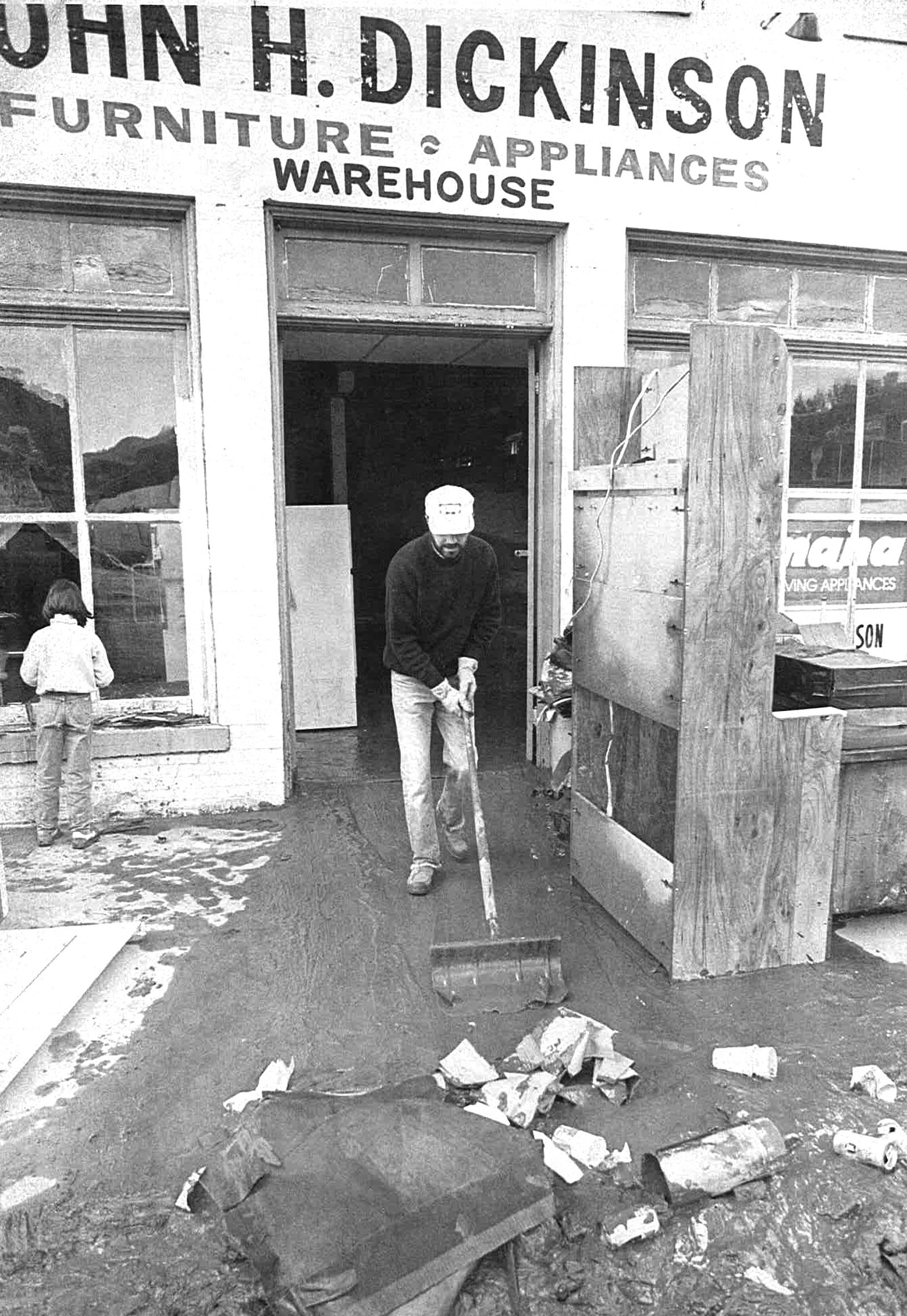
A WORKER cleans up the muck outside the John H. Dickinson Furniture Appliances Warehouse, one of many Buena Vista businesses that sustained heavy damages from the 1985 flood. (N-G file photo)