At VMI, Israeli Woman Describes Her Journey
“When you wake up in the morning,” Moran Stella Yanai told a packed hall of cadets, “the first person you meet is yourself.”
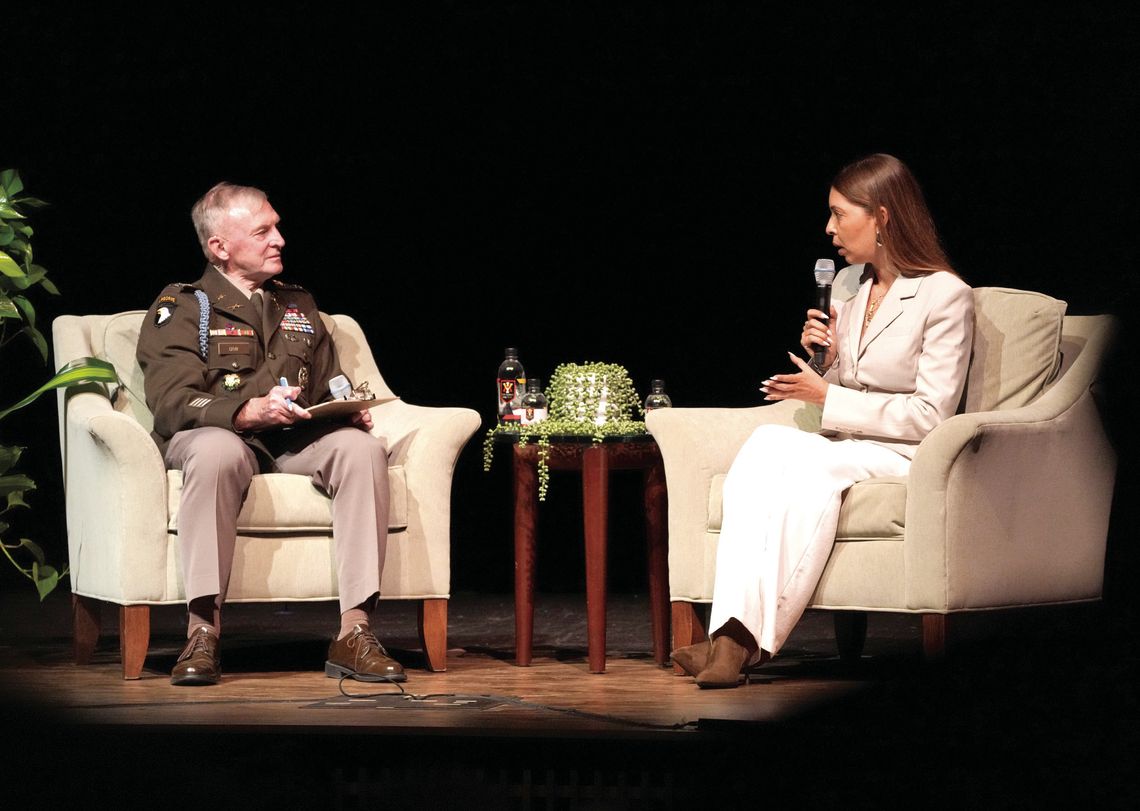
Her steady voice carried through the crowded but silent Gillis Theater, inside the Virginia Military Institute’s Center for Leadership & Ethics, on Monday afternoon, as she described the 54 days she spent as a hostage of Hamas, and the values that helped her survive.
Yanai, an Israeli jewelry designer, was abducted during the Oct. 7, 2023, attack on the Nova Music Festival. She was held in Gaza until Nov. 29, when she was released as part of a temporary cease-fire and prisoner exchange. Her appearance closed the first day of VMI’s 16th Annual Leadership & Ethics Conference, whose theme, “Leading with Integrity,” accurately described her story of tenacity.
Yanai took questions from moderator Col. David Gray, executive director of the Center for Leadership and Ethics, who prompted her to explain the turns in her life that brought her to the fateful festival.
“Before October 7, I didn’t have a purpose,” she said. “I didn’t understand why I’m here. Then one morning a voice in my head said there must be a different way.” She undertook a four-year quest to learn who she really was. Ultimately, she said, “I
‘I was counting my miracles that happened to me that day … I was saved so many times from a sheer death.’ finally became my best friend.”
That personal search for meaning, during the years prior to the attack, prepared her in ways she could not have foreseen.
At 6 a.m. on Oct. 7, she and a friend were selling handmade jewelry at the outdoor music festival in southern Israel when rockets filled the sky. “Nobody taught us how to drive between screaming and falling people,” she said. She credited her compulsory military service for her quick actions: “The soldier I was 23 years ago jumped out and acted for me.”
Over the next hours, she was captured, escaped, and recaptured. Quick thinking — and an Arabic necklace she happened to wear — saved her life twice.
“I had an Arabic necklace on my neck that I received as a present a month before, out of the blue,” she said. “Something made me keep it, even though my mother told me to take it off.
“The first time, it was two Hamas terrorists … The first thing that came out of my mouth was, ‘Don’t kill me, I’m Arabic,’ in Arabic,” she recalled. “I managed to be released from that situation.”
Yanai explained to the audience the reality of growing up in Israel, and why she would know Arabic words or possess a necklace with Arabic writing, despite being “very much Jewish.”
“Arabic is not a foreign language for us,” she said. “It’s something that we used to grow up next to … We live with it 24-7. They are my neighbors that are with me in school. They are my colleagues at work. They’re fine, you know? So it was not a foreign language for me.”
After briefly escaping capture, Yanai was seized again by a group of 10 Hamas militants. Still wearing the Arabic necklace that had saved her once before, she relied on it again, trusting that quick instinct and faith might keep her alive a second time. This time, acting quickly, she gave her necklace to the group as a gift and they left her alone again.
But one risk taken — a scream out to the Israeli army to come rescue her — alerted a third group of Hamas fighters, who took her captive.
She described being beaten, thrown into a car with 10 militants, and dragged into Gaza. Both legs were broken. “I was counting my miracles that happened to me that day … I was saved so many times from a sheer death.”
Her captors told her daily that no one was looking for her. When asked how she kept her strength amidst such despair: “Mind over body,” she said simply. “Believing He will give me the strength to do it.”
Yanai framed her endurance not in terms of heroism but of surrender to the unknown. “If I still have a chance to live, I don’t resist. I surrender,” she said. “At one point you know you can’t change the situation, only accept it …When you surrender into those two possible realities — alive and dead at the same time — then magic happens. You find strength in places you could not imagine.”
In one room, she cared for an 18-year-old girl, and eventually the girl’s mother as well, kidnapped from a nearby kibbutz, and they learned to communicate and work as a team. “Every time I fall, you must be stronger. Every time you fall, I have to be stronger,” Yanai said of their pact. Together, they came up with ways to stay resilient.
Even under bombardment, she found ways to deny her captors the satisfaction of fear. “When the next bomb came, I told the other hostage, ‘I don’t want your eyebrow to move.’ We just looked at him and smiled. We broke him that day. We took his toy.”
False hopes of release came and went, but several weeks later, she finally saw the Red Cross jeep that would take her home. As they drove away, “I was smiling behind my hands,” she said. “I said, thank you. Not only that I broke every limited thought in my head — I won myself. I made the impossible possible because I chose to.”
Her faith, she emphasized, left no room for vengeance. “I didn’t have revenge. I didn’t have anger inside of me. I won myself in so many ways.”
Since her release, Yanai has traveled internationally to advocate for the remaining hostages and to speak about survival and faith. Yet the transition back to ordinary life remains difficult. “If you put me in front of 40,000 people, easy — I’ll speak,” she told a cadet. “But when I go back to my kitchen to make dinner, that’s harder.”
She still experiences triggers: noise, smells, flashes of memory. Her strategy, she said, is to face them. “I like to take them back into my house and see them every day in my face, and not give them that power.”
Cadets lined the aisles to ask questions about leadership, forgiveness, and bravery.
“When you wake up in the morning, the first person you meet is yourself,” Yanai told one. “What extra value do I give to myself today? If I commit to becoming a better person, it’s easy to bring that energy to everyone else.”
Asked how she maintains empathy toward Arabs and Palestinians, she answered without hesitation: “Even if you give me the terrorist that punched me in the face, I will never punch him back. As long as we are getting more aware of our own self, that’s how we find compassion for other people.”
Throughout her talk and the Q&A that followed, Yanai steered clear of political commentary, even when questions invited it. “I’ll not answer in a political way,” she said at one point, adding that the war was “not over yet” for her and that she could only speak from her personal experience. Still, she spoke movingly about her hope for empathy on both sides of the conflict. She said she did not want to make the gap between Israelis and Palestinians wider, but smaller — and that real peace would depend on education and imagination.
In her view, many people in Gaza have grown up with limited opportunities and restricted access to the wider world. “I don’t know how much I can expect from a person who doesn’t know how to dream,” she said.
Even as she continues to recover from captivity, Yanai said she hopes one day to return to the role she sees as most natural to her: that of a peace seeker in her homeland. “When all of my people come back home,” she said, “I’ll go back to being that peace seeker, I’m sure.”
At the end of the hour, Gray called Yanai “a morally courageous person in every sense.” Cadets rose in applause, giving her a standing ovation as she was presented with a gift by a female cadet from the crowd. The two embraced, underscoring Yanai’s message of honest connection.