Go to main contentsGo to main menu
Sunday, December 14, 2025 at 2:47 PM

Revolutionary Lands

Revolutionary Lands
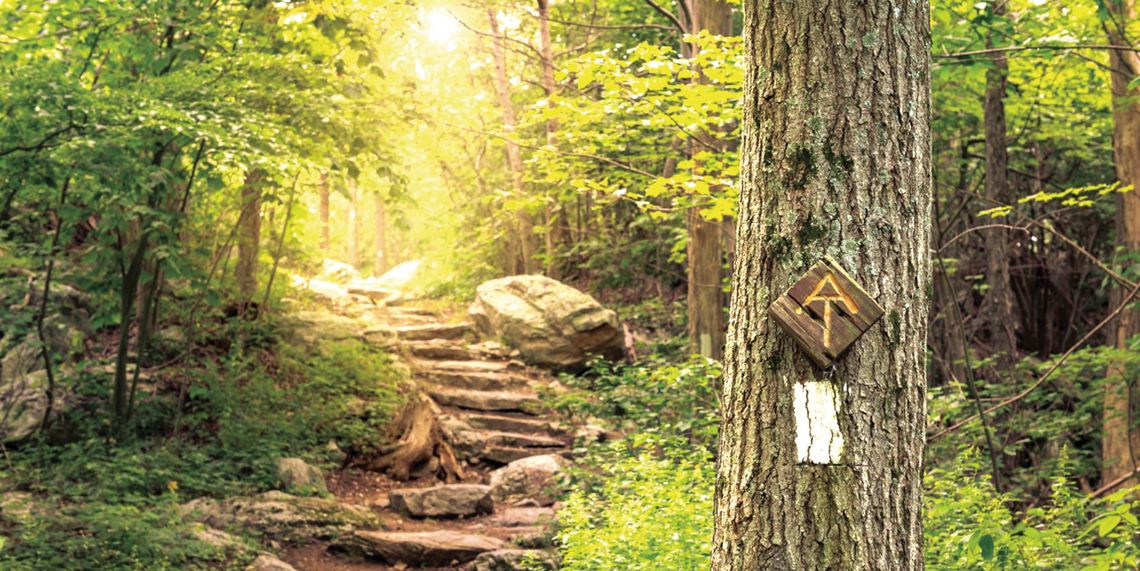
SINCE its completion in 1937, the distinctive white trail blazes on the Appalachian Trail traverse nearly 2,200 miles. Benton MacKaye (shown below in photo courtesy of the Appalachian Trail Conservancy) published the inaugural proposal for “An Appalachian Trail” in the 1921 issue of the Journal of the American Institute of Architects. Bill Bryson’s bestselling memoir of his failed attempt to thru-hike the AT in 1996 is partly credited for the 50% increase in long distance hikers on the trail in the two years after its 1998 publication.

The Appalachian Trail At 100

Editor’s note: This article was written by Eric Wilson, executive director of the Rockbridge Historical Society and regional co-chair of the VA250: American Revolutions Committee. It extends his series of four precedent “Revolutionary Moments” into the 20th century. It’s timed to precede a series of historical presentations and hikes on the Appalachian Trail described below, and will be updated next week, pending the status of the federal government’s shutdown.

In the height of another Shenandoah Valley fall, the Rockbridge Historical Society invites curious hikers and readers to explore one of our most valued natural resources, during the 2025 centennial of the Appalachian Trail Conservancy.

A pair of “History Hikes” organized along local stretches of the AT’s Blue Ridge spine will be bracketed by a reading group and slideshow presentations designed to illuminate relevant historical and ecological contexts. This varied menu offers different interactive modes to pick and choose from, more singularly or cumulatively.

Hiking Through History

To open the series, in concert with the Rockbridge-VA250 Committee, RHS is launching its multi-year initiative, a “Revolutionary Reading Group, 1776-2028,” grounding the evolving place of “Revolutionary Lands” within our local history. Free and open to all, these occasions for lifelong learning will be curated to bridge both genres and generations. Beyond this first centennial cue, the series’ longer arc will be highlighted by the joint 250th anniversaries of American independence, and the establishment of Lexington and Rockbridge County as frontier assets during the heart of the Revolutionary War, in 1778.

On Tuesday, Oct. 28, the Lexington Library’s “trailhead” fronts the month’s events, discussing three short, digitally accessible readings: Benton MacKaye’s foundational proposal from 1921, “An Appalachian Trail: A Project in Regional Planning” (tinyurl.com/1921AppTrail-Proposal-MacKaye); the opening chapters of Bill Bryson’s bestselling comic and often quixotic travel-memoir, “A Walk in the Woods: Re-Discovering America on the Appalachian Trail (tinyurl.com/Bryson-Walk-Appalachian-Trail); and the AC blogpost on “Native Lands” published in 2023 by Trey Adcock, UNC’s director of American Indian and Indigenous Studies, and an enrolled member of the Cherokee Nation (tinyurl.com/ Native-Lands-Appalachian-Trail).

On Nov. 17, at 5:30 p.m. a post-hike “epilogue” will sample from Philip D’Anieri’s “The Appalachian Trail: A Biography” for final group reflections.

On Saturday, Nov. 1, at noon, a collaborative slideshow will immediately precede the first of the two “History Hikes.” Hosted by Natural Bridge State Park, local rangers and writers, historians from the ATC and leaders from the Natural Bridge AT Club – along with teachers and students from Lexington and Rockbridge County public schools – will combine forces to survey the histories, challenges, and opportunities that this American landmark and our local environs continue to offer.

After this introduction, attendees can then drive past Glasgow on Va. 130, joining others at the James River footbridge for a two-hour, relatively flat interpretive hike to and from Matts Creek Shelter.

Pending the terms of the federal government’s shutdown, the second hike is tentatively scheduled for Sunday, Nov. 9, from noon to 4 p.m. A one-mile climb up from Hog Camp Gap ascends to the balds of Cole Mountain, where comments will be offered by regional conservationists, as well as personal stories shared by seasoned AT thru-hikers. Hikers can then choose to return back down the same path, or extend the conversational outing on the 6-mile loop back to the parking lot, via the Old Hotel Trail, hugging the foot of Mount Pleasant.

Before each hike, check facebook.com/rockbridgehistory for latest updates, directions, and specific details about each hike, along with links to the free online readings grounding discussion of these “Revolutionary Lands.”

A Revolutionary Path

Topographically, the Appalachian Trail has always shifted its course, as the veins of its trail systems have matured, threaded, and bonded since its first blazes in the 1920s, and lead designation in the 1968 National Trails System Act. Its compressions and contractions (like the tectonic play between the African and North American plates which gave rise to its ridges and valleys) continue with the necessary management of ecological and economic obstacles of its footways and sanctuaries. Its forests’ oxygenating lungs give life to thousands of species, including the humans who dayhike or trek through its trees, fields, and rocky peaks.

As D’Anieri writes, the trail’s vitality is not merely a product of natural forces and human achievements, but an index of our own lived ideals, habits, and habitats. Its impact is felt not just when walking in the woods, but in the more metropolitan haunts from which it was first envisioned. Not just an “escape to nature,” but as a new, balancing structure for communal connection, and social health in an over-industrializing world: at its conception in 1921, still in the clutches of a global World War where labor and leisure had become increasingly out of whack.

The trail was first proposed by Benton MacKaye, the son of pioneering theatrical entrepreneurs, who found his own stage as a writer and designer of a different sort. While also working with the U.S. Forest Service, he taught for six years in Harvard’s School of Forestry, immediately after becoming its first graduate to earn a master’s degree in 1905. But his visionary essay didn’t lead with the rewards of solitary odyssey, or seclusion, like Henry David Thoreau at Walden, or atop Mount Katahdin, 80 years earlier. Rather, he called for alternative communities supported by a network of “recreation camps” to advance social health and more balanced resource management, in an age of relentless “profit.”

As currents of modernism were beginning to revolutionize the arts, principles of design, and industry, MacKaye’s pithy proposal sounds less like that of a philosophical sage, than a community planner who chose to publish this in the nation’s premier architectural journal, rallying architects, economists, and political leaders to create “revolutionary” paths (a term he often used) to civic connection.

We can now see this concept of “revolutionary lands” more clearly while assessing the 21st century legacies of the American Revolution. Indeed, the hindsight of 250 years of “American Evolution” newly helps to spotlight the hopes and commitments of the 18th century. Locally, Thomas Jefferson resonantly described the Natural Bridge he’d purchased from King George III as a “public trust,” turning royal land patents into newly republican capital.

From those early footprints, it’s much easier to reckon other dramatic shifts from indigenous traditions of land use to the private claims and profits of Euro-colonial settlers through the Shenandoah Valley and Piedmont. Admittedly, more fundamentally democratic provisions for more truly public access (and taxpayers’ collective ownership) would have to wait until the arrival of the modern conservation movement in the late 19th century. John Muir and Theodore Roosevelt emerged as iconic figureheads, then, for a system of national parks, wilderness areas, monumental spaces, and National Historic Trails that still and daily require both local, state, and federal management.

Trailblazing Partners

Geographically speaking, the Appalachian Trail traverses the traditional territories of 22 Native nations, and requires the partnering efforts of 14 state governments and attendant regional land agencies. But beyond those coordinated jurisdictions – and the more individual initiatives that D’Anieri highlights in his 10 biographical profiles – I’d stress “partnering teamwork” at the ethical core of public land preservation, and authentic community-based programming.

In this particular instance, we’ve recruited six organizations to ensure these commemorative events’ full and inclusive reach. Along with RHS, VA250, and NBSP, the Appalachian Trail Conservancy, the Natural Bridge Appalachian Trail Club and the Rockbridge Regional Library System are each deploying their own free, public resources, along with other outing clubs, trail groups, and local educational institutions contributing to the events.

Several of these organizations will be represented at the introductory presentation at the NBSP visitor center on Nov. 1.

Kathryn Herndon-Powell is regional manager of the Central Virginia Appalachian Trail Conservancy, based in Roanoke. Recruiting her own staff and volunteers, she offers an enthusiastic invitation and welcome, as the ATC’s centennial programming draws to its conclusion here and across the country: “As the Appalachian Trail Conservancy marks 100 years since our founding in 1925, everyone’s invited to the celebration — especially vital local communities like Rockbridge,” she says. “This milestone is also an opportunity to examine the Trail’s fascinating history and the lessons it has to guide us in the next 100 years. The stories of the AT, both past and future, are really those of dreamers and doers brought together by a shared love for the land, and through the transformative power of a simple footpath through the wilderness.”

The slideshow presentations also turn the compass north, looking to the near-coincident history of the Shenandoah National Park, which holds just over 100 miles of the AT.

This past spring, while freshmen at Rockbridge County High School, Sarah Edgar and Liesl Niebur were honored for the second straight year at National History Day for their creation of an original website titled “Shenandoah National Park Land Grab” (in 2024, they were state champions for another project in local history focusing on co-education at VMI).

As a former student of mine at Lylburn Downing, Edgar now directs their findings to new collaborative purposes. When we spoke last week, Sarah reflected that the valued glow of environmental conservation is also tempered by darker histories: “As we enjoy our beautiful public lands in peak fall foliage, it’s important to recognize how our country made the decisions to set aside various, often vast, amounts of nature for public recreation. But often, that story is not as simple as the celebrated conservation of natural resources and beauty,” she says.

Shenandoah National Park was established in 1926, dedicated in 1935, and desegregated in 1950. And as Edgar rightly emphasizes, that public benefit came at a significant if often occluded cost: “Hundreds of families in Virginia had their land seized, sometimes with little to no compensation, often evicted to nearby cities and counties. Unlike National Parks or early settlements in the western portion of our country that drove out tribal citizens from their land, the creation of the SNP targeted neighboring Appalachian communities and families who lived high in the Blue Ridge Mountains. Unfairly portrayed by privately funded companies as uncivilized – sometimes criminal, with no right to the land that they lived on – over 2,000 Virginians were evicted by their commonwealth’s claim of eminent domain, only for their land to be handed over to the federal government to create its 22nd national park.”

She concluded, “Still today, we need to honestly understand how American citizens were used as scapegoats and roadblocks to the goal of creating public lands. So it’s our responsibility to recognize the turbulent past of Shenandoah National Park, and to continue protecting the land without erasing its histories.”

As the AT moves into its second century – and as our community’s youngest historians take the baton to frame our local and national histories ahead of America’s Tercentennial in 2076 – it’s important that we write and record the experiences and lessons of our current era, so that our own ideals, and blindspots, can be revisited, ahead.

Visit RHS’ Facebook and Instagram pages @rockbridgehistory for the latest program updates, as they finalize, or email [email protected].


Share
Rate

Subscribe to the N-G Now Newsletter

* indicates required

Intuit Mailchimp

Lexington News Gazette