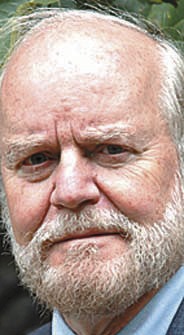
“It’s a very interesting thing that in times of war, we blockade our enemies in order to prevent them from getting goods from us. In time of peace we do to ourselves by tariffs what we do to our enemy in time of war.” – Henry George, political economist, 1839-1897.
Among the influential names that have shaped our country that most people never heard of, you’ll find Henry George.
Many might be surprised to discover that up until 1888 the secret ballot was not law. George, in two articles, “Bribery in Elections” (1871) and “Money in Elections” (1883) moved reformers in Massachusetts to adopt the secret ballot in 1888. By 1891 more than half of the states had adopted it, too.
George also argued in his book “Protection or Free Trade” that “tariffs kept prices high for consumers, while failing to produce any increase in overall wages” protecting “monopolistic companies from competition, thus augmenting their power” (Wikipedia).
In the 1800s, tariffs were a major, but oft forgot, contributor to the southern states’ growing disaffection with their membership in the United States. Tariffs were a protection of goods made by the increasingly industrialized north competing with foreign imports to the south.
I’m not sure how many people understand t ariffs. T he c ountry w ith a listed tariff, for example, India, at 50% with Trump’s newly enacted tariffs, does not pay the tariff on goods produced there. Neither does the “producer” of the goods (e.g., a factory or a solo weaver of a rug). When that buyer imports those goods to the United States, that buyer pays the 50% tariff to the United States and then decides on a price for those goods. The importer may absorb the cost of the tariff or add any percentage to subsequent buyers in the U.S. Of course, the importer can’t operate at a loss, so any amount of the tariff might have to be passed along to the wholesaler and then the retailer. Everybody down the supply chain wants the product to be competitive, so some of the added expense of the tariff may be absorbed along the way to ensure that the final buyer, in this case, the American consumer, you and me, can afford it.
When the supply train can’t cover the expense of the tariff and still be profitable, a product from India that was $100 before the tariff, would cost the consumer $150.
The 50% tariff, paid originally by the importer, goes into the U.S. treasury.
The irony is: if tariffs to protect domestic products work, Americans won’t buy foreign products! Hence, there will be no money coming into the U.S. treasury!
For many Americans this current “tariff war” against ally and adversary is not about making our country more prosperous and respected in the world; it is about stroking Donald Trump’s massive ego – his lust for attention and his flaunting of personal power, the power we “loan” our presidents to act in our best interests, not his to lord over others!
Trump has said that some Americans may get a rebate from the money collected by his tariffs, but not specifically which Americans.
I’m not expecting any benefit from any largesse that Trump’s tariffs may create.
“You’re fired” is the watchword for his sycophants now in administrative positions, anxious to purge anyone who participates in actions not favorable to Donald Trump. D.O.J. and F.B.I. agents, acting under legitimate orders of their superiors, are being terminated for their work examining Trump’s activities. The commissioner of the Bureau of Labor Statistics, Erika McEntarfer, was fired because the agency’s negative jobs report didn’t flatter Trump.
Eliminating messengers with bad news, a tactic used to ruthlessly remove anyone not in lockstep with the “Boss,” is replete with disaster for, if not the autocrat, the organization the autocrat ruled.
Do we, making our individual daily decisions, choose to ignore information that warrants a change in our plans?
Do we plan a trip to the beach with a hurricane lurking up the coast? A picnic on a day expected to be a rainout? Do we fail to slow down when a sign warns of a rough road ahead?
Only an idiot wants reports of nothing but good news and clear sailing for his/her plans.
An idiot … or someone so above the fray as to be immune from any disaster that might fall on the less fortunate.
Beyond retaliating against his critics, Trump wants to control and dictate our colleges’ and universities’ curricula, our states’ prerogatives, and even the nicknames of our sports teams and the sweeteners in our soft drinks.
Trump has used the power of the presidency to leverage a personal multimillion dollar settlement from a federally regulated company, Paramount, that must get government approval for its actions, protections intended to protect the American citizen, not line someone’s pockets.
Trump sits on information that may link him to sex offender Jeffrey Epstein.
Trump wants to bring Louis XIV’s symbol of absolute monarchy to the White House with his own opulent version of Versailles, and yet he is so petty as to cheat at golf.
Challenge Donald Trump, or any of his advocates and apologists, to explain these actions and you will get a conclusory explanation – no supporting evidence offered – or a perseveration – a knee-jerk continuation of irrelevant points, usually a Democrat’s alleged misstep. Even foreign governments and private citizens are not immune from his wrath. So too, a Republican or former trusted aide or once valued friend can expect to be jettisoned as a diversion to his flagrant misbehavior.
Alas, Mr. Lincoln, “You can fool some of the people all of the time.”
A post script: The creation of the income tax, officially created when Congress enacted the Revenue Act of 1913, replaced tariffs as a primary source of income for the federal government.