Local Residents Visit Monastery Of Saint-Paul-de-Mausole
Editor’s note: It’s time to travel once again with Lexington resident Lynn Lowry Leech, who has written a number of travel pieces for us over the years and offered up this piece on her and her husband’s latest trip.
St.-Paul where? Most of us have never heard of this quiet monastery near St.-Remy-de-Provence, in southern France.
But the name Vincent van Gogh and his distinctive artistic style are familiar to us, and it was at this monastery-turned-psychiatric hospital that van Gogh lived at the end of his life. I visited St. Paul-de-Mausole on a sunny day in June and learned something about its fascinating history and its famous resident.
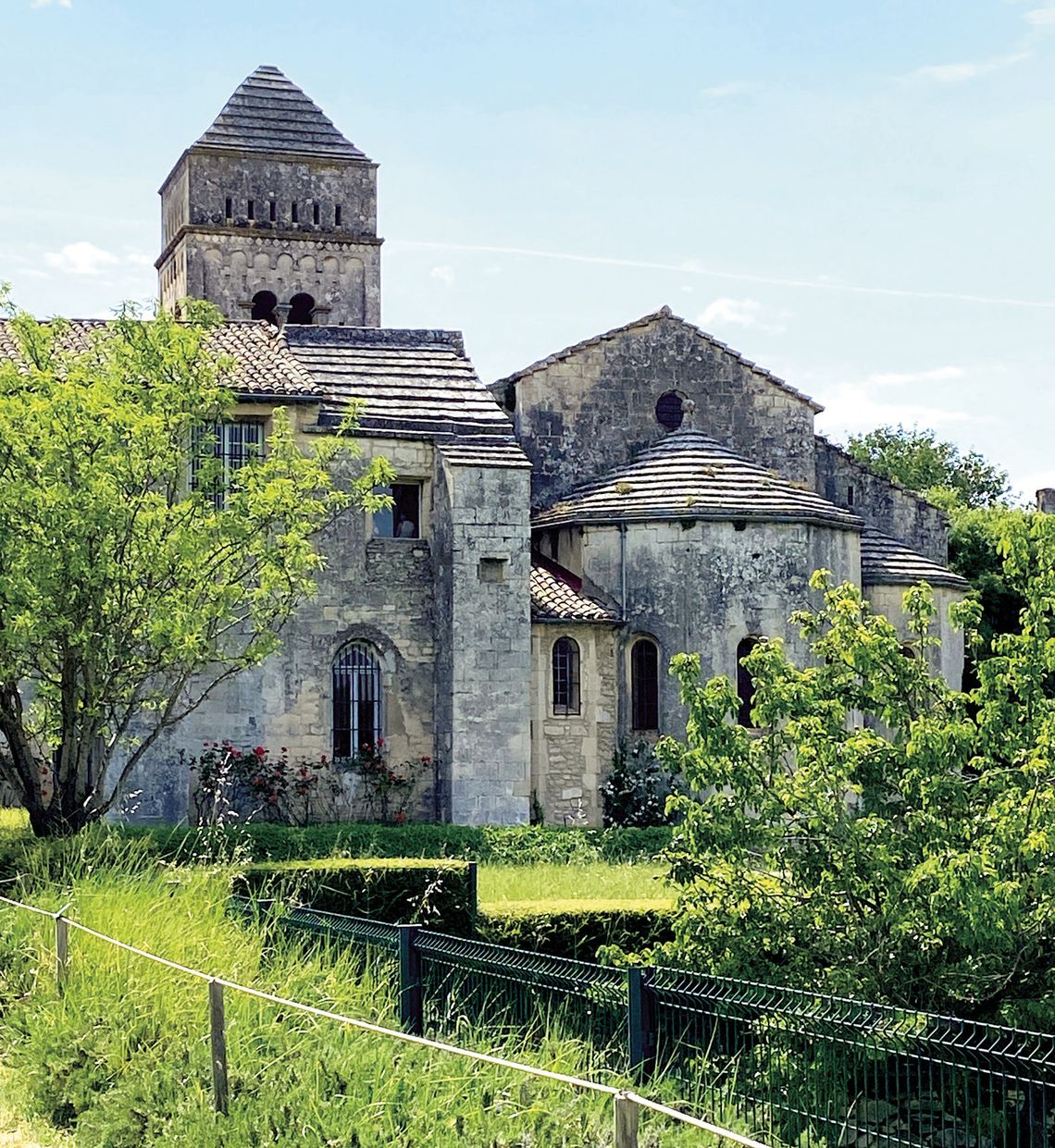
Founded in the 11th century by the Benedictines and dedicated to Saint Paul the Apostle, this Romanesque monastery welcomed the insane, sick and poor from the outset, Franciscan Observatines took over the monastery in 1605 and established a psychiatric asylum there. The monastery was confiscated and sold during the French Revolution, forcing the Franciscan monks to leave, and it was used as a prisoner-of-war camp during World War I. German troops used the monastery as barracks during their occupation of Southern France from 1942 to 1944.
Although it is not apparent to today’s visitor, St.-Paul-de-Mausole continues its purpose as a working psychiatric hospital, admitting more than 130 patients and residents to its short-stay clinics. But the day tourist sees nothing of this operation: visitors are guided to a wing of the serene stone building that has been converted into a museum, with rooms decorated with period pieces to reflect van Gogh’s time there as a patient. The corridors lining the peaceful interior courtyard garden only hint at the whisper of the dark habits of passing monks and nuns from bygone days, and the surrounding gardens and olive groves offer a peaceful respite for the wandering tourist.
A Famous Patient
Vincent Willem van Gogh was born to a Protestant clergyman and his wife on March 30, 1853, in The Netherlands, exactly a year after the birth of his stillborn brother, also named Vincent. He was quiet and thoughtful as a child and had a fragmented early education. After quitting school at 16, he began working at the Hague gallery of French art dealers Goupil et Cie, at which his uncle Vincent was a partner. His younger brother Theo later worked for the same firm.
Losing interest in being an art dealer, van Gogh became obsessed with religion and lost his job with Goupil. He found work as a teacher in England, but proving unsuccessful in this role, he became depressed and turned to religion for comfort. He trained briefly as an evangelist and went to minister to coal miners in southern Belgium. After a short tenure, his appointment there was not renewed.
Frustrated by his inability to establish himself in a lucrative career, his parents handed financial responsibility for Vincent to his younger brother Theo. Recognizing Vincent’s habit of drawing and doodling, Theo suggested he pursue a career in art.
Taking his brother’s advice to heart, between 1881 and 1885 van Gogh set about training to be an artist, studying in Brussels, The Hague and Antwerp. As he later wrote, his desire to help mankind as an evangelist evolved into a desire to leave behind “some memento in the form of drawings or paintings – not made to please any particular movement, but to express a sincere human feeling.”
Despite his desire to form human connections, throughout his life van Gogh was unsuccessful in developing close ties with others and was misunderstood, ignored and widely despised. Contemporary psychiatrists think his suffering had multiple biological, psychological and social causes, including bipolar disorder and epilepsy. Despite his social inabilities, he enjoyed a life-long, close relationship with his brother, Theo, who supported him and with whom he maintained a lively correspondence throughout his life.
Moving to Paris in 1886, van Gogh met impressionist and postimpressionist artists, including Paul Gauguin and Georges Seurat. He continued to paint, and as he sought to lighten the dark, moody style he’d developed in Holland to reflect the lighter French style, he began to develop his own distinctive, very personal style.


ABOVE, founded as an Augustinian monastery in the 12th century, St.Paul-de-Mausole became a psychiatric hospital in the 19th century. AT RIGHT, during his stay at the hospital, van Gogh was initially confined to his rooms and often painted (without the bars) what he could see from his window. These paintings included “The Starry Night,” a portion of which is reproduced at the top of this page.
In early 1888, van Gogh was living in Arles, enthusiastically painting the landscape and some portraits. He did not try to sell any of this work, planning to wait until he had accumulated 30 first-rate pictures with which to announce himself as an artist to the world. He hoped to establish an artists’ colony in Arles and invited several artists to join him there. Paul Gauguin arrived in October 1888, but their relationship became tense and within a few weeks Gauguin threatened to leave.
Shortly before Christmas, 1888, van Gogh experienced a severe epileptic attack that caused delusions and psychosis. He was so distraught at Gauguin’s impending departure that he accosted Gauguin with a razor and later that evening sliced off his own ear, which he wrapped in newspaper and gave to a prostitute in a nearby red-light district. Gauguin left soon thereafter and van Gogh’s dream of establishing an artist’s colony in Arles vanished.
The wound quickly healed, and van Gogh remembered little about the incident. He resumed painting, but his fluctuating mental state alarmed him and he voluntarily admitted himself to the St.-Paul-de-Mausole psychiatric hospital in St.-Remy-de-Provence on May 8, 1889.
Patients were allowed two baths a week and food was not plentiful, but as part of their treatment the staff encouraged patients to pursue their interests. Because the hospital was only half-full when Van Gogh arrived, he was allowed to occupy not only a secondstory bedroom but to also use a ground-floor room as a painting studio. His brother Theo provided him with paint and brushes and paid for his care at the hospital.
During his year at the asylum, van Gogh experienced four severe mental episodes, which incapacitated him for several months and confined him indoors and to the grounds of the asylum for much of his stay. Despite these setbacks, he painted prolifically and created more than 150 paintings and drawings during his time at St.Paul-de-Mausole.
Today, markers inside the hospital and on the grounds show visitors where van Gogh created some of his most iconic paintings, including “Cypresses” and “Irises.” “The Starry Night” records his recollections of the night sky as seen through the bars of his bedroom window, with the village of St. Remy loosely recreated beneath the brilliant moon.
In May 1889, van Gogh wrote from St.-Paul-de-Mausole to Theo: “I wanted to tell you that I think I’ve done well to come here, first, in seeing the reality of life for the diverse mad or crazy people in this menagerie, I’m losing the vague dread, the fear of the thing. And little by little I can come to consider madness as being an illness like any other. And the change of surroundings is doing me good, I imagine (...) .”
In early June 1889, van Gogh wrote to Theo, “As for me, my health is good, and as for the head it will, let’s hope, be a matter of time and patience.”
As his health improved, he also enjoyed some success and recognition in the art world. With Theo’s help, six of his paintings were shown at a group exhibition of the Belgian artists’ association, Les Vingt (The Twenty), in Brussels in early 1890. An art critic published a positive article about van Gogh’s work and praised one painting, in particular. He even sold a painting at the exhibition. And in March 1890, 10 of van Gogh’s works were selected for the annual Salon des Independents in Paris.
Van Gogh left the hospital in St. Remy in May 1890 and went to Auvers-sur-Oise, near Paris, where several artists had settled. The village offered the tranquility he needed, the companionship of fellow artists, and it was close enough to Paris for him to visit his brother Theo. A local doctor, Paul Gachet, also an amateur painter, befriended van Gogh and encouraged him to focus completely on his art. He followed Gachet’s advice and completed nearly a painting a day. His health seemed to continue to improve, and his future looked brighter.
Van Gogh grew worried when he heard Theo might leave his long-time job at the art dealers to start his own business. Despite assurances from his brother and sisterin- law to the contrary, he was afraid the financial risk of this career change could potentially threaten the financial support he had relied on from his brother. He also feared experiencing further psychological attacks.
He wrote to Theo around July 10, 1890, “Once back here I too still felt very saddened and had continued to feel the storm that threatens you also weighing upon me. What can be done – you see I usually try to be quite goodhumored, but my life, too, is attached at the very root, my step is faltering.”
Before the month was out, on July 27, 1890, van Gogh was shot in the stomach in a wheat field near Auvers-sur-Oise. He staggered back to his room in the village and died there on July 30, 1890. Although the official history maintains that, burdened by financial worries and concerns about his mental health, he committed suicide, other research suggests he may have been shot by a local farmer who held a grudge against him. Another theory is that he was shot by some boys playing with a gun in the wheat field and that van Gogh chose to let people believe the wound was self-inflicted, rather than have the boys’ lives ruined by their crime.
In his 37 years, van Gogh created a large body of work: 850 paintings and nearly 1,300 drawings. One can only wonder how many more beautiful works he could have given the world had his life not been tragically cut short.

VAN GOGH’S brother Theo, who paid for his stay at the hospital and provided painting supplies, arranged for him to have two rooms: one to use as a bedroom, the other as a studio.

TOWARD the end of his stay, Van Gogh made many paintings of the wheat fields and olive groves surrounding the hospital, with the Apilles Mountains looming in the background.