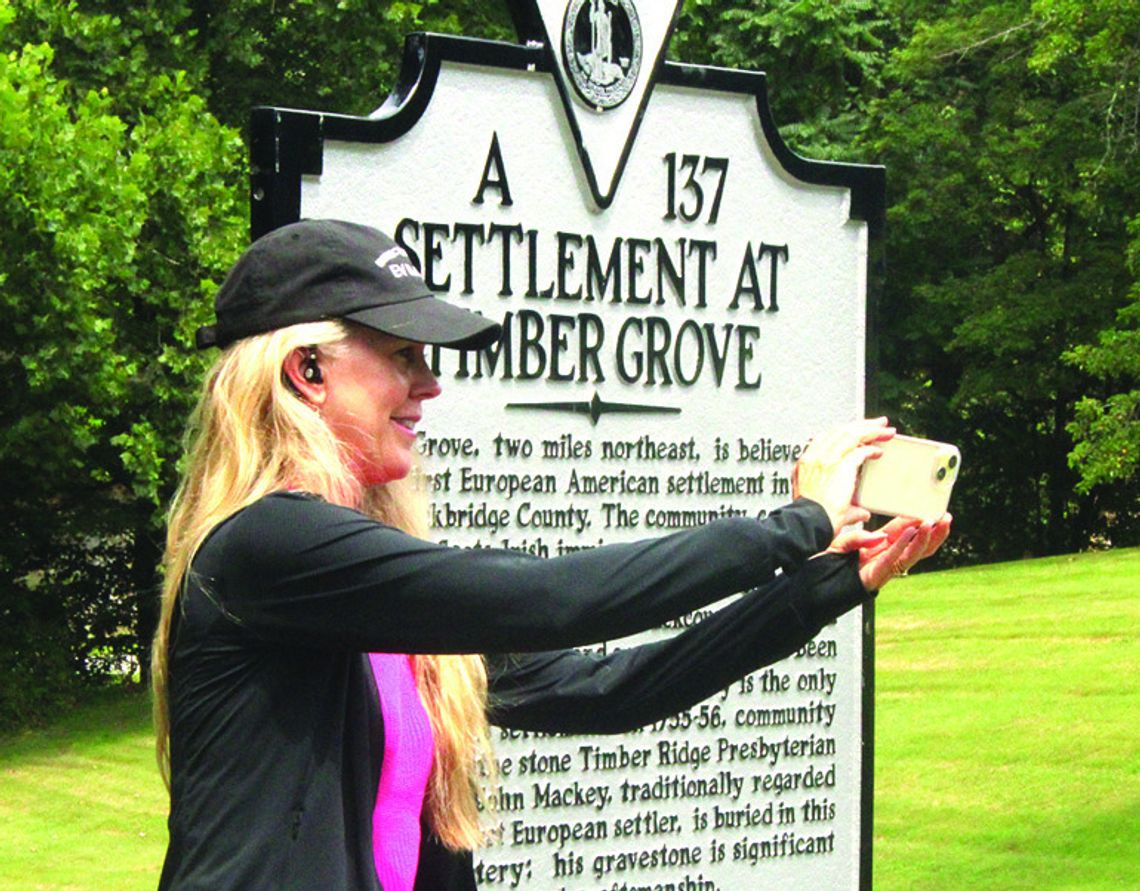
Multi-state Trip Included Stop In Kerrs Creek
For the past four summers Daphne Dixon, executive director of Live Green Network, has driven her electric car across the country with a two-fold purpose – to raise awareness about electric vehicles and to visit places that her ancestors called home.
The journeys have taken her from her home in Norwalk, Conn., to many different stops across the country, and this year, it included a brief stop in Rockbridge County to visit some sites connected to her relatives.
The relatives in question, John and Martha Stevenson, came from England in 1734 and eventually settled in the area that would become Rockbridge County. They were founding members of Timber Ridge Presbyterian Church and settled in the area of Kerrs Creek. Martha was among those killed in the first Kerrs Creek massacre in 1759. Dixon’s brief stop in Rockbridge County last Wednesday included visits to Timber Ridge and in Kerrs Creek at the site of memorials for the massacres.
“It’s hard to identify what the emotion is [with being here],” she said. “The word that comes to mind is love. I just wish I could talk to these people and pay them my respects. It’s a dream come true just to be here, because they’re such heroes to me. Being able to know that you were somehow connected that far back and somehow be able to trace it, I don’t have a word for that. It just feels really profound. It makes you feel really grounded and proud that I had relatives that were part of a brave group of people.”
Dixon’s interest in her family history began when she was young when a relative passed away and her family went through a storage unit which had a number of family heirlooms, including a family bible that had a family tree in the front of it.
“My mom always said that we had relatives that fought in the Revolutionary War,” she said. “I saw that family bible … and I opened it. It had the birth, death and marriage [dates] going back pretty far. It didn’t have it back to the Revolution, but it had it back to the early 1800s, so there were really good bread crumbs. I saw all the names of the towns written in there. I was 10, so I was immediately enthralled with the whole thing … I thought, ‘One day I want to go to all of these places.’ I just had this immediate connection to Virginia and Kentucky.”
Dixon was living in California at the time, but eventually moved to Connecticut. Once on the East Coast, she began digging into her family history in earnest, looking for records of her ancestors in the places she knew they had lived.
“What was great was, back then, you had to do everything by calling the churches and calling the historical societies,” she said. “There really wasn’t anything available online. So I started calling all these small towns and talking to all these people and requesting death certificates and birth certificates.”
She also began reading books about the experiences of people, including the Draper manuscripts, a collection of nearly 500 papers, books and manuscripts compiled by Lyman Copeland Draper about the history of the settlers in the western parts of Virginia and the Carolinas, and the Ohio River Valley and Upper Mississippi River Valley, covering the period between the 1740s and 1830.
“You read these stories and you get pictures in your mind, and you feel like you know these people as you start reading about them, and then you read the history that goes along with it,” she said. “It’s not just that you’re doing your own history, but then I was reading about all of the Scotch-Irish people and what it was like for all of them, so I just got immersed … in what their life was like, and I was just captivated by it, and I wanted to see it. I wanted to come and walk in their steps, because … they were so brave and so smart and they kind of didn’t have a choice. They were just continuously put in these situations where they had to innovate and they had to fight or they had to do whatever it took. It’s such a source of courage in everyday life. Whenever I’m having a bad day, I think of these people and think of what they had to do.”
From Lexington, Dixon planned to head west into Kentucky, with a stop in that state’s Lexington to see where John Stevenson is buried, having moved west after Martha’s death. She also planned to visit the graves of one of John’s sons in Illinois. Her trip concluded back in Norwalk on Tuesday.
In between stops to visit places connected to her family, Dixon made stops in Massachusetts Ohio, Pennsylvania and Kentucky to visit with eight Clean City Coalitions and highlight the advantages of using electric vehicles. The trip covered 3,000 miles and seven states. This year’s trip was the shortest to date, with the three previous trips covering 5,000 miles each and all of them spanning from one coast to the other.
Dixon has been an advocate for electric vehicles for many years and uses the trips as a way to show that they can be effective at driving long distances, provided that there are enough charging stations along the way. Virginia, she noted, has more than 5,100 electric vehicle charging stations, making it one of the more friendly states to electric vehicles.
Dixon said she sees some parallels in making the switch to an electric vehicle and the changes that John and Martha Stevenson made in coming to a new world.
“It can be scary and it’s new technology,” she said. “It’s not as easy as driving a regular vehicle [because] you do have to plan everything out, but it’s kind of pushing things forward a little. So I feel like part of me doing the electric vehicle road trip, I feel like it’s kind of rooted in that spirit of adventure that John and Martha and their sons had – just moving forward for something that could be better, that moves things forward in some way.”