New Research Reveals Details From Jordans Point’s History
Editor’s note: The following essay was written by Neely Young, who is on board of directors at the Miller’s House Museum Foundation. The Foundation was recently contacted by a person who is doing some family research, inquiring if his distant relative had occupied the Miller’s House in the 19th century. That led Young to do some research, and he subsequently wrote this piece about the miller, James Newham.
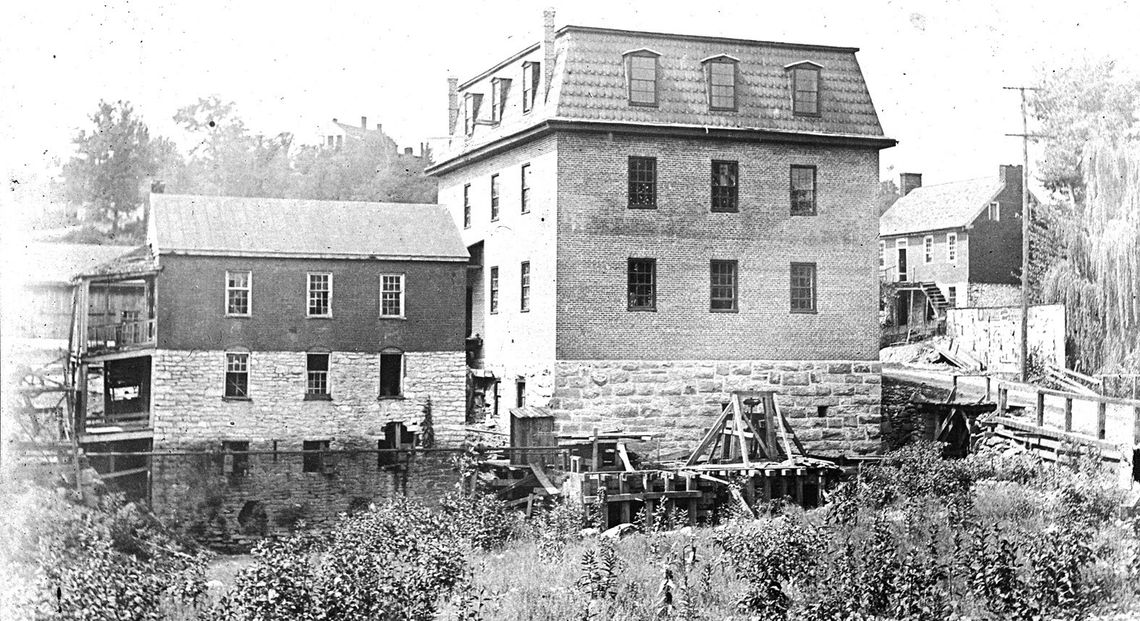
Jordans Point was long the home of road, river and rail activity. It was also the center of many industrial and commercial enterprises, including milling operations. The Jordan family constructed and owned most of the buildings in the area, including a cotton factory, tilt hammer shop and a merchant mill. The Miller’s House was constructed in 1811 and was occupied by numerous individuals down into the early 20th century.
Until recently, we knew nothing about the various millers who lived in the house, but we have now discovered information about one of them, James E. Newham.
In 1853, the administrator of the Newham estate brought a suit against members of the Jordan family regarding disputed bills and payments deriving from the mill operation. The administrator was Samuel Beard who was the son-in-law of Newham (who died in December 1852) and had worked in the mill with him for several years.
The Jordans were the most economically powerful family in Rockbridge County. The court case and some genealogical snooping has revealed the following.
James Newham was born in 1793 in Frederick County, Va. On Dec. 30, 1814, he married Susan Shipler in Frederick County. He had four children, one son and three daughters. From 1820 to 1840 he moved up the valley from Frederick County to Rockingham and then Augusta. By 1841 or 1842, Newham was working in the Lexington Mills.
In 1847, he entered a contract with John and Samuel F. Jordan whereby Newham ran the mill and received one-fourth of the profits from the enterprise with the Jordan brothers receiving the other threefourths. The mill ground not only flour but plaster which was very popular in building construction at the time. The Jordans also agreed to provide fuel and lighting for the Miller’s House.
Newham and his wife lived in the house rent free from 1847 until 1852. In 1850, Samuel Beard married Susan Newham. In that same year, the 1850 census shows Susan Newham and Samuel Beard living in the Miller’s House with the elder Newhams. There was also a John Miller, aged 18, living in the house. Miller was probably serving as an apprentice. James Newham’s wife, Susan, died in September 1852 and James Newham in December of that year.
Newham ran the mill on his own with no interference from the Jordans and is described in court documents as an entirely honest, fair and competent manager. Newham must have been financially successful as in the 1850 census he is shown as owning two enslaved people.
He kept a comprehensive Mill Book, which became a part of the documents in the court case. This shows that although there were numerous customers, the most significant of these by far were the Jordans themselves. They used the grains primarily to feed horses in their many entrepreneurial undertakings.
Following Newham’s death, Samuel Beard continued the milling operation for about six months. Beard’s position as miller and occupant of the house probably ended because of the suit he had brought against the Jordans. He was succeeded by Henry Locker who ran the mill and occupied the house until at least 1855.
The court case dragged on until 1859 with neither side gaining a particular advantage. All bills were settled, and the heirs of the Newham estate received a small inheritance of less than $300.
James Newham did not live a spectacular life, but he appears to have been an honest and productive worker, a responsible husband and father, and a solid citizen of Lexington and Rockbridge County. Perhaps, over time, we will learn more about other occupants of the Miller’s House.