Historical Marker Tells
Story; Book Is In The Work
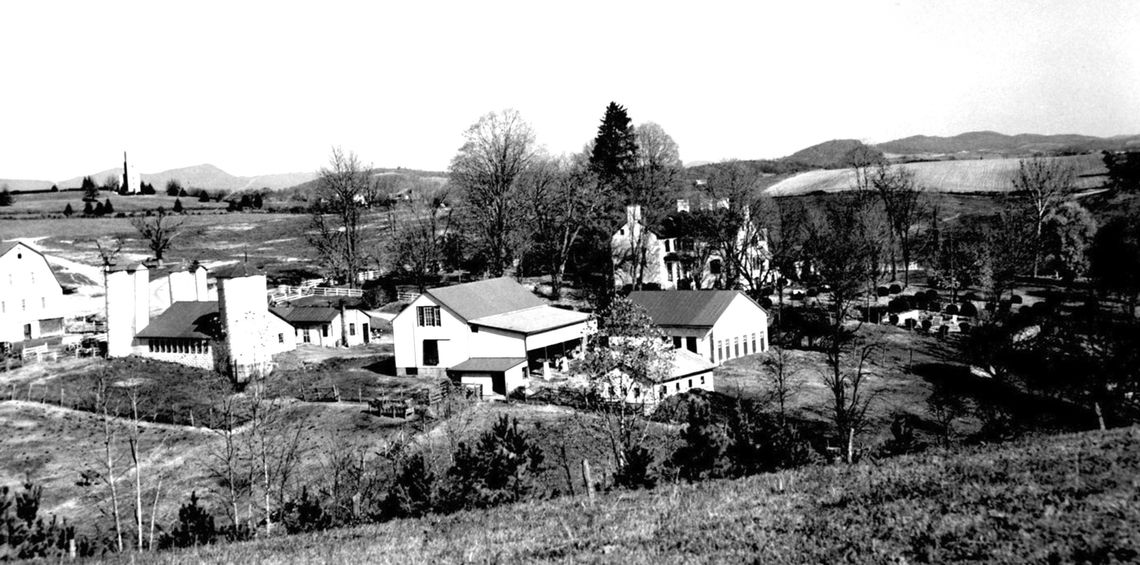
In the buildup to the 25th anniversary celebration of Kendal at Lexington, four of the residents – two of whom have extensive backgrounds in historical research – decided to dig into the history of Sunnyside, the house and farm where the continuing care retirement community is located.
Cinder Stanton, Katharine Brown, Ed Dooley and Lee Henkel, the four Kendal residents who comprise the Sunnyside history task group, have uncovered a wealth of information related to the history of the manor house and 600-acre farm that dates back well over two centuries.
Fred and Isabel Bartenstein, members of the last of about nine different families who owned Sunnyside, donated the house and 84 acres in 1997 for the purpose of establishing Kendal at Lexington, which opened in 2000. Approximately 400 acres of the Sunnyside farm is now held in a conservation easement by the Virginia Outdoors Foundation and remains in active agricultural use.
A partial and concise summary of what the task force has found on Sunnyside’s history is contained on panels of a historical marker installed in front of the house that was unveiled earlier this summer during a ceremony and reception held for Kendal residents.
Initially, when the group began its work two years ago researching Sunnyside’s history, the purpose was to compile information for the historical marker. However, the deeper they dug into the history, the more they realized that there was just too much pertinent information to confine to a historical marker.
So, they decided to write a book that will tell a much more complete story. They’re hoping to have the book completed and published sometime next year.
“We found a long, long history,” said Brown, a past executive director of the Stonewall Jackson House in Lexington and the Woodrow Wilson Birthplace Foundation in Staunton. “What we were learning was deserving of a book.”
“Our research is spread all over,” said Stanton, a retired historian from Monticello who conducted years of research on the enslaved at Thomas Jefferson’s plantation. “We have chapters built and some not so built,” she added. “It has been a fascinating two years.”
Also contributing to these efforts have been Dooley, a retired administrator and history professor at Virginia Military Institute, and Henkel, a retired administrator for a medical organization.
‘A Fine Farming And Grazing Estate’
Sunnyside is described thusly on the historical marker. The inscription continues: “For two centuries, the 600acre property later called Sunnyside was a mixed-grain and livestock farm and plantation, often noted as one of the finest in the county. Wheat – or the flour milled from it – was its principal market crop and it featured the latest improvements in crops, cattle and machinery. In the 20th century, it became a successful commercial dairy, selling milk locally and even in Washington, D.C.”


UNVEILING a historical marker in front of the Sunnyside house on June 26 are Katharine Brown (left) and Cinder Stanton, members of the Sunnyside history task group. (Ed Smith photo)
The marker notes that the farmland “was once part of the ancestral homelands and hunting grounds of the Eastern Siouan people, including the Monacan tribe from about 1000 to 1600. Beginning in 1747 with a 500-acre purchase by Scots-Irish settler John Moore, Sunnyside was a working plantation supported until 1865 by the labor of enslaved people.”
Most of the families who have owned Sunnyside through the years are acknowledged on the marker. These include the Moores, Barclays, Ransons, Maddoxes, Tutwilers, Rosses, Websters, Andersons and Bartensteins.
The marker also acknowledges the many others who worked and lived at Sunnyside, including more than 120 enslaved individuals who worked and lived there until emancipation in 1865.
A sampling from the inscription lists some of the enslaved – most only by their first names: “Louisa and children Lizzy Ann, Bob and Margaret; Mariah and William and children Benton, Emily, Lizzie, Sally and William; Andy, Andy, Ann, Ann, Cynthia Brooks, David, Eli, Esther, Fannie, Francis, Hannah, Isaac, Jacob Bowyer, Joe, John Mead, Lee, Let, Levi, Louisa, Magdalen, Mat, Ned, Patsy, Preston, Samuel, Sarah.”
“Learning about the enslaved people is challenging but possible with all the records out now,” commented Stanton.
Culling court documents and census records, among other sources, the group is compiling many of the full names of the enslaved. “We’re beginning to put together surnames of enslaved people,” said Brown. “They did have surnames that went back generations, prior to emancipation, and they weren’t the names of their owners.”
Sunnyside House has been listed in the National Register of Historic Places since 2002.
Owners’ Stories Revealed The Moore family, original owners of the Sunnyside farm, built what the historical marker describes as a “five-bay brick dwelling” around 1810. The house was enlarged three times between 1820 and 1859, when an eastern addition was built by Joseph Maddox that contained a distinctive curved staircase.
“Research is being done on all aspects of the house, from attic to cellar,” said Stanton.
Brown notes that Maddox, who came to Virginia from New Orleans, was “an interesting character.” He was accused of shooting a man in a duel and known to have worked for both the North and South during the Civil War. The group came across records that showed Maddox purchased 60,000 bricks in 1858 that were apparently used in the addition.
Eli Tutwiler, owner of Sunnyside from 1862 to 1880, was known as a “progressive farmer and innovative thinker,” according to Brown. He utilized advances in science and technology with his farming practices. During his time at Sunnyside, the first public demonstration of Cyrus Mc-Cormick’s reaper took place just across the creek, where a large crowd gathered to watch.
John DeHart Ross, who owned Sunnyside from 1880 to 1926, had ambitions of making Lexington a leading manufacturer of the south. He subdivided parcels of his land into hundreds of lots that were to be sold for workers’ houses. He built a hotel near Mulberry Hill, west of Lexington. His big plans came crashing down, however, with an economic collapse in 1893. Only one or two industries sprang up from Ross’s plans.
Isabel Bartenstein’s father, James Anderson, ran a successful dairy farm at Sunnyside in the mid-20th century. Anderson was a professor at VMI and later a state highway commissioner.
Arthur and Margoth Bartenstein were the last of the Bartensteins to live at Sunnyside, having resided there for a couple of years in the 1990s. Arthur, son of Isabel, is a landscape architect who grew up in New Jersey but spent the summers of his youth at Sunnyside. He is a Lexington resident and actively engaged in the affairs of the community.
“Sunnyside has been a very stable farm over its 250-year history, said Stanton. “It’s unusual in Virginia for such a large tract of land to be held together as a single farm for such a long period of time.”
“Most people who owned the land were quite wealthy,” said Brown. “The owners were not all local. Some came from states far away because the farm was so profitable. … Quite a few actually went to W&L and VMI. They were quite vested with community institutions.”
Contemplating the history of the place they’ve come to call home, Brown remarked, “We are possessive of Sunnyside. We think of it as a treasure to our community.”
Looking ahead to publishing the book in 2026, she added, “We are proud of the information [we’ve compiled]. We want to give and share it with a wider community.”


MEETING inside the Sunnyside house (at left) are Katharine Brown (left) and Cinder Stanton as they discuss research they’ve conducted into the historic house and plantation. (Ed Smith photo) A screen print (above) shows the West Lexington portion of an 1891 plan for turning Lexington into a city. Sunnyside’s owner at the time had grand plans for subdividing tracts of land into lots for houses where workers from envisioned factories would live. As a reference point in this image, Virginia Street is where present-day Enfield Road is. Sunnyside house is in the inset. (image from W&L special collections library)