Experience’
Church Fire, Recovery Recalled 25 Years Later
Among the many, many messages Rev. Bill Klein received in the aftermath of the fire that destroyed the sanctuary at Lexington Presbyterian Church in July of 2000, one comment in particular stuck with him.
“Early on, somebody had sent me a message right after the fire that said, essentially, God is going to do something that was too big for those previous walls,” he said. “I kept referring to that comment, because … that was an inspiring sort of way to think about it.”
In reflecting on the 25 years since the fire, Klein and other members of the church mention one thing that stands out, not just from the day of the fire, but through the process of rebuilding the sanctuary over the next two-and-a-half years: the true nature of community that emerged following the tragedy.
“It wasn’t Presbyterian – it was total community,” said Skip Hess, a long-time member of the church who was serving on its Property Committee at the time of the fire. “People that had never been in this church came in. They brought us checks, they gave us money, [and] they offered services. It was just such a fantastic thing to come out of a horrifying fire. People just opened their hearts to us. That, to me, was just so amazing. I’ve lived here most of my life, and I always thought, ‘It’s there, I think,’ but I had never seen it really in action until then. It pulled together the whole community.”
“It was a good example of how disaster [and] tragedy brings out the community in a community,” Bill McCorkle, music director for Lexington Presbyterian Church, added.
“The reach was unbelievably wide,” Klein recalled. “Folks were communicating from Europe and from Africa and all across the country almost immediately. They were able to log into the paper and see videos of what was going on. That was incredible, in our day and age, that people were able to do it.” Day of the fire
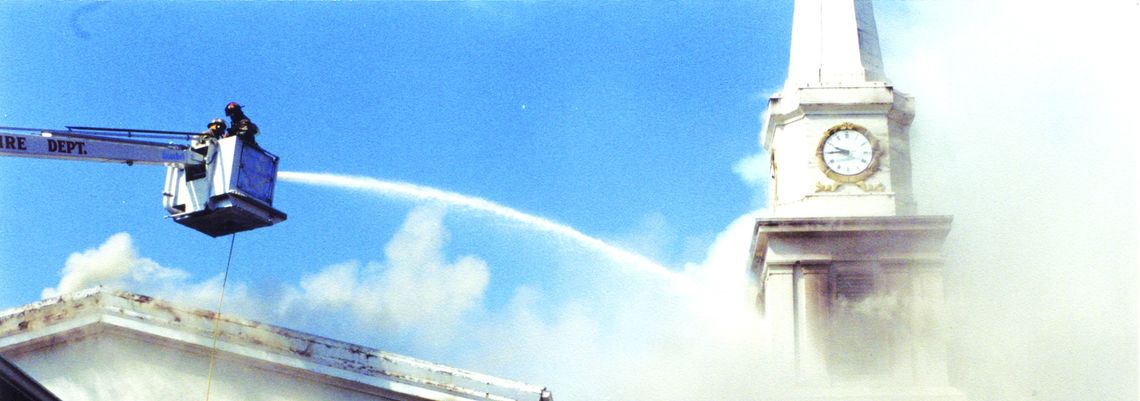
When the fire began on July 18, 2000, Klein was in his study in the church, preparing for a funeral service that was scheduled for 11 a.m. in the sanctuary. While he was working, he heard a worker who was in the church doing some paint removal running down the hall yelling for someone to get a fire hose. Klein asked what was going on and was told that there was a fire in the ceiling above the sanctuary.
Firefighters soon arrived and began to work to put the fire out. Klein recalls a group of them coming into the educational building and saying that they were “going to make our stand here and make sure it doesn’t take the rest of the building.”
Hess, who owned a business across the street from the church at the time, first saw the smoke as he was driving into town, and initially worried it was coming from his building. Upon arriving downtown, he ran into Lila Rogers, the administrative assistant at the church, who told him what was going on. Rogers, Hess and Doug Stevens, the church sexton, went through the rest of the building and closed all of the doors and windows. Hess recalls that a firefighter came in while they were doing that and asked what they were doing.
“We told him, and he said, ‘Good, then get out,” Hess said.
Once that task was done, Hess went back outside, took Rogers to his parents’ house where they could listen to what was happening on the scanner, then came back downtown. He went to a local grocery store to get water for the firefighters and the owner helped him fill carts with bottles and jugs of water.
“I went to the cash register and she said ‘What are you doing?’” Hess said. “I said I had to pay for this stuff, and she said ‘No. Your money’s no good here today.’” Hess took the carts down Main Street to the church to give out to the firefighters. A large trash can was filled with water and ice, and the owner of a fabric shop came out with some fabric that was torn into bandanas, which were dipped into the ice water and brought to the firefighters.
“It was miraculous, the way people just jumped right in,” he said.
Hess and Klein then started working to move things out of the educational building to prevent them from being damaged, getting help from people within the community to move things over to a storage area beneath the horse stables on Randolph Street.
“The community was amazing,” Klein said. “People were coming into the building and just hauling stuff out, taking it over to storage under the carriage house. People I’ve never seen in my life were taking pianos down the street.”
Among the items that needed to be moved was a desk that had belonged to Stonewall Jackson, who was a member of the church when he lived in Lexington before the Civil War. The desk was too big and heavy for Hess and Klein to move, so they went outside to find someone to help. Hess found help in a group of “kind of tough-looking characters” he saw walking down the street.
“My mouth opened – sometimes I’ll open my mouth before the brain’s engaged – and I said ‘Hey guys, we’ve got something here that’s really heavy. Could you help us with it?’” Hess said. “And they kind of looked at each other and said ‘Okay.’ They took the desk apart and carried it over to the horse stable place. Never saw the guy since.”
Fire crews worked through the day and were eventually able to put out the fire, but there was significant damage to the building. The roof of the sanctuary was gone, as was the Möller pipe organ that had been installed in the church in 1959.
“I had known that organ since it was installed, which was before I was on the job here,” McCorkle said. “It was gone, so there was not a question of can it be fixed, can it be saved.”
McCorkle was attending a hymn writing workshop in Boston on the day of the fire. He’d gone up the Sunday before and returned to Lexington the Sunday after. He watched some video from the local radio station of the fire and recalls feeling shock as he watched it.
“I was surrounded by colleagues who were totally nurturing and sympathetic, but [I had] a long drive back to think about it,” he said. He doesn’t recall exactly when he was able to get into the church and see the damage, but he remembers what he saw.
“The piano was there with stuff all over it and water all in it,” he said. “I saw that, it was still in place or maybe slightly moved, but still in the room … I’m sure I must have been told that the organ was not there. It’s almost as if the chamber where the organ is almost acted like a chimney, because there was nothing there.”
The floors, which had been replaced in a renovation just two years earlier, were damaged and needed to be replaced, as were many of the pews and the Chickering grand piano that had been recently rebuilt and restored and given to the church as a gift. The walls and the balcony were still standing, and many things stored in rooms beyond the sanctuary were able to be salvaged, including the choir robes and sheet music.
Among the things in the sanctuary that survived the fire was a banner that was hanging on the wall depicting a descending dove. It was charred, but largely undamaged, and hangs in the sanctuary to this day.
As significant as the damage to the property was, Klein was able to find relief in the fact that no one was hurt, and that the fire was an accident.
“This was different from other church fires in that nobody intentionally set this fire,” he said. “There are plenty of churches that are set on fire for some hateful reasons, and that did not happen to us. We didn’t have to work through that at all. We just had to come together and figure out how to rebuild.”
Rebuilding
With the fire out and the damage assessed, the Klein and his congregation began the work of rebuilding the sanctuary. The first step in the process was to form a Rebuilding Committee, or as Klein called it, the Point and Pivot Group.
“I knew they were going to [take] point, and I also knew they were going to have to pivot to guide the reconstruction,” he said.
In addition to Klein, the committee consisted of four other members: Pat Brady, Diane Herrick, Mick Strickler and John McNemar. Among the first jobs the committee undertook was hiring a company to clear out the sanctuary, and then hiring a contractor to oversee the reconstruction. The committee hired Train & Partners out of Charlottesville, and were so pleased with their work that when the church renovated the education building a few years later, they hired the company again.
Another question that needed to be answered was where services would be held while the work was being done. Trinity Methodist Church invited the congregation to worship with them, an extension of a practice of joint worships that had begun during the renovation of the sanctuary two years earlier. Washington and Lee University also offered University Chapel for the congregation to use as their temporary home. Ultimately, the decision was made to continue to worship at the church, in Dunlap Auditorium in the educational building.
“We decided that it made sense for us to meet in our fellowship hall and just be a congregation working through this by ourselves, in a sense,” Klein said. “We had help from everybody else, but this was a good time to worship together, and the fellowship hall was just packed. It was awesome to have it just packed.”
In addition to weekly worship services, the fellowship hall was home to weekly dinners where the Rebuilding Committee would keep the congregation updated on the progress of the reconstruction, occasionally bringing in contractors to answer questions about the work being done.
In addition to regular worship services, other things that took place in the sanctuary had to find new homes, such as the Music at Noon concerts that were occasionally held at the church. They became “Music in Exile” concerts, with different churches in the community offering spaces for the concerts to be held.
“In a community, the strength of a whole is so much greater than the sum of its parts,” McCorkle said. “The church is not a building, the church is not the steeple … The church is the people. That showed itself to be true. The concern of people was as much how to continue what the church is, as opposed to being about where [the next service] is … You make do with what you’ve got in terms of programs and outreach, so the church can continue.”
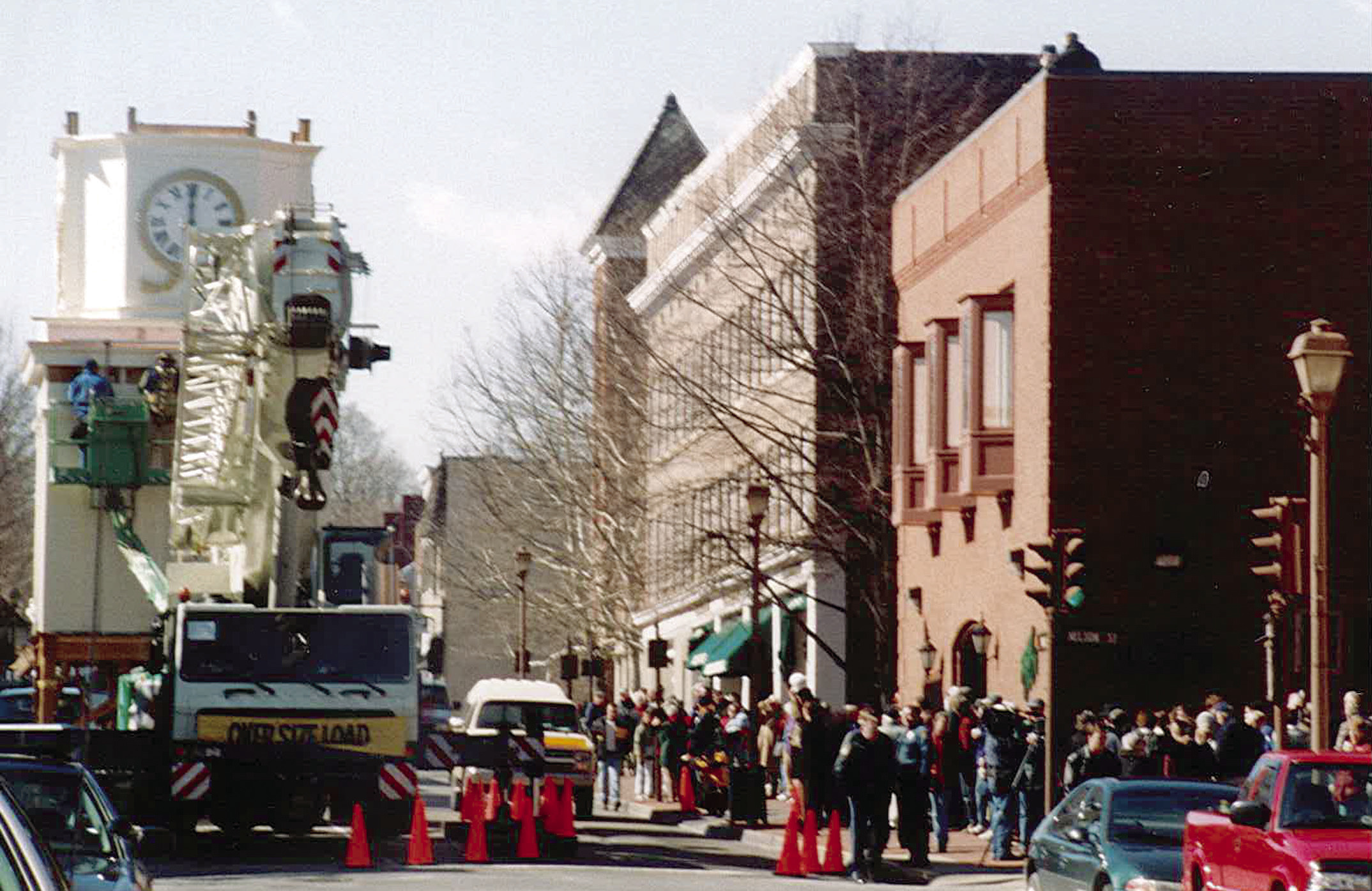
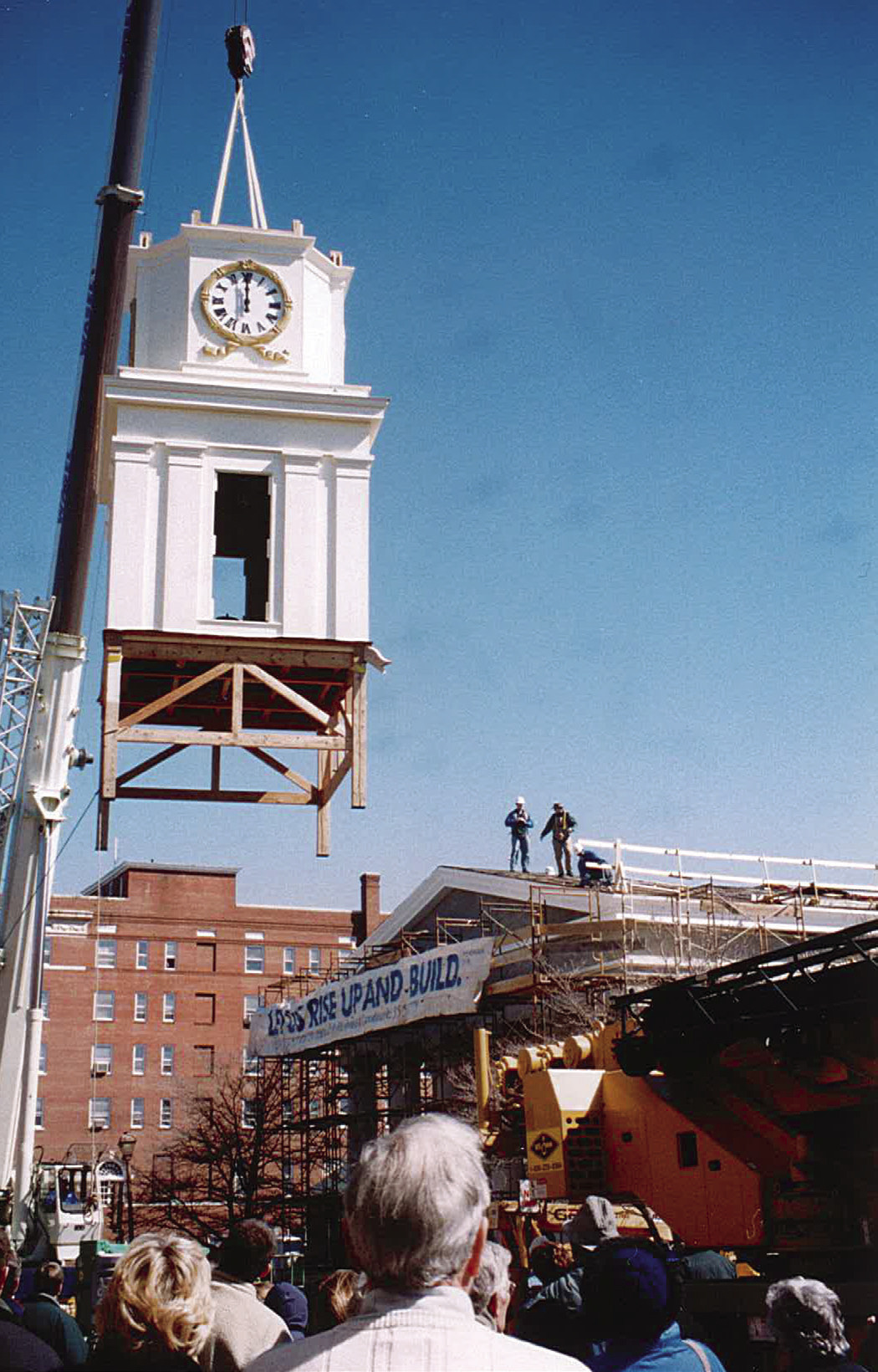
Rebuilding the sanctuary took two-and-a half years and by the end of 2002, the new sanctuary was ready to be worshipped in. The first service in the space took place on a snowy January Sunday, the first of the new year (2003). It began in Dunlap Auditorium before the congregation processed out of the building and around the block to the front of the church. Upon reaching the front of the building, Klein knocked on the door, which was opened by an usher who invited the congregation into the new sanctuary for the first time.
“It was very moving to begin in fellowship hall, march out the door, march down the street, bagpiper leading us the whole way into the sanctuary,” Klein said. “It was a great feeling.”
“It was a worship service, but you couldn’t help but look around and see what had happened,” Hess recalled. “It was very emotional. A lot of people had gotten married there and gotten baptized there, but I think everybody was pleased that it was so close and respected the old building.”
A Tale of Two Organs
There was one notable absence that first Sunday in the new sanctuary: the pipe organ. While a new one had been ordered from C.B. Fisk of Gloucester, Mass, it wouldn’t be ready for installation until 2006 due to a backlog of orders.
“The ‘90s had been a very healthy economy and all the builders were backed up,” Mc-Corkle explained. “These builders are pretty much artisan builders – they build one instrument a year.”
McCorkle was prepared to wait for the sound of an organ to ring through the sanctuary again, but as fortune would have it, it wouldn’t be three years – it would just be a few weeks.
While the church ultimately went with C.B. Fisk for its new organ, it also looked at purchasing one from Taylor & Boody, an organ building company in Staunton, which specializes in stained wood organs. In 2002, they made an organ for St. Mark’s Lutheran Church in San Francisco, which the church was unable to accept right away due to having to do some renovations and earthquake retrofitting to the building. McCorkle heard from Jim Ramsey, then the organist at Mt. Carmel Presbyterian Church in Steeles Tavern, that Taylor & Boody were looking for a place to store the organ and he’d suggested Lexington Presbyterian Church.
A contract was drawn up and McCorkle recalled that George Moody had had two conditions for storing the organ: He wanted it to go somewhere someone could play it and that it could fit. Moody knew McCorkle was up to playing it, and the organ did fit in the sanctuary – with just a few inches to spare on either side. St. Mark’s agreed to pay $37,000 of the $44,000 cost of installing the organ, an amount they’d already set aside for the storage costs. Lexington raised the money to cover the difference. Installation of the organ took a few weeks, but it wasn’t long before McCorkle was able to play it for a Sunday service.
“It was fabulous, because it was beautiful,” he said. “It was a beautiful instrument, but also, the room was beautiful because the room was new.”
The Taylor & Boody organ stayed in Lexington until October of 2006, when it was disassembled and sent to California to its permanent home. Soon after, in early November, installation began on the Fisk organ, named Opus 128. Several members of the congregation helped with unloading the parts of the organ into the sanctuary.
“This instrument has changed my life,” McCorkle said. “It is arguably my closest friend. Every moment I spend on it is filled with gratitude. [The old sanctuary] was not a bad place to have music in, to have concerts in, but [the new room] was better, and that empowered us to go forward with a decades-old music ministry in this church – predating me by a century – of musical outreach in the community. That’s what I think about every time I go in there.”
As a final coda to this tale of two organs, both Opus 128 and the Taylor & Boody organ (named Opus 37) were featured in the 2007 calendar put out by the Organ Historical Society.
“We had two of the 12, so we won,” McCorkle said. “I don’t think that’s happened before or since.”
Lessons Learned
While July 18, 2000, can be viewed as a day of tragedy for Lexington Presbyterian Church, those who watched the building burn down and then be rebuilt see it a little differently.
“It was, for the congregation of the church, a hugely important, energizing time,” McCorkle said. “It is so easy, in any organization or institution, to get comfortable, [but] times change and needs change, in churches as much as anywhere. That was huge. It strengthened the ties of the people of this congregation with and in their community.”
“It was the best horrible experience I’ve ever had,” Hess recalled. “I think we grew a lot by seeing other churches and other people in our community came to our rescue. It brought us together. It brought young people and old people in the church together and gave us a common goal to work toward. There was something for everybody to do, and a lot of educating. The committees got stronger, and everybody felt like they had some input.”
Donations to help cover costs of reconstruction came from all over, something that stuck with Klein, and over the years, whenever he heard about a church that had had a fire, he made sure some money was sent to help them rebuild.
“It was amazing to me,” Klein said. “People from Timbuktu would send a letter with a check for five dollars in it for the restoration. It was just astonishing. They’d never seen us before and they’re sending us money.”
Even local donations came from unexpected places. Hess remembers one day after the fire, when he and Rogers were at the church, a young woman came in with two young children, wanting to give her paycheck for that month to the church despite not being Presbyterian, or even someone who attended church regularly.
“Lila and I tried to [assess the situation] to see if it was a good idea, but she was pretty insistent,” he said. “That was something that would really hurt. Wealthy people in this town could give you a thousand dollars and not miss it, but somebody with a young family like that, who cared that much to give their check was pretty remarkable.”
Klein retired from Lexington Presbyterian Church in May of 2020, but the support he and the church received from within and outside of the community during that time has remained with him.
“I hope it continues,” he said. “I hope it has continued. I hope that lady was right who wrote me that letter – what God had in mind was bigger than those walls.”