Eric Wilson RHS Executive Director
A Tale of Two Georges:
Fort Necessity, July 3, 1754
Not by accident, Washington has figured prominently in the first two “Revolutionary Moments” that launched this series. General “Lighthorse Harry” Lee famously eulogized his kinsman to Congress as “first in war, first in peace, and first in the hearts of his countrymen.” But ahead of all the patriotic, triumphant excitements of July 4, it’s worth remembering that – as so often “in the course of human events” – George Washington had to learn not only how to win, but how to lose.
The third and fourth installments of this three-year series focus not only on moments when Washington “came in second” (or worse), but depended on second chances. In his 20s, he was repeatedly passed over for the promotion and British command he’d solicited through the 1750s. Later entrusted by the Founders as America’s first general, he was assigned an army that instantly disillusioned him on arrival near Boston in 1775. Uncannily, two of the signal dates in George Washington’s military career would land not on the 4th of July, but the 3rd. Twenty years apart, they jointly lens him, and the revolutionary era at large, in fuller light.
In 1754, Washington served as a 22-year-old officer in the Virginia Regiment, part of the colonial militia supplementing the professional British army. Washington led 186 men through the colony’s western frontier, sent by royal Governor Dinwiddie to halt the growing incursions of French settlers and soldiers moving into “Ohio Country” from the Great Lakes, the Mississippi, and French Louisiana.
On May 28, Washington faced the first combat of his career, spanning 30 fabled years of triumphs and tragic defeats. Near the Forks of the Ohio, in an unprovoked, confused ambush of French forces, 40 militiamen and a dozen Mingo warriors killed 10 French soldiers, capturing 21 at the Battle of Jumonville Glen. With this fateful decision, Washington is now conventionally said to have unintentionally precipitated the global conflict now known as the French and Indian War.
As the smoke cleared, Lt. Col. Washington quickly called a retreat, harried by 600 French and 100 Indian allies to a defensive enclave in Great Meadows. 60 miles south of Pittsburgh, Fort Necessity was tellingly named, and hastily constructed within a week. On a rainy July 3, the outnumbered British would be attacked from the woods (along the very road they’d constructed) and quickly beaten into surrender. Later that day, Washington signed the formal surrender, which included an admission that he’d “assassinated” a French officer; not surprisingly, Washington later claimed a mis-translation of that crucial diplomatic word.
The next year, at the Battle of Monongahela, he was shot through the coat five times, while surviving unscathed. He was again nearly killed in 1758, running in front of his own soldiers’ guns to stop their friendly fire, before the crucial capture of Fort Duquesne. Retiring soon afterward, nearly two decades would pass before Washington again took up arms: this time, to fight against the very British forces that he’d eagerly served.
The local repercussions of the French and Indian War extend to the deadly Rockbridge raids at Kerrs Creek in 1759 and 1763. It prompted a new (if quickly failed) continental policy through which the British sought to limit their own settlement west of the 1763 “Proclamation Line” along the western Appalachian range. And the shifting international and intra-colonial balance of power soon drove another globally contested “War for Independence,” and the emergence of the United States, commemorated here and ahead through VA250.
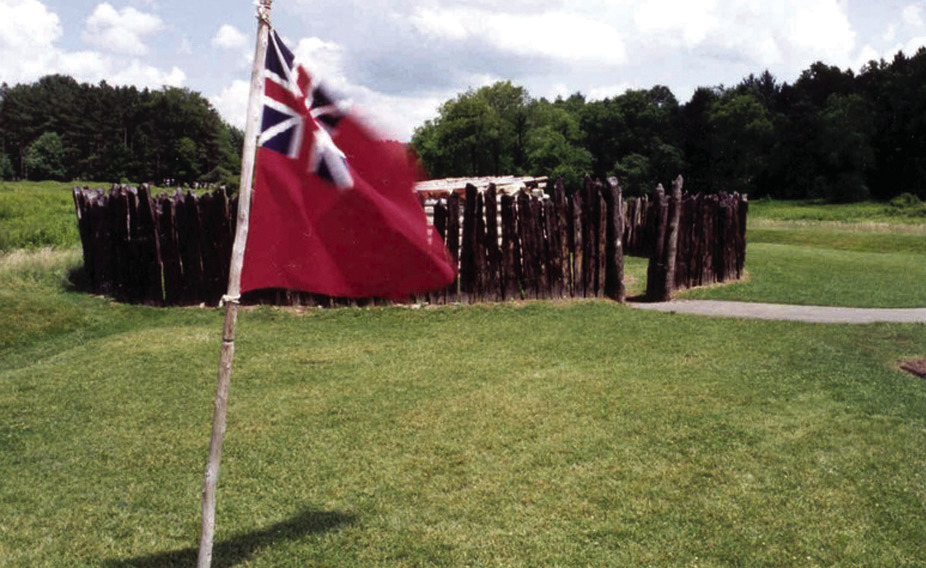
Fort Necessity (photo courtesy of National Park Service)