Go to main contentsGo to main menu
Saturday, December 13, 2025 at 8:48 AM

Remembering G. Otis Mead III

Remembering G. Otis Mead III
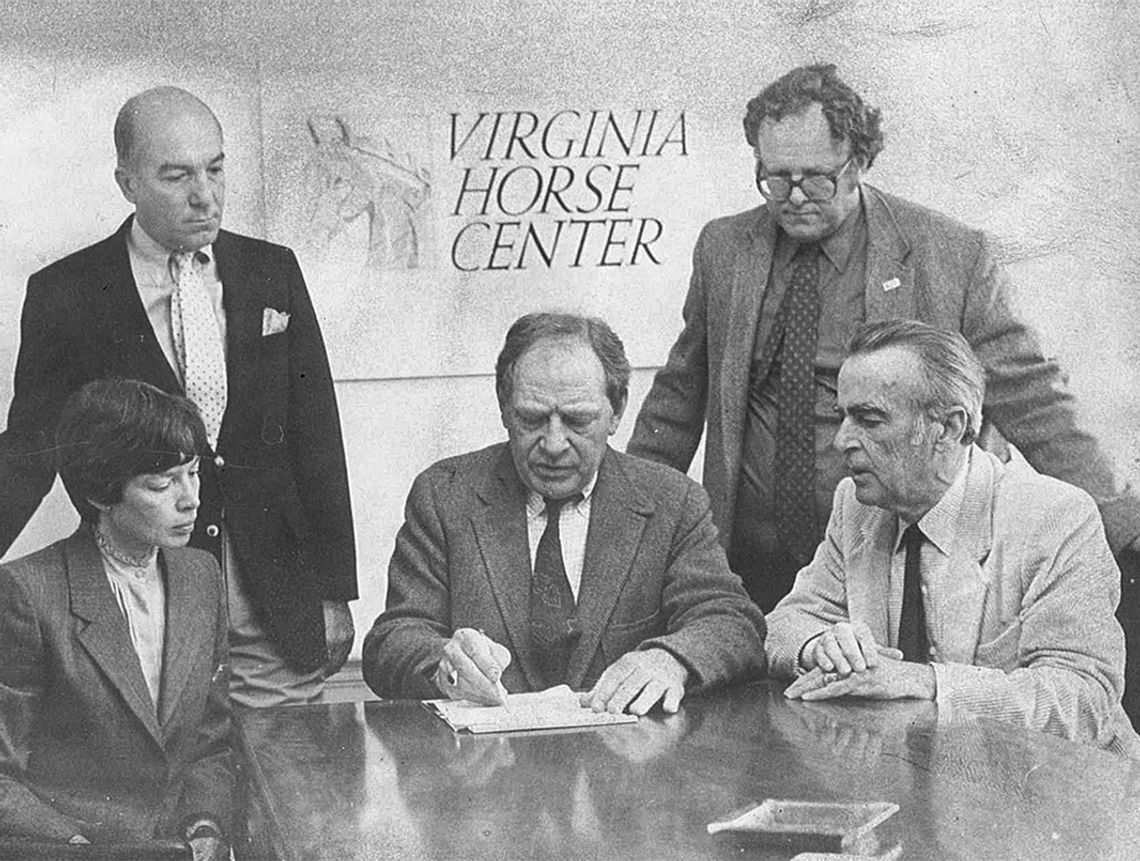
CHAIRING the local steering committee for the Virginia Horse Center in 1985 was (center, seated) G. Otis Mead III. With him are (seated) Louise Dooley and Robert Nelson. Behind them are H.E. “Buddy” Derrick III (left) and Tom Bradshaw.

Editorial

The Rockbridge area community has lost one of its most stalwart advocates with the passing of G. Otis Mead III this past Saturday, June 21. A gregarious story-teller, Realtor, developer and civic-minded individual, Mead is best remembered for leading the efforts in the mid-1980s to bring the Virginia Horse Center to Rockbridge County.

It was an 11th-hour bid. Half-a-dozen other localities were already leading well-heeled campaigns to land the much-coveted state equine facility when a group of community leaders met at then-Southern Seminary College in February 1984 to consider entering the fray. Mead was drafted to head the effort as chairman of the Rockbridge Area Committee for the Virginia Equine Center.

The local effort began just a few months before a state subcommittee was scheduled to make its site selection for the state equine facility. A whirlwind campaign ensued, with Mead leading the way. A beautiful 361-acre site was selected and secured near the Interstates 64-81 interchange, north of Lexington, and the persuasive powers of Mead went into overdrive.

He persuaded the community and all three local jurisdictions to get behind the effort. He and other local leaders then convinced a state subcommittee to select the site and General Assembly members to support the decision. In little more than a year after the campaign first began, Gov. Charles Robb came to Cameron Hall at Virginia Military Institute to sign legislation making the Rockbridge County site the future home of the Virginia Horse Center.

Mead stayed involved as a founder and leader of the horse center, serving as president of the Virginia Horse Center Foundation for a number of years as well as serving on the Virginia Equine Center Foundation, the horse center’s public board. He was very active in the civic affairs of the Rockbridge community for decades. He served on the Lexington School Board and was on the board of then-Stonewall Jackson Hospital. He was a president of the Lexington- Rockbridge Chamber of Commerce. He was awarded membership in the ODK national honorary society.

Mead was the developer behind the Birdfield subdivision, a well-planned development of dozens of homes that sprang up in the 1970s off of Thornhill Road just outside Lexington. He helped restore the interior of the historic Jacob Ruff House, former headquarters for a hat factory in downtown Lexington that became the home of Mead’s real estate offices, also in the 1970s.

Steve Shank, who became CEO of the horse center in March of last year, said he’d gotten to know Mead well in his short time here and learned from him how the horse center came into being. “At one of our first of many dinners Otis explained the Virginia Horse Center in his own words and told of the ‘romantic history’ that the facility has cultivated in so many people over the last 40 plus years. Whether it was telling stories while riding on the golf cart or saying hello as Otis drove the parking lots and counted how many states were represented at each different equestrian event, he brought a singular elegance that I have never experienced.”

Mead, Shank said, told him that “it wasn’t by chance or luck that brought the horse center to this part of Virginia. It was a lot of hard work, visionary volunteers and a looming deadline. That core group of volunteers, led by Otis, made it possible. In a mere 123 days, Otis and his committee put together the land deal, raised $1.5 million in pledges and prepared a presentation for the state site selection committee.”

When, on March 23, 1985 the governor signed a photo enlargement of the horse center bill into law, master of ceremonies H.E. “Buddy” Derrick Jr., declared, “That man [Mead] had a dream, and he made sure all of us shared that dream. He made us forget political boundaries.”

Shank asked, “How did a small, rural community successfully compete for and attain such a prestigious and economically attractive facility as the Virginia Horse Center?”

Mead provided the answer to that question: “We got the horse center because we needed it, we wanted it and we decided we were going to get it. We used every fiber of talent and enthusiasm in this community. And we overprepared for every step of the way.”


Share
Rate

Subscribe to the N-G Now Newsletter

* indicates required

Intuit Mailchimp

Lexington News Gazette