A mixed air of ceremony, history, and urgent reflection filled the Hillel House at Washington and Lee University last Wednesday, as members of the legal and military communities gathered with law students to celebrate National Law Day.
Hosted by W&L Law, organized by the school’s chapter of the American Constitution Society and co-sponsored by 50 Ways Rockbridge, the event featured a keynote address from constitutional law scholar Dr. Jill Fraley, followed by a ceremonial renewal of oaths of office for attorneys and veterans from multiple states and branches of service.
Fraley’s remarks, delivered in the tone of both teacher and historian, emphasized that “a constitutional democracy is not self-sustaining” and warned that the coming years may test the commitments of civil servants and military members in ways not seen for generations.
A professor at W&L and a twotime Fulbright Scholar, Fraley anchored her talk in historical examples of executive defiance, judicial overreach, and the fragility of American legal norms — from President Andrew Jackson’s disregard of court orders in the 1830s, to a 1935 standoff in South Carolina, where Gov. Olin Johnston deployed National Guard troops and machine guns against his own Highway Commission.
Her central point: legal structures endure only when individuals — often far from the spotlight — refuse to violate them.
“What I think about [in the South Carolina case],” Fraley said, “is the agency members who had to walk into a room with a machine gun outside the door. [Johnston] forced them to live the means of their oaths.
“Our Constitution is not selfexecuting,” she added. “It requires vigilance, commitment, and courage — not just from institutions, but from individuals.”
One of the most urgent responsibilities of those individuals, she argued, is to choose compassion over contempt.
“We may have shared disagreements. They may be very serious disagreements, over moral values, over questions of equality and justice,” Fraley said. “But that disagreement, however serious, however passionate, however clear to our conscience, is not dangerous to democracy. Contempt for our fellow citizens is dangerous to democracy.”
To help illuminate the present moment, Fraley turned to the past. She cited Franklin D. Roosevelt’s failed 1937 attempt to pack the Supreme Court — a move that, while controversial, remained within constitutional bounds. “It was forged within the constitutional boundaries and not outside of them,” she said.
She then pointed to even lesser-known precedents: “There are closer parallels if we look to conflicts between state governors and their own state supreme courts,” she said. “My home state of Kentucky, for example, once had such a conflict between the executive and the judiciary that the Kentucky Supreme Court was abolished for a period of time.”
Fraley also expressed deep respect for the commitments of the U.S. military. “Their willingness to defend our constitutional order, often at the greatest personal cost, is an act of profound courage,” she said. “It is also an act of trust — trust in all of the rest of us. Trust in the ideals. Trust that we will live up to the enduring principles of our democracy.”
She closed her address with a stark reminder: “Constitutional government is not sustained by words alone.”
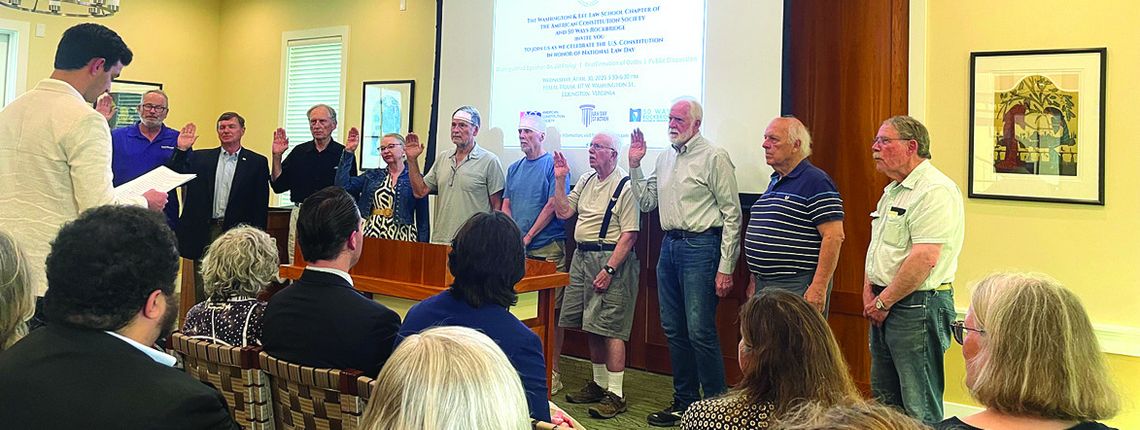
The event’s core ceremony followed her remarks. Lawyers in attendance stood and recited oaths of office from Virginia, Kentucky, New York, Georgia, and Arizona, reaffirming their commitments to uphold the Constitution and practice law ethically. Kentucky’s oath included its famously quirky antidueling clause, which Fraley noted remains not for utility, but as a symbolic statement that “the rule of law should always trump violence.”
Veterans were also invited to retake their military oaths, which include a dual pledge to the Constitution and to follow the orders of the president — a duality that sparked conversation during the Q&A that followed.
Before the Q&A, there was a brief address by third-year law student Gabby Roberts, president of W&L’s American Constitution Society chapter, who will clerk next year for the Stafford County Circuit Court. She emphasized the need to keep justice accessible and to center marginalized voices. “We are not in a position to be complicit,” she said. “We have the duty and the immense privilege to wield the law for positive change.”
The audience — a mix of students, attorneys, judges, veterans, and community members — applauded warmly, then engaged Fraley in a wide-ranging Q&A that touched on Supreme Court ethics, political polarization, and the erosion of institutional trust.
On the question of dual military oaths, Fraley stressed the importance of sequence: “If there is any conflict between the Constitution and the orders of the president,” she said, “your duty is first to the Constitution.”
When asked what citizens should do if the president appears to ignore court orders, Fraley again pointed to the role of civil servants.
“These cases will come down to the courage and commitment of individuals in smaller positions,” she said. “Their willingness to say no to an illegal order is what sustains our institutions.”
She offered a hopeful historical trend: “The American people have not been kind to someone who was not kind to its institutions,” she said. Citing Roosevelt’s failed court-packing plan, she noted, “Many of the senators who supported it lost re-election. Even though people supported the New Deal, they didn’t want to destabilize the Court. So you see that pattern over and over — that Americans do care about our institutions.”
The challenge, she argued, is clarity: “We have to make sure Americans understand what’s being wrapped up in the language of procedure … so that they actually understand when something is an attack on their institutions.”
She returned, once again, to the danger of contempt.
“There are studies about divorce that show the best predictor is contempt,” Fraley said. “It’s one thing to lovingly roll your eyes. It’s another to truly hold someone in contempt. And I see a lot of contempt in American politics right now. That is very scary. That is a threat to democracy. Even though we have serious disagreements about moral issues, those issues are not, in the end, worth losing our democracy for.”
She ended on a note both solemn and hopeful: “It is a profound and often overlooked truth,” Fraley said, “that there is joy in commitment — in knowing that your life is tied to something larger than yourself.”