Radar Leads To Discoveries At Cemetery
A local historic cemetery, the stories of its inhabitants obscured by time, continued its path to restoration last weekend.
Volunteers at the McKee/Big Spring Cemetery began installing 106 stainless steel markers on Sunday, permanently identifying each gravesite at the burial ground near Kerrs Creek.
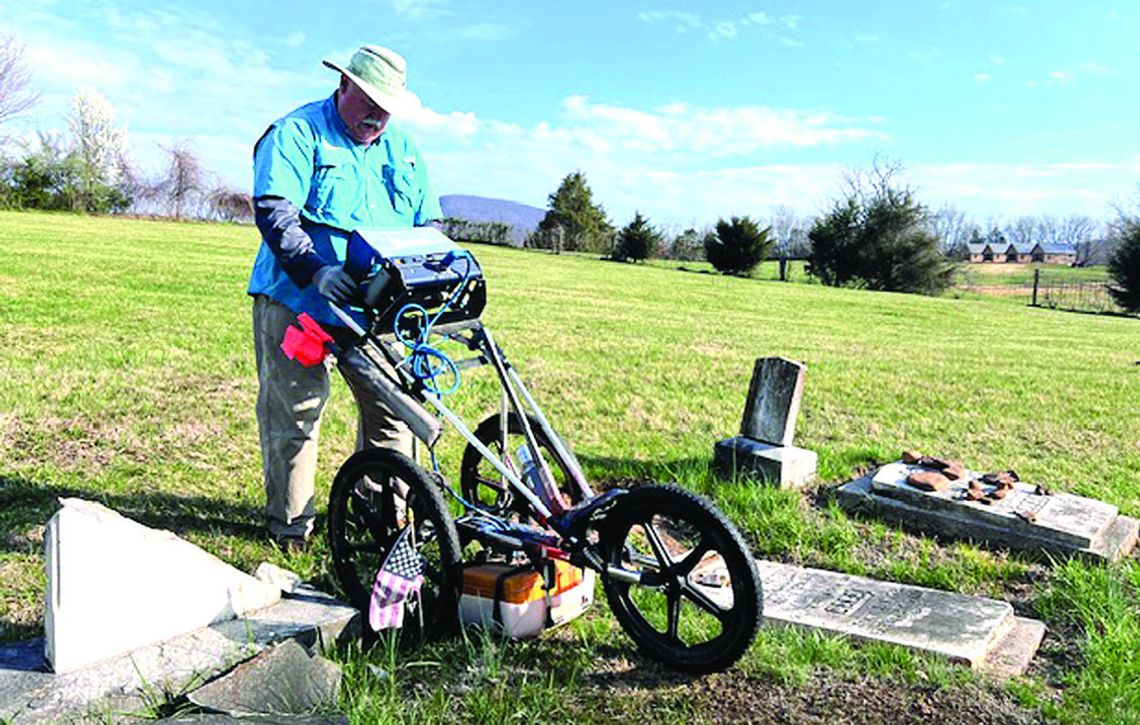
The markers were placed after extensive surveying using drone photography and ground-penetrating radar (GPR) revealed far more burials than previously documented, according to Pauline McKee, chair of the McKee/ Big Spring Cemetery Association.
“It’s been fascinating,” McKee said in an interview. “You keep going deeper, and you keep finding more things. It’s been an interesting historical project.”
For years, the cemetery had fallen into disrepair, with most graves unmarked or hidden beneath layers of sod. Only 23 engraved headstones remained visible. Many of those buried there were early settlers of the region, including victims of the Kerrs Creek raids in 1759 and 1763 — attacks by Shawnee warriors during a period of frontier conflict. Much of the history surrounding the cemetery had been obscured or lost over generations: “The stories are all second-hand, or even third-hand,” said McKee.
The current restoration project formally began in 2021, when a group of volunteers —including descendants of those buried at the site — came together for the first time. “Before Covid, many different people had an interest, but they hadn’t connected with each other,” said McKee. “After Covid, it came to fruition.” In 2022, Washington and Lee University’s geology department conducted a preliminary study using drone thermal imaging to locate buried stones in the first two rows of the cemetery. Shortly afterward, the nonprofit McKee/Big Spring Cemetery Association was formally created, and then ownership of the land was officially transferred from New Monmouth Presbyterian Church to Big Spring Farm, and its head of farming operations, Buddy Powers.
“Buddy was very enthusiastic,” said McKee. “It bothered him that [the cemetery] was just sitting there and people would say, ‘Don’t touch it.’ Since then, he has enthusiastically supported and helped us. He wanted to do the work pro bono, and it’s very easy to work with him and his staff.”
In 2024, the association launched a GoFundMe campaign that raised over $6,200 to fund full ground-penetrating radar (GPR) work. The survey revealed 106 burials — far exceeding the earlier estimate of 63 graves. “We found where the people who were killed in the Kerrs Creek massacres are buried,” McKee said. “They’re there [in little clusters]. They’re not in any kind of neat rows.”
The survey was conducted on March 29 by Len Strozier, owner and operator of Omega Mapping Services, based in Fortson, Ga. Strozier is a Baptist minister who has been working with GPR technology for over 20 years, specializing in cemetery surveys across the country.
His equipment and expertise allow him not only to locate graves, but also to determine whether a body was buried in a casket or shroud, and whether the remains belong to an adult or child. Many of the newly discovered graves had no headstones, or were marked only with small fieldstones.
“We just stood there with Len and looked,” McKee said. “He said, ‘I think I hit the mother lode.’” Strozier’s work was key to confirming the presence of more than 100 burials — many previously undocumented — and provided the GPS coordinates used to place permanent stainless steel markers at each site.
“We’ll permanently be able to find those unmarked graves now,” McKee said. “And a lawnmower can go right over them.” -With this milestone reached, the project is moving into a new phase: the careful restoration of existing headstones. McKee and the board recently interviewed three professional stone restoration organizations, and expect to choose one at their annual meeting in June.
“We’ve learned a lot about what we were doing wrong,” McKee said. “The danger is, there are a lot of quick-fix workshops, but true conservation is an art and a science. We want these repairs to last the next 75 to 100 years.”
McKee emphasized that the restoration isn’t just about fixing stones — it’s about doing it right for future generations. “I don’t want a generation looking back and going, ‘What the heck did those people do?’” she said. “We want this cemetery to stand for another hundred years — and we’re building the foundation now.”
In addition to the physical restoration, the association continues working to locate and involve descendants of those buried at the cemetery, what McKee calls “a parallel process” that is in constant motion. She has spent years trying to find families across the country.
“Social media has changed everything,” she said. “We’re intentionally tracking down as many descendants as we can, so they know what’s happening with their ancestors’ graves. It’s their stone, not ours.”
Some descendants have already become deeply involved, traveling from as far away as California to assist with volunteer days. Donations have also come in from across the country. “All the little snowballs met,” McKee said. “They became a big one. They all came rolling down that hill.”
Looking ahead, the cemetery association plans to submit a grant application to the Historic Lexington Foundation to help fund the stone restoration work. They are also preparing for a major ceremony next June in partnership with the Daughters of the American Revolution to honor the cemetery’s Revolutionary War-era burials.
Community members interested in helping can contribute through the McKee/Big Spring Cemetery Association’s Go-FundMe campaign at https:// gofund.me/0ec86318, or by contacting McKee directly to volunteer time, materials, or lodging for restoration crews. She can be reached at Pauline McKee, c/o McKee/Big Springs Cemetery Association, 1837 Back Creek Court, Asheboro, NC 27205.
“It’s a spectacular setting to be buried,” McKee said. “My family is from here, but I came in kind of to take up the big picture view, and look at all the threads that are coming together. This project is about preserving the past, but it’s also about building a future.”
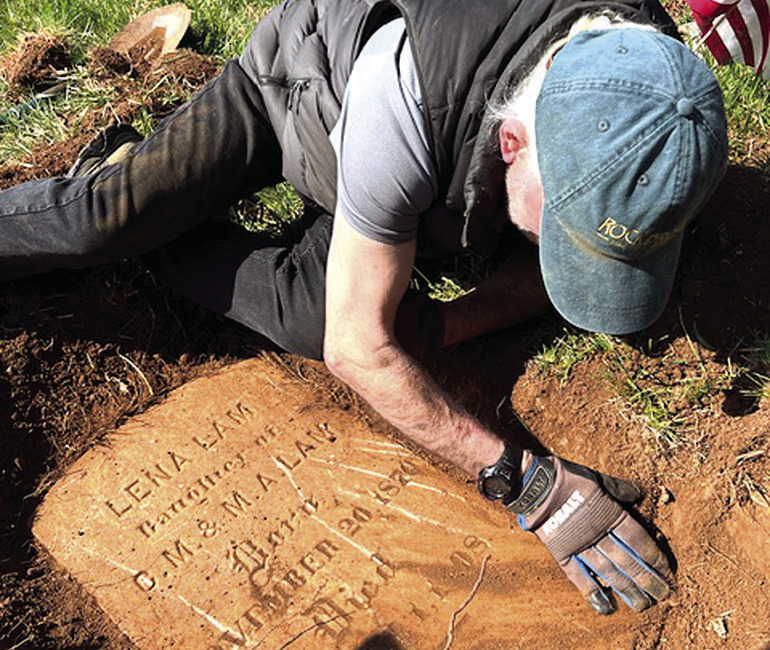
MARK CUNNINGHAM of Rockbridge Baths, who has early Kerrs Creek relatives buried in the cemetery, some victims of the Indian raids of 1759 and 1763, excavates one of the 23 tombstones found at the site last month. (Sarah Clayton photo)
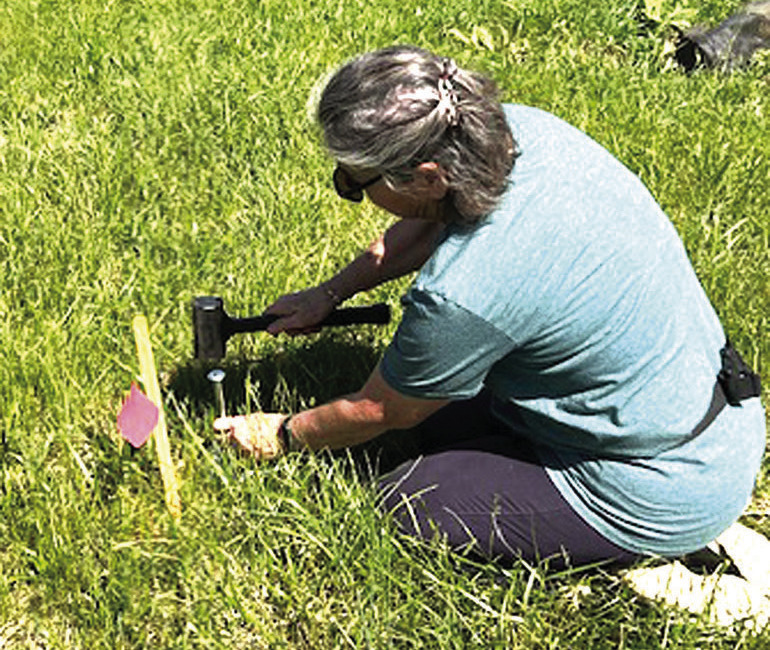
THIS PAST SUNDAY, Marydith Gilbert Dunning places a stainless steel marker on a location determined by groundpenetrating radar to have been a gravesite. (photo courtesy of Pauline McKee)
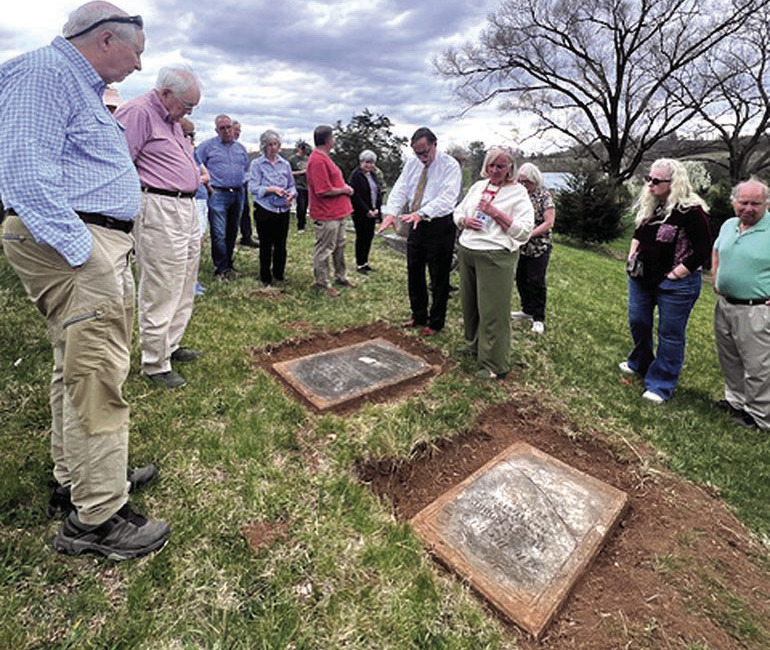
PAULINE McKEE (center) gives a tour of the cemetery to those who attended the Rockbridge Historical Society’s program on the 18th century Indian raids on Kerrs Creek held at New Monmouth Presbyterian Church last month. (Sarah Clayton photo)
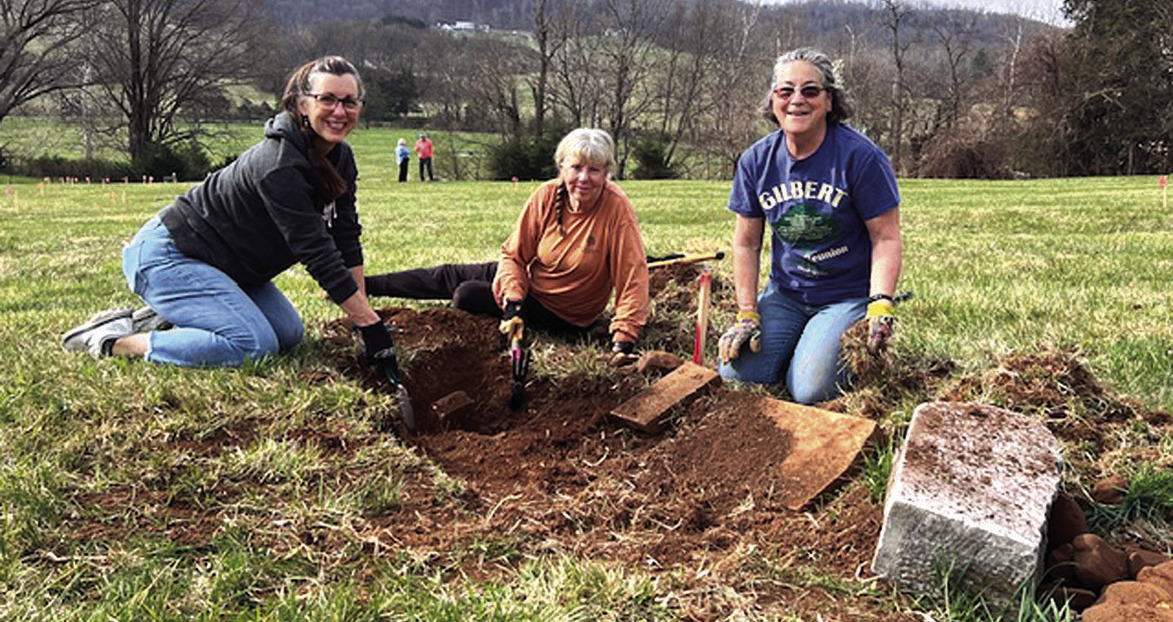
NANCY LAIRD NORTH (left) came from California last month to help excavate tombstones at the McKee/BigSpring Cemetery as she is related to three of the families buried in the cemetery. With her are cemetery association members Cathy Campbell (center) and Marydith Gilbert Dunning who also has ancestors buried in the graveyard. (Sarah Clayton photo)