Rockbridge -

This feature is written by Eric Wilson, executive director of the Rockbridge Historical Society, and co-chair of the Rockbridge-VA250 American Revolutions committee.
The formal name – a tongue-twister, which doesn’t yet even register in spellcheck – is semiquincentennial (that’s half-500th, if the mental math helps). The clearest cue – its own long mouthful – would be “250th Anniversary of the American Revolution” (if somewhat reductive in its own singular signaling). The sleek-but-still sweeping cue you’ll be seeing frequently in the years to come – VA250, or Rockbridge-VA250: American Revolutions – registers our local complement. It also affirms connections across the commonwealth that bridge the past, present future: not just a moment in time, but continued stretches of remembrance, and reflection.
For the past three years, I’ve been working with local, state, and national partners to organize and plan a range of different community engagements to commemorate this era, its ideals, and its limits through a range of experiences, with and beyond historically grounded educational efforts. Our national committee has come to more inclusively call this “A Revolutionary Decade,” or “A Revolution of Ideas,” to frame that diverse and often disjointed process to establish new and lasting political and cultural forms and legacies.
But the question of what to commemorate, or what to celebrate, prompts its own important considerations, no less than when and how. This is particularly important when thinking about local historical contexts, as well as more authentic “community narratives” that signal values and distinctive assets today, not just the 1770s – and why they may still, or should mat ter.
This weekend, for instance, brings a globally recognized day in Massachusetts, the 250th anniversary of the Battles of Lexington and Concord on April 19, 1775, regionally observed each year as Patriot’s Day. In addition to recalling “the shot heard round the world,” Saturday’s hallmark date serves as a fitting 2025 “launch date” for communities and organizations across the country to target Independence Day 2026, when patriotic spirits and public gatherings will be in full, varied display. Replica Liberty Bells, quill pens, and 13-circle-starred flags will duly wave on July 4, 2026, here and across the country.
Getting to Lexington
Historically, here in Lexington, Virginia, that inaugural event holds unique charge, given our own purposefully chosen namesake. As a growing settlement in the Shenandoah Valley, the town was officially formed in 1778, three years after that already iconic battle. That strategic, wartime measure provided a legal, administrative, and commercial center for the state’s frontier, still several years ahead of becoming a proper nation.
Geographically, Lexington’s position at the crossroads of the Great Wagon Road and the North River placed it conveniently in the heart of new Rockbridge borders that were jointly carved from the lower half of Augusta and the top half of Botetourt counties. Named not for a British Lord (as those “precedent parents” were), “Rockbridge” simultaneously took its cue from a natural formation, Natural Bridge, which had not incidentally purchased four years earlier on July 5, 1774, by Thomas Jefferson. The young lawyer and budding politician may have had a thumb on the naming committee, as soon-to-be wartime governor from 1779 to 1781. But the nominal, symbolic designation seems apt for its association with the author of core principles of natural law, who played a signal role in Philadelphia when drafting the words of many others into a shared and still familiar chorus: declaring the aspirational ideals – often just fully beyond us, but collectively aspirational – of “life, liberty, and the pursuit of happiness.”
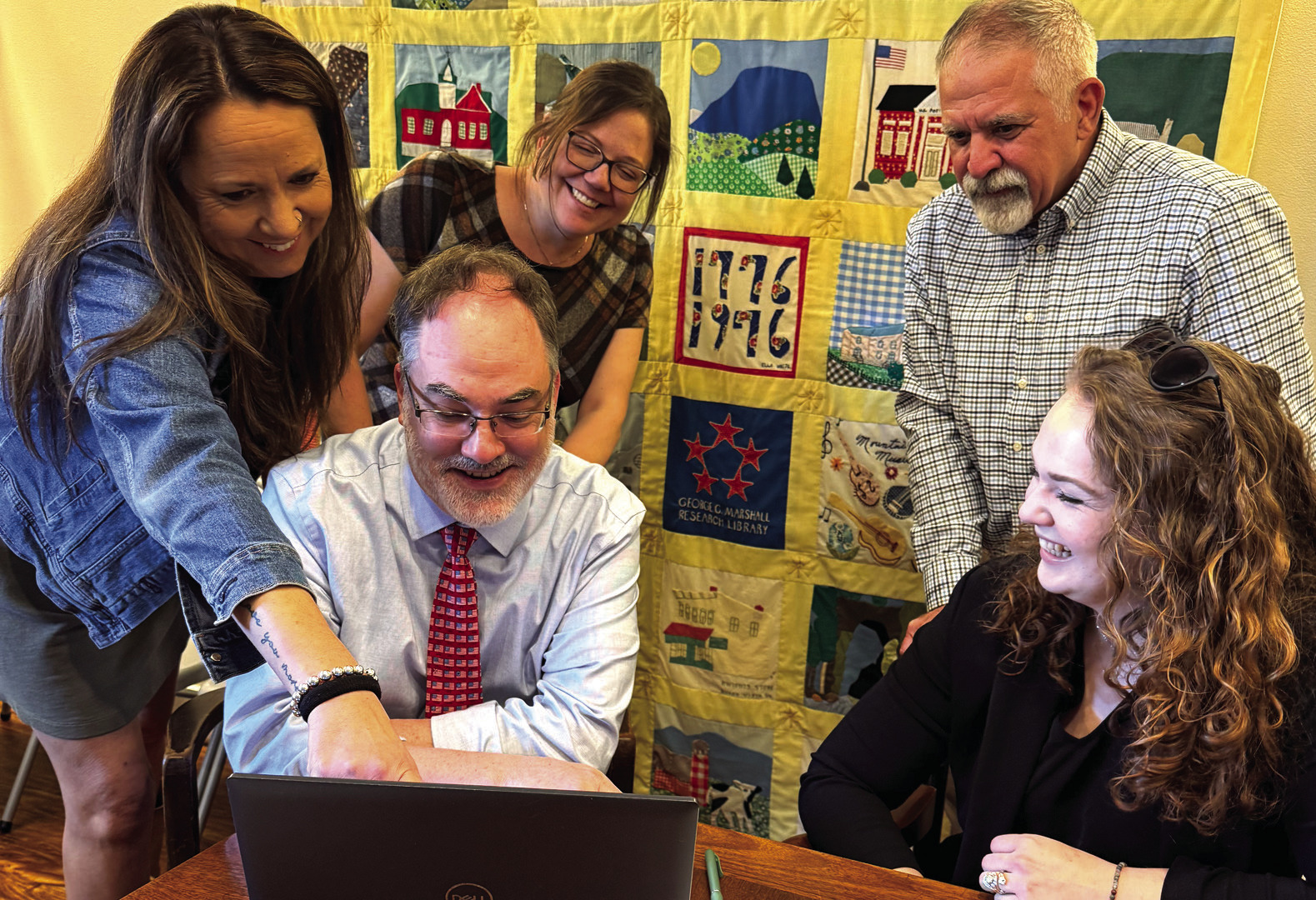
THE ROCKBRIDGE-VA250 steering committee met last week to advance local planning for commemorative community events. Pictured are (from left) Co-Chairs Sheryl Wagner and Eric Wilson; with Jennifer Bell, Spencer Suter, and Kristina Ramsey representing Lexington, Rockbridge and Buena Vista, respectively. (photo courtesy of Lexington Rockbridge Tourism)
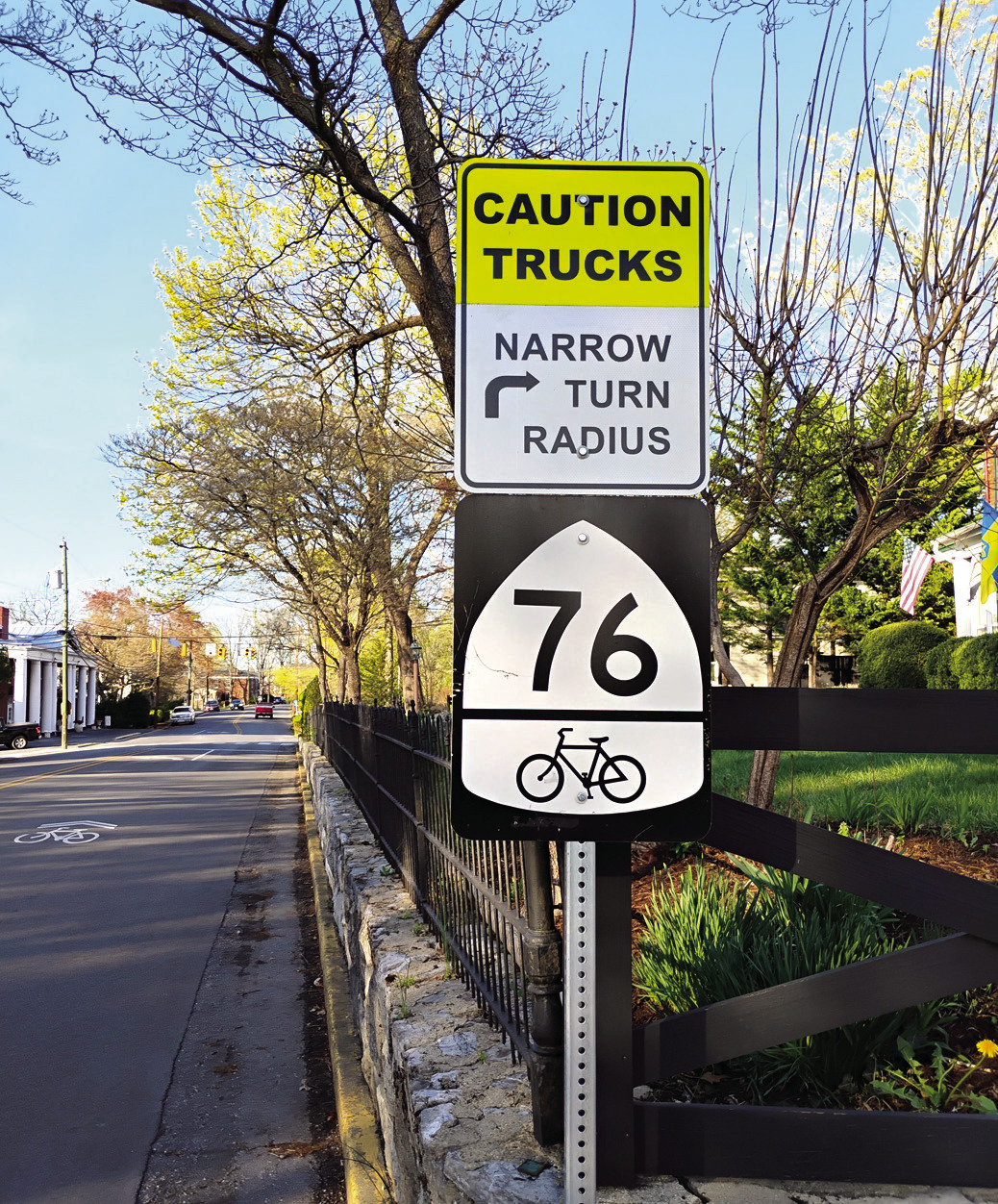
FIFTY miles of national Route 76 – established in the bicentennial year – run through Rockbridge County: from Natural Bridge and Plank Road, through Main Street, Lexington, up South River to Vesuvius before climbing to the Blue Ridge Parkway. (photo by Eric Wilson)
Our “Common Cause” Since the VA250 Commission was established in 2020, our annual conferences in Colonial Williamsburg have been titled “A Common Cause,” with 40 states and over 400 local committees attending. These intensive meetings have provided a collective opportunity to articulate and settle on shared vocabularies and priorities, sustainable organizational and civic networks, as well as more specific collaborative planning and projects within and between our distinct contexts and goals.
In 2020, Gov. Ralph Northam appointed Terry Austin (this area’s 37th District delegate to the General Assembly) as founding chair of the Virginia American Revolution 250 Commission. On March 25, Austin articulated the Commission’s goals here at the chamber of commerce’s State of the Community Breakfast. In describing the initiative’s purpose, Austin affirmed that “the 250th anniversary of American Independence is more than a commemoration. It is an opportunity for communities across the commonwealth and the United States to come together in support of our nation’s founding, our long and storied history, and the future opportunities that lie ahead. The VA250 Commission’s slogan is ‘America. Made in Virginia.’ And this anniversary serves as a powerful reminder of Virginia’s pivotal role in shaping our nation’s past and future.”
Locally, Rockbridge-VA250 is co-chaired by Sheryl Wagner, executive director of Lexington & Rockbridge Area Tourism, and myself, the executive director of the Rockbridge Historical Society, as both of our organizations’ broader missions provide representative umbrellas to this area’s distinct jurisdictions.
Our steering committee includes three governmental staff members: Jennifer Bell, finance director for Lexington; Kristina Ramsey, director of economic development for Buena Vista; and Spencer Suter, Rockbridge County administrator. We met together last week to identify members for a broader advisory committee that will help recruit other community members and organizations to help to plan events in the coming years.
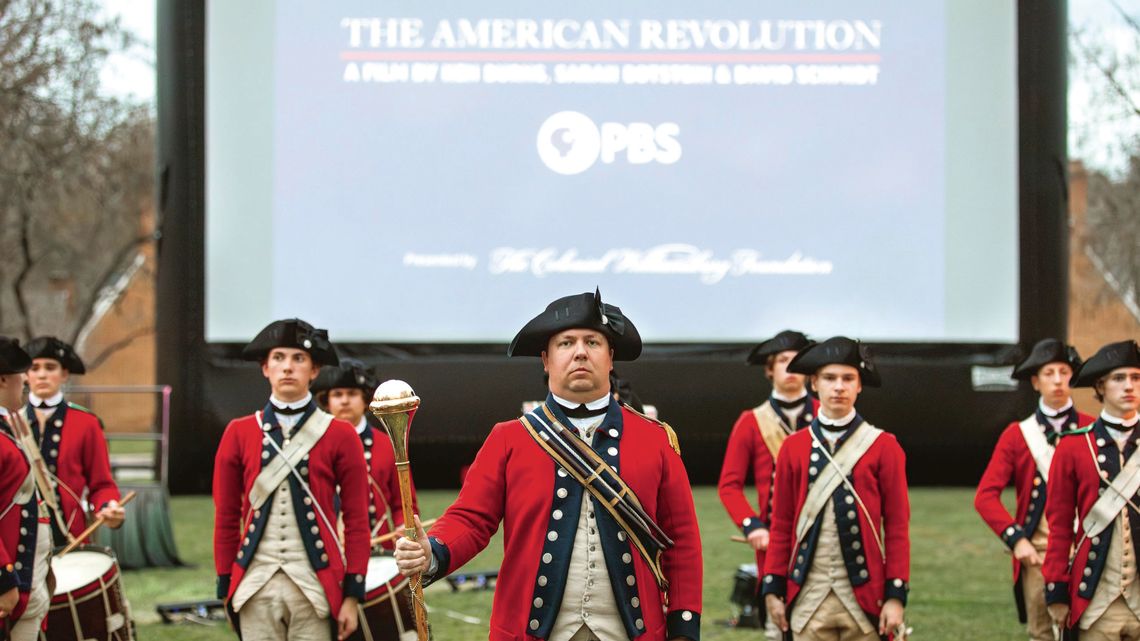
On the same day that Delegate Austin was advocating for the importance of VA250 to a range of local affairs, Colonial Williamsburg staged a special event for the VA250 conference. Over 4,000 people gathered on the Governor’s Palace Green for the public premiere of “The American Revolution,” the forthcoming documentary co-directed by Ken Burns, often heralded as our generation’s greatest “American Storyteller.”
In the months following its release this November, RHS plans to serially screen selected episodes from this sixpart, 12-hour series, along with other feature films and children’s movies that provide portals into those revolutionary efforts and ideals, and how they extended and evolved through the Civil War, and Civil Rights movement, and today.
In Burns’ newest epic chronicle, the grounding, purposeful chords of a “Common Cause” are harmonized in varied keys through the voices of over 200 first-person narrators, combining those of celebrated actors, as well as everyday American, African American, and Native American descendants. Indeed, the ethnic and cultural diversity of colonial and contemporary experience, along with those of women and other historically underrepresented groups, has been a hallmark of this these commemorative and civic visions from the start.
Before the outdoor screening, Burns noted, “We feel history is the greatest teacher. Mark Twain is supposed to have said that ‘history does not repeat itself — which of course it doesn’t — but it rhymes.’ So we are always interested in the way, after we finish a film, that we lift our heads up from our desk ... and then we see and are thrilled by the ways in which it rhymes.”
Events To Come
Locally, plans are already building toward communitywide events that herald July 4, 2026, and Jan. 24, 1778, as nationally shared and locally distinctive dates. The former acknowledges the Declaration of Independence by the Continental Congress in Philadelphia, while the latter heralds the legal organization of Rockbridge and Lexington by the Virginia General Assembly.
In gradual ramp-up – mindful of the need to “save some powder” for an engaging, sustainable run of events, spanning five years – a prologue of sorts kicked off local efforts at Natural Bridge on July 5, 2024, the 250th anniversary of its purchase by Thomas Jefferson. L ast m onth, a nother teaser of things to come was brought to another corner of the county, with RHS’ program about the deadly raids at Kerrs Creek illuminating new contexts of this area’s growing frontier, and local repercussions of the French, Indian, and British Wars, from the 1750s through 1770s.
Continuing that march, another RHS program this fall will center on Dunmore’s War. Also fought on the Virginia and Pennsylvania frontiers in 1774, that lesserknown conflict is sometimes called the “last colonial war.” Importantly for Rockbridge-VA250, that royal campaign involved a number of local men in the Virginia militia, before many of them, and their descendants, would turn to fight against Great Britain to establish a new American republic, later that same decade.
In complement to that pair of programs, you can explore to the run-up and thickets of these “Revolutions of Ideas, and Arms” alike, through a free exhibit at the RHS Museum in October, “Give Me Liberty: Virginia and the Forging of Nation,” loaned by the Virginia Museum of History Culture, in another local and state alliance.
In even wider and interactive reach, a program bridging history and recreation will look back to 1976, as the “Bikecentennial” rode across the continent, and right through Rockbridge along 50 miles of Route 76, which was established to more permanently mark those years in both the 20th and 18th centuries. (In a related vein, and older wheels, News-Gazette editor Darryl Woodson noted the bicentennial arrival here, that same year, of covered wagons that parked and circled-up on his family farm at Fancy Hill).
Yet another set of wheels beckons in the coming years, with the VA250’s celebrated, cutting-edge “Mobile Museum” providing another accessible portal to the past, for all ages. With the Virginia Department of Education, VA250 has also set a goal to have this ‘history-mobile’ visit all 341 middle schools across the commonwealth, because the state’s seventh grade civics curriculum provides a vital touchstone lasting well past the commemorative calls of colonial fife, drum, and musket.
In additional to these educationally grounded opportunities – for both local schools and the general public – Rockbridge-VA250 is planning to organize a lively series of events and experiences that will involve live music, and the performing and visual a rts. W ith our flanking mountain ranges and rivers, recreational organizations will have inviting opportunities to partner. Other prospective community events include Buena Vista’s annual Labor Day festivities, ceremonies on Memorial and Veterans Day, Lexington’s Freedom Food Fest, as well as “America’s Potluck” on July 5, 2026 (staged by Made by US, a growing, national youthadvocacy group organized to promote cross-generational civic engagement). We will count on churches schools and community centers – as well as city, state, and national parks – to host different events, as the 1976 bicentennial so successfully did.
The impact and lasting influence of these gatherings will depend on the participation and contributions of both seniors and schoolchildren. Through its impressive audience-sourced data, Made by US has emphasized that while Gen-X and Millennials may now be at the organizing heart of such public history and non-profit ventures, Gen-Alpha and Gen-Z, no less than a continued core of Boomers, will be vital to these civic enterprises, in this moment, and for decades ahead.
To learn more, or to ask about volunteer opportunities for organizations and individuals, contact Director@RockbridgeHistory. org. Stay tuned for a new web portal we are developing that will provide “planning toolkits” for your own creative initiatives, and digital resources that allow you to explore the long arc of “American Revolutions” in our ever-evolving national and local contexts.
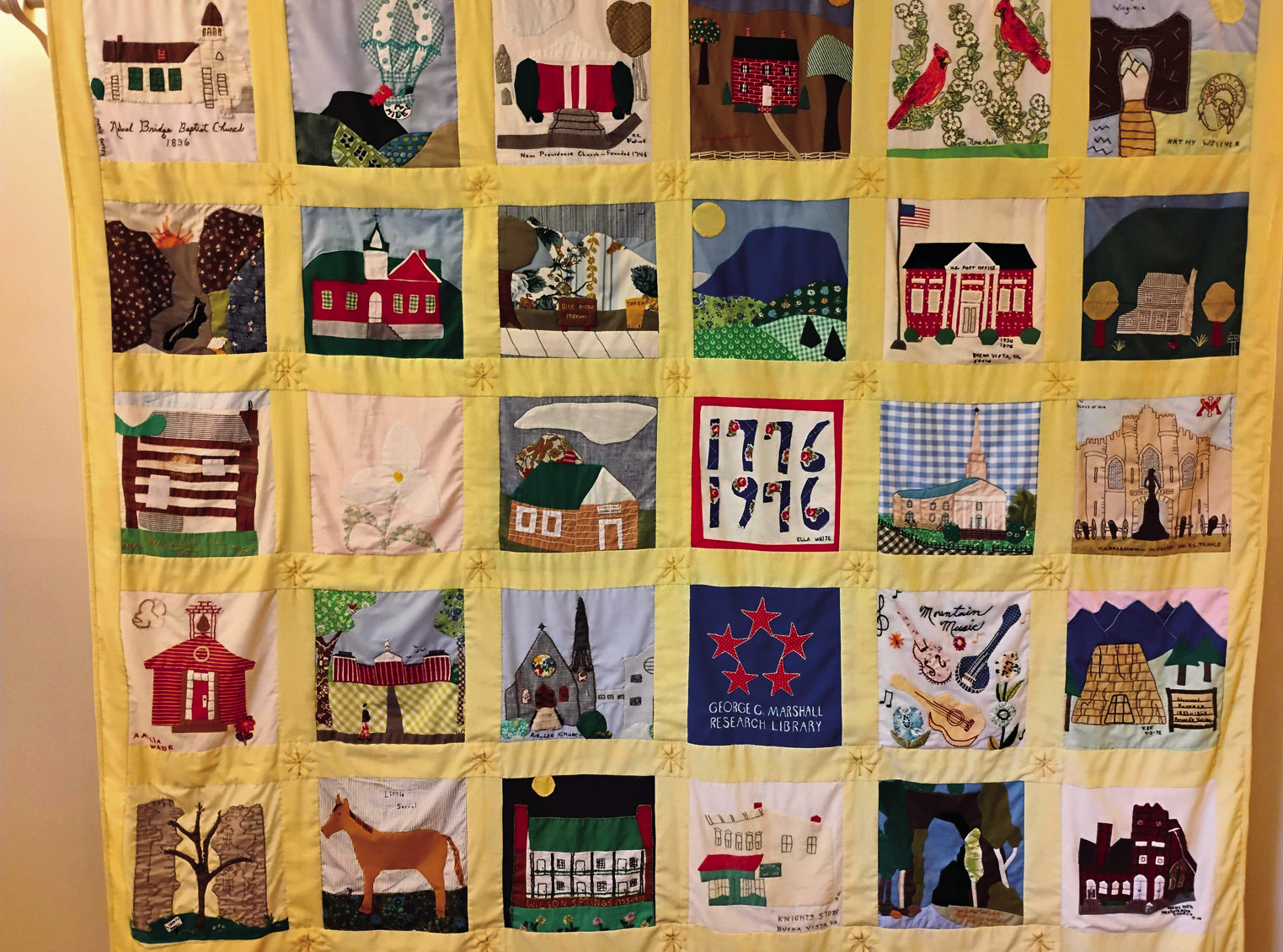
SEVERAL community-made quilts produced for the 1976 bicentennial still hang today in the Visitor Center. Their diverse panels represent distinctive historic and natural sites, religious and civic landmarks across our area, signaling that the celebrations ahead will also continue to reflect present perspectives, not just the past, in creative ways. (photo by Eric Wilson)