
G. OTIS MEAD III
G. OTIS MEAD III
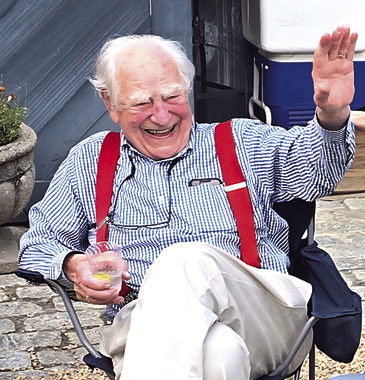
Mead, 90, passed away Saturday, June 21, after a short illness, precisely three weeks shy of his 91st birthday.
With Mead’s death, Lexington loses not only one of its once most sought-after realtors and community advocates, but also a human library of the city’s history dating back to his arrival nearly seven decades ago. Mead was a natural storyteller, and he would regale visitors for hours with entertaining tales about defining moments in local history and the colorful characters who helped shape them.
Mead’s own life story is epic. Born George Otis Mead, III in 1934 to Virginia Blizzard and Lynne Burgoyne Mead near St. Albans, W.Va., he grew up in the village of Low Moor, Va. living in a 23-room house with three generations and local boarders who ate dinner together every night until war emptied the house. Mead had lost his father, an Episcopal clergyman, at age 4, leading his grandmother to declare him “the man of the house” after his older brother and sister went away to school. The women in his life, especially, his mother and grandmother, in addition to the family’s cook and groundskeeper, played critical roles in teaching a lonely little boy, with an adventurous imaginary friend George, how to be a good man.
Coping with dyslexia long before the disorder was commonly diagnosed, Mead could have easily been counted out. He struggled in school. At Hampden Sydney, where he played football, sang in the glee club, and was a proud member of an unusually large pledge class at Chi Phi fraternity, an academic dean declared him a likely record- holder: the student with the lowest grade point average to survive at the college longer than anyone else without flunking out. The dean said “Mead, you’ll be okay.”
Perhaps Mead’s learning disability helped him become an extraordinarily creative thinker. He displayed that vividly in leading a late-entry, come-from-behind bid in 1985 to land the Virginia Horse Center and the $95 million economic impact it delivered, another aspect to what he believed was his greatest contribution: championing tourism as a cornerstone to a vibrant business community in a unique rural college setting. Mead enlisted the local school superintendents to bus all of the city and county students to see the first piece of legislation signed by a governor outside of Richmond, establishing the Virginia Horse Center in Rockbridge County. He later served on the VHC board and remained active there throughout his life.
Mead demonstrated leadership skills early. In his senior year at Central High School, he was given the Danforth Foundation’s “I Dare You Award” for his community contributions. After leaving Hampden Sydney in 1956, Mead moved to Lexington where he took a job at a clothing store under the tutelage of Earl N. Levitt to pay off his wardrobe debt. He served in the National Guard, and within three years in Lexington joined what became Kinnear-Mead Real Estate, later Mead Associates. In 1972, Mead was elected president of the Virginia
Association of Realtors, and held prominent roles in the organization’s national governing body. In the decades since, Mead negotiated sales and purchases of property across the Shenandoah Valley, served as an ad hoc adviser to local politicians and other community leaders, always striving to make “a neat place even neater.”
Mead and his wife “My Sue Ann” Brown of Clifton Forge, whom he married in 1957, were both active participants in numerous community causes. He would go on to leadership roles in the Jaycees, the local and state Chamber of Commerce, Southern Seminary College, the Lexington School Board, Stonewall Jackson Hospital, the Lion’s Club, and many other organizations. For his extraordinary community engagement, Mead was awarded membership in the ODK national honorary society.
Friends and family members recall how their beloved “Otie” had an exceptional sense of humor, a big heart, and sentimentality for times gone by; he was occasionally prone to outbursts over the general foolishness of others, especially incompetent politicians. Often, he lamented the growing disconnectedness of today’s society, blaming the advent of the air conditioner for driving people indoors from their porches and ending of an era of meaningful interaction between “town, gown, and shako.”
Despite reaching the age of 90, some loved ones say Mead left behind an unfinished life. Days before succumbing to illness, Mead, who’d grown bored of puzzles and Solitaire, told a family member “I need a project.” Once hospitalized, however, Mead opted against heroic measures to prolong his life. He died on a sunny morning facing a mountain outside his hospital window with his daughters, Susan Virginia Mead and Mary Curtis Mead Stolarz, holding his hands.
Along with his daughters and Mary Curtis’ husband, Michael Stolarz, and Susan’s partner, Ben Smith, Mead is survived by four grandchildren: Mead Stolarz and Turner Stolarz; Mellea Holliday Mead and Morgan Holliday Mead, his granddaughter-in-law, Georgia Gleason Mead; and one great-granddaughter, Kora Azalea Mead.
If Mead were still here, he might tell them and the friends and community he is leaving behind: “Look for me when you see me.” And so many did here, there, and everywhere.
A graveside service is planned at Oak Grove Cemetery on Saturday, June 28, at 11 a.m., with a reception to follow at the Patton Room, 7 N. Main St. Harrison’s Funeral Home & Crematory is handling arrangements. The family requests donations be sent to the Virginia Horse Center Foundation or the Cowpasture River Preservation Association in his memory. In honor of his favorite song, “Daisy a Day,” daisies are welcome. NG