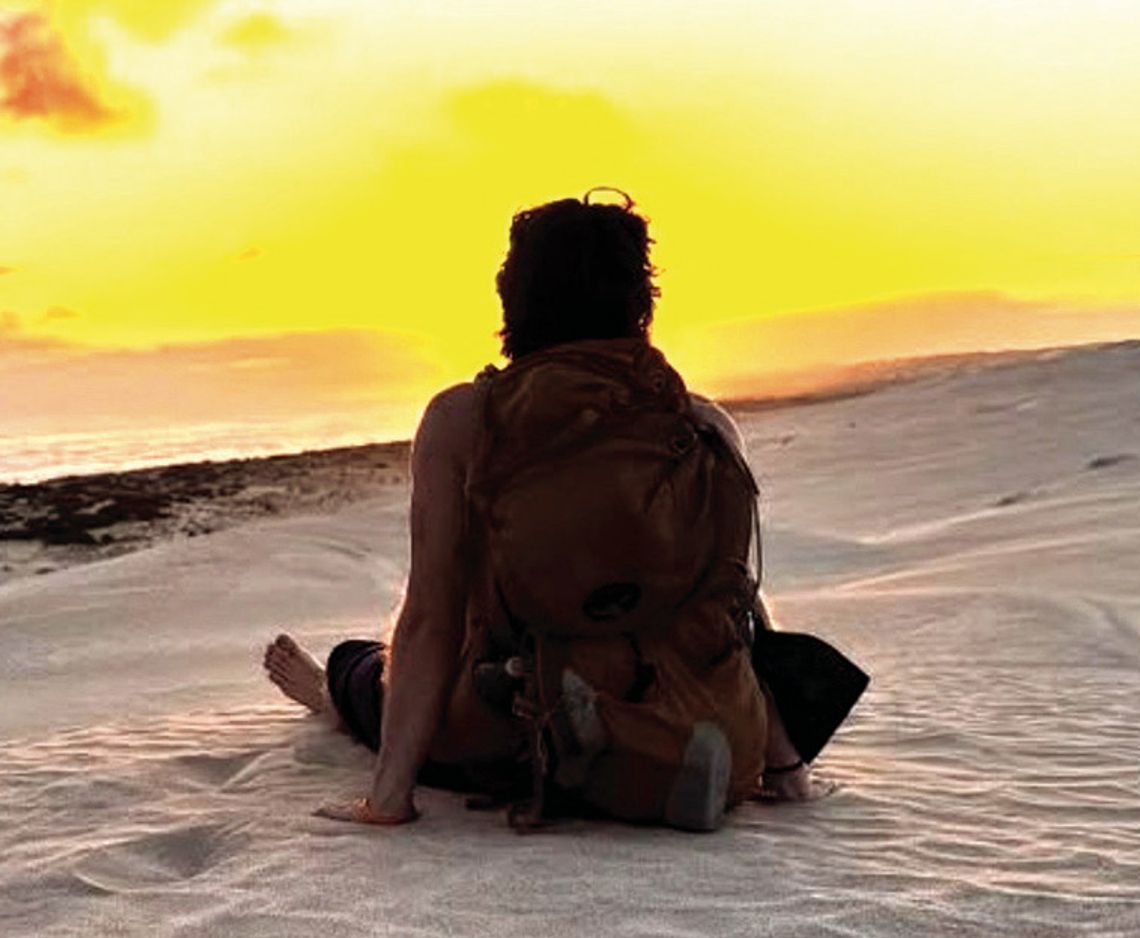
Ian Treger Remembered At Service, With Foundation
Nearly every pew in Collierstown Presbyterian Church was full Sunday for a memorial service honoring the life of Ian Treger, on what would have been his 30th birthday.
A Rockbridge County native and graduate of Washington and Lee University, Treger died while hiking Ausangate Mountain in Peru earlier this year. Several friends and family members shared memories of him as part of the service.
Christian Larsen, a childhood friend of Treger’s, recalled a story of how Treger was once asked how many brownies he wanted and he replied with a grin, “I think I’ll start with 10.”
“That’s now turned into a family expression,” Larsen said. “I still use it to this day for whenever you just kind of go for something and see what sticks – start with 10 and … see what happens, then carry on.”
Mohamed Kamara, one of Treger’s professors at W&L, recalled that Treger “never stood or sat still, in a good way,” and that he would “always engage me in deep conversations about the topics that I taught in class [and] would force me to think even more about what I was going to say.
“I remember him as a curious and open-minded person, so I had absolutely no doubt that he would travel far and wide,” he said.
“I’m deeply sad that I’ve lost my son, and he was a wonderful person,” Treger’s mother, Michelle Ludwig, told The News-Gazette in an interview on Friday. “There’s so much unfairness in the world, and I’m sad that he’s not here to help me see the world the way he saw the world.”
Ludwig, in the interview, recalled how Treger would regularly send messages or photos to her of places he was visiting and things he was doing, just to check in and let her know he was alright, and talked about the “unfairness of such a wonderful, kind, loving, generous, thoughtful person to longer be on this earth.”
In an effort to highlight Treger’s generous spirit, Ludwig and Celine Price, Treger’s aunt, created the What Would Ian Do Foundation, a nonprofit dedicated to continuing Treger’s adventurous nature and generous spirit by providing financial assistance to students studying English abroad – including at the Galapagos Language Academy where Treger taught English. The foundation will also sponsor students who wish to study abroad, and support search and rescue operations that assist families of missing persons.
“It’s a way for me to keep his spirit alive, [and] to keep his goodness here on earth, even though he no longer is,” Ludwig said.
Treger’s love for travel was “somewhat genetic,” Ludwig said. She grew up with a mother who liked to travel and visit new places, and she spent her summers split between a hunting camp in the Adirondack Mountains her father built and a 200-year-old stone house on a river “not far from Canada” in upstate New York. That tradition of summering away from home was something Ludwig wanted to pass on to her children.
“I have wonderful memories and I wanted my children to be able to go away for the summer to a place that was theirs,” she said. “That, when they got there, they had friends that they remembered from the summer before.”
Treger’s love of travel grew with him. He spent a year as an exchange student in Germany when he was in high school and visited a variety of different countries, some on his own and some with his family. In addition to English, he spoke French and German, and minored in French at W&L.
“I loved traveling with him,” Ludwig said. “He saw things differently. It was wonderful. He would mention something to me that I didn’t even notice. He also was very kind to people and very patient. He didn’t mind bartering in some of the countries where we were. He always he really did see the best in people.”
Another aspect of Treger’s mindset is the idea that he was never lost, but on a new adventure, something Ludwig said that her mother would often say when they were traveling.
“I think Ian really took that to heart,” Ludwig said. “He was never lost. There were times he fell asleep on the bus and ended up in the wrong place, but he had a great experience.”
According to a map on the foundation’s website, Treger visited at least one country on every continent except Antarctica. Ludwig said that most of the photos he took of those places were of the scenery around him.
The foundation isn’t Treger’s only memorial. A stone monument with his name, dates, and a brief epitaph sits on Ausangate Mountain in the spot where he was found. There is a traditional belief among the people who live in the Andes Mountains that certain, special souls are called to remain and join the mountain’s spirit, and that belief was honored in a ceremony held when the monument was installed. As part of the ceremony, three leaves from a coca plant were placed at the memorial – one for Pachamama, the mother of all life; one for the Apus, the mountain spirits that serve as protectors of the mountains and guardians of the Andean people who live there; and one for Treger himself.
“Today, he is no longer just a mountaineer,” Chief Rodriguez with the Peruvian National Police said in a eulogy he wrote for the ceremony. “He is a new guardian of Ausangate – a spirit that will walk among the peaks and paths, watch over the glaciers, and accompany, invisible yet present, those who seek the grandeur of that sacred mountain with humility and respect.
“For there are beings whose imprint does not disappear with death,” he continued. “They merge with the earth, the wind, and the snow, becoming part of the sacred landscape that inspires future generations.”
A video of Chief Rodriguez reading his full eulogy was played at Sunday’s memorial service, and an English translation was provided to attendees. It is also available on the foundation’s website.
The speakers at Sunday’s memorial service offered similar words about Treger’s spirit living on.
“We never said goodbye,” Larsen said. “We always said ‘See you later.’ That’s a very small distinction or difference, but the impact is huge because of the implication, the promise that there will be another time. And, while he might not be here with us, I know he is watching over us.”
“In my faith, when we hear of the passing of someone, the first thing we say is ‘From God we came and to God we shall return,’” Kamara said. “But we also believe that those who are gone have not gone. They have only changed locations and now occupy a more consequential place in the universe. And as a child of the universe, Ian is everywhere – in the mountains, in the rivers, in the wind that blows, in the breaths that we take. And we pray that he continues to enjoy that journey, that adventure.”
To learn more about the foundation, or to make a donation to it, visit www.wwidf.org.
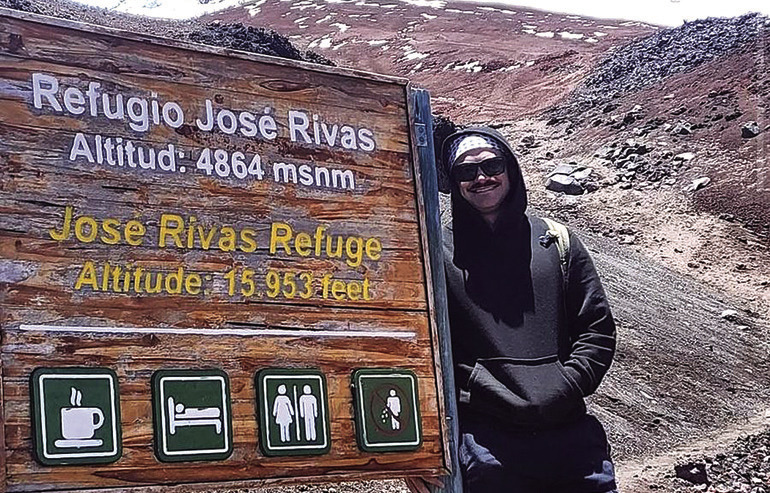
IAN TREGER’S love of travel led him to many exotic places, including the José Rivas Refuge in Ecuador. (photo from What Would Ian Do Foundation)