Smart Glasses Give Blind Veteran More Independence
Al Carr hasn’t been able to walk down his driveway on Overhill Drive to get his mail on his own in years.
But on a warm and sunny early September day, he stood near his back door and took a few halting, but increasingly steady steps toward his mailbox.
Carr is completely blind and has relied on a walking cane – and his wife Gail – to help him navigate the world, even his own house, for nearly a decade.
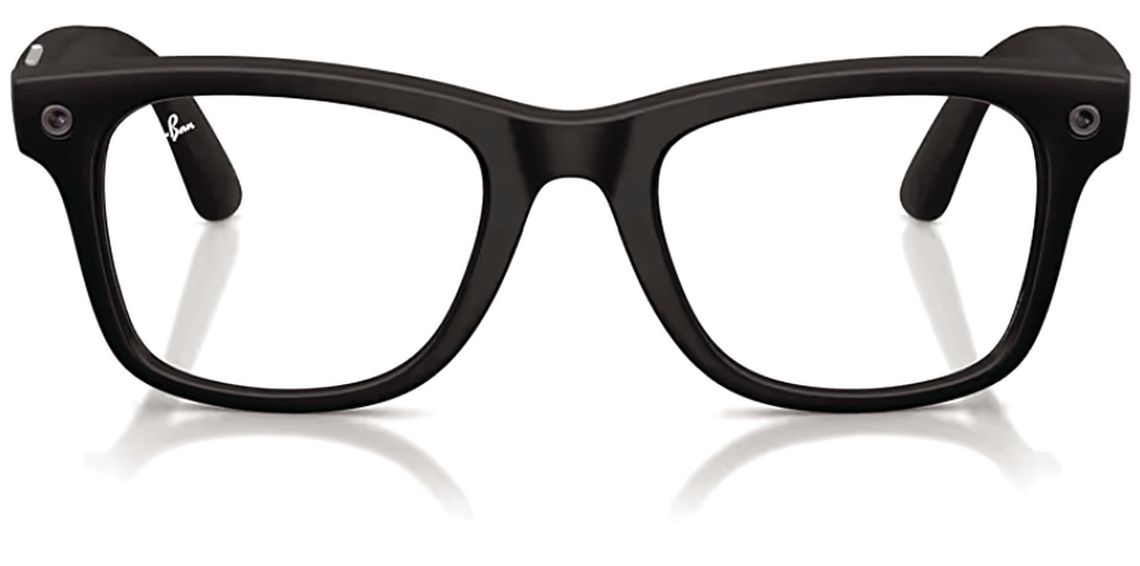
But these days he’s got new, life-changing technology to assist him: a pair of Meta AI smart glasses with chunky black frames.
If you stand next to Carr in his driveway while he’s wearing the glasses, you may be able to hear a faint voice gently guiding his steps through tiny speakers mounted above his ears: “A few steps to the right, a few forward, make that turn at the bend.”
The glasses are connected to an app called BeMyEyes, which helps visually impaired people get around to do simple tasks. When Carr activates the app with his voice, it instantly pairs him with one of an army of live volunteers around the world that are available 24/7. One of those volunteers patches into his glasses through the tiny camera mounted on the frames, sees what he would see, and guides him to where he wants to go.
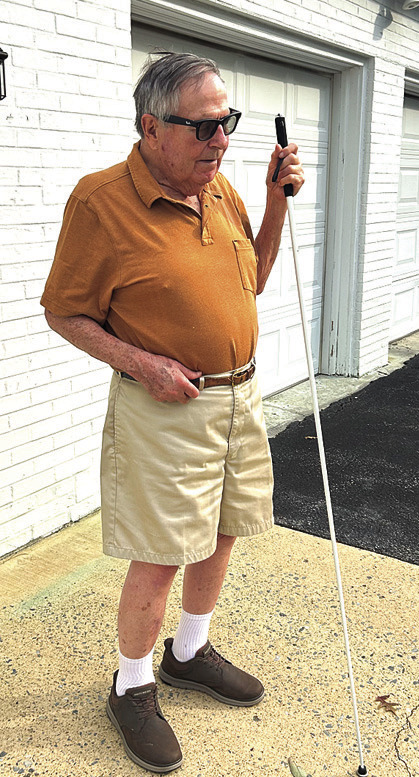
AL CARR, sporting his Meta AI glasses, ventures outside his home in Lexington for a short walk. (photo by Allie Goolrick, and image of glasses courtesy of Meta)
Glasses
continued from page 1 “For the first time in eight and a half years, I can go outside on my own,” Carr said. “I’ve got to tell you, that is a life changer.”
Carr, 84, is a former Marine, Virginia Military Institute graduate, retired lawyer and law professor at Washington and Lee University. About 30 years ago, he lost vision in his right eye due to glaucoma. More than eight years ago, he lost sight in his left eye after he lost blood flow to his retina.
He’s one of many veterans to receive a pair of free Ray-Ban Meta AI glasses, which Meta has donated to 130,000 blind former service members across the country through the Blinded Veterans Association (BVA). The glasses use the speakers, camera and microphone along with an AI assistant to connect to a smartphone via Bluetooth and Wi-Fi. BeMy-Eyes is one of several apps Carr can pull up in addition to his Meta voice assistant, which is like Alexa or Siri.
Carr got his glasses in late summer through The Cadet Foundation, which distributed about 100 pairs through the BVA/Meta program.
He’s still getting the hang of them, but he’s found multiple benefits beyond the human-guided assistance in walking. As a former lawyer who is full of questions, Carr uses his Meta voice assistant to research anything and everything he’s interested in. The voice assistant pipes the answers directly into Carr’s own personal speakers from anywhere he can connect to Wi-Fi.
“You can talk to it and ask it questions and that sort of thing, and it can provide you information,” he explained. “I can ask Meta a question about something that comes up, and it will provide me with an answer faster than Gail can Google.”
The glasses can also describe what he is “looking at” in detail. That’s a big help to Carr, who occasionally gets disoriented in his house.
Meta will also read to him any text he holds in front of the camera on his lenses, which is a huge benefit because he’s always been a voracious reader.
Right now, he’s using his new glasses to do everything from following debates and researching data centers to having the technology read him books on Douglas MacArthur and Winston Churchill.
The BeMyEyes app is one of Carr’s favorite ways to use his Meta glasses, because it is helping him regain some physical independence. He still relies on Gail for most daily tasks, like making his coffee and his lunch, and will continue to.
But Gail Carr said that before he got the glasses, her husband had not gone outside alone in eight years.
“And all of a sudden, he could go out there. He didn’t have me by the arm,” she said. “That was a biggie.”
Before he lost his vision, Carr was a big walker and tried to get in at least 3 miles several days a week on the campuses of VMI and W&L.
Gail Carr said that in addition to her husband being unable to leave the house on his own, his blindness has profoundly affected the way that he walks, which has taken a toll on his muscle tone over the years.
The couple hopes the Be-MyEyes app will help him build back muscle and walk at a more normal pace. He’ll always use the cane to help him stay aware of the ground and any obstacles he might encounter, but the app provides some needed backup for the cane.
“The more he can do this, the faster, bigger steps he’ll be able to take,” she said. “But for so long, for years, they’ve all had to be little steps. So that’s what we were looking forward to, that with this, he’ll be able to go back on those walks,” Gail Carr said.
‘Prepare to Be Blind’
Carr’s vision was never perfect, but it was good enough for him to join the Marine Corps as an enlisted man in 1961. Eighteen months later, he matriculated at Virginia Military Institute. It was during his time on post that his recruiting officer noticed he was having trouble seeing and sent him to the eye doctor.
“Legal blindness is around 20/700,” Carr said. “My right eye came back at 20/1350. In other words, I could just barely see lights and shadows.”
Because of issues with his sight, he couldn’t commission, so Carr went to law school and then practiced law for years. In 2000, he and Gail moved back to Lexington to retire and he was asked to teach a law class at Washington and Lee University. He’d already lost sight in his right eye, but managed in the classroom well enough. Carr said that as a left-hander, it didn’t bother him much at first to navigate the world with one good eye.
“For a period of time, I could have flown fighter jets,” Carr said. “I could see so well, and then just all of a sudden, one day the vision started going down quickly.”
Doctors realized he had an occlusion of blood vessels, which compromised the blood supply to his left retina. Doctors said that there wasn’t much they could do to change his prognosis.
“You need to go back home and prepare to be blind,” Carr said a doctor told him.
The couple said they weren’t given any further guidance than that.
“So, we learned to live blind,” Al Carr said. “And that’s a problem, because there’s no manual for it, and we didn’t have anybody around us who also was blind, so we just kind of stumbled along.”
Carr was 76 years old at the time.
With the help of the Virginia Department for the Blind and Visually Impaired, Carr learned to walk with a cane, but in the process, he also met many younger people who were facing blindness. Something about seeing other people grappling with losing their vision at a younger age put things in perspective for Carr.
“To see their agony and uncertainty, I did the best I could to convince them that when you lose your eyesight, the world doesn’t come to an end. You’ve just got to figure out how to deal with it,” Carr said. “We happened to draw the short straw, and we’ve got two choices. One is we could dig a hole and get in it and spend all our time feeling sorry for ourselves and making everybody around us miserable. Or we can accept what we’ve got and make do the best we can.”
Making the best of it remains a goal for Carr nearly a decade later. At 84, he is still actively attending events for the blind and learning about new technology that can help him live his life to the fullest.
He’s had his Meta glasses for a little over four months now, and he and Gail have been practicing walks on the VMI parade grounds and at Waddell Elementary down the hill from their home.
He has discovered a few limitations. Most significantly, the glasses have to connect to Wi-Fi for Carr to be able to use apps like BeMyEyes. A lso, l ike a n iPhone, they tend to get too hot in the bright summer sun. In addition, users are advised not to rely on them to do things with an inherent risk, like crossing the street, because the Wi-Fi could drop out.
But the benefits far outweigh the cons.
Gail is still never far away, but now, she’s able to watch from a distance as her husband gains more confidence with the help of volunteers looking out for him on the other end of his frames.
“I started out slowly,” Carr said of a recent walk. “And the woman said, “You can take bigger steps. I’ve got you covered.’”
Editor’s Note: The BVA’s Meta program for veterans has been so popular that new applicants are waitlisted. Veterans can still apply through an interest form on the BVA website.