W&L Students Learned About The People Behind Historic Rockfish Gap Project
Editor’s note: The following story falls into the “better late than never” category for us. As you will notice, the story is about a course from last spring that was submitted to us in late summer. Unfortunately, space constraints have kept us from being able to run this until today. Apologies for the delay.
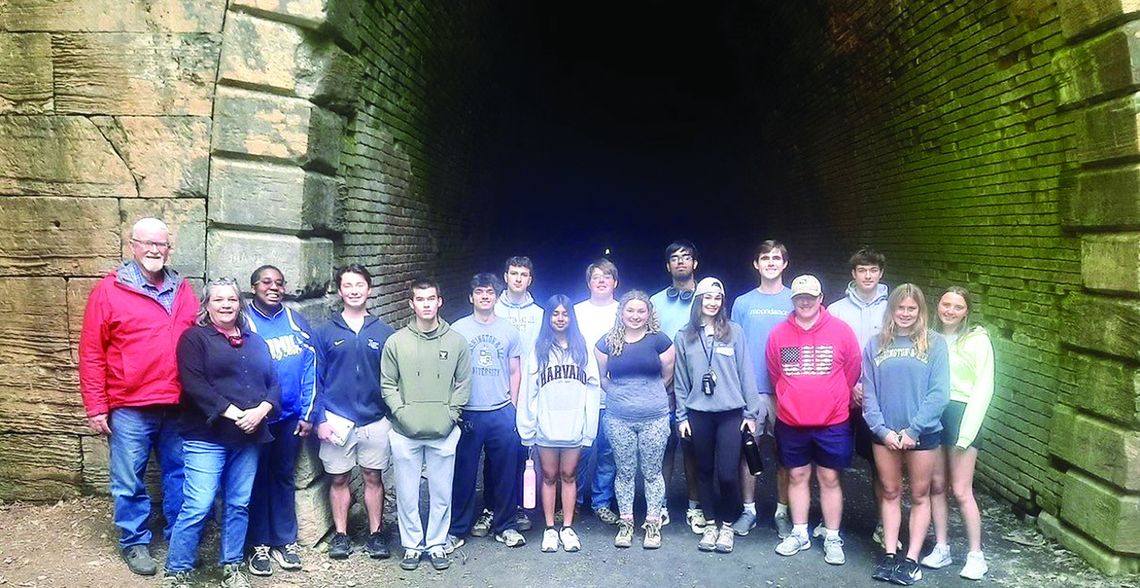
Last spring, 16 students in Washington and Lee’s Anthropology of American History class, taught by professor Alison Bell, learned about the history of the Blue Ridge Tunnel through a pair of lectures by John Friedrichs, area historic masonry authority and owner of New Dimension Masonry, LLC.
The first lecture was a threehour interactive, classroom-based experience. Friedrichs explained how, beginning in 1850, chief civil engineer Claudius Crozet plotted the location and direction of the tunnel beneath Rockfish Gap. Friedrichs also described the geology and invited students to handle tools, including drills and sledge hammers, like those used in driving the tunnel.
The second part of the educational experience was at the tunnel itself. Friedrichs shared remarks in memory of the 189 men who died in the driving of the tunnel and provided flowers that students placed on a marker recognizing the tunnel as a National Historic Engineering Landmark. Doing so, Friedrichs explained, stems from his “desire to educate, and bear witness, to craftsmen and their families of the past.”
Friedrichs, Bell, and W&L research archaeologist Don Gaylord have worked together since 2023 when restoration of the Liberty Hall Steward’s House on W&L’s back campus began.
Gaylord’s students, and those of anthropology professor John McDaniel before him, archaeologically tested the remains of this building where students had their meals in the late 1700s. Collaborative work in 2023-2024 used archaeology to guide reconstruction of the steward’s house foundation, restoring the masonry it to its appearance when first excavated in the 1970s. As a memorial to the enslaved people who labored there, the footprints of a Black woman from Roanoke, Sharon Robinson, were set in front of the western cooking fireplace.
Bell said, “When students see the footprints in the steward’s house or drill marks in the Blue Ridge Tunnel, they stop to think about the skills, knowledge, and lives of people who helped to create the world around us today.”
The Blue Ridge Tunnel is a single-track railroad tunnel constructed between 1850 and 1859. The first train ran through it in 1858 and the last one in 1944 when the C&O Railroad opened a larger, parallel tunnel. In the fall of 2020, the tunnel opened to the public as a biking and hiking path.
The tunnel is 4,273 feet, or eight-tenths of a mile, long. The western portal is in Augusta County, and the eastern portal is in Nelson County. There are parking areas at both ends; the whole length of the trail is 2.25 miles.
The Blue Ridge Tunnel is open, without cost, from dawn until dusk. Flashlights are needed and closed-toe shoes recommended. Though the trails from the parking lots can be hot in the summer, the temperature inside the tunnel is a constant 56 degrees.
Touring the tunnel, students learned to identify drill marks created by workers as they prepared holes for the use of black powder, which at times was quite unpredictable. According to the Virginia Department of Historic Resources, when finished in the 1850s, the Blue Ridge Tunnel was the longest tunnel in the U.S. that was hand-dug using black powder blasting.
Given the technology available, progress at the tunnel only averaged 26 feet on each side per month. Both ends of the tunnel presented challenges. The Catoctin greenstone was extremely hard on the eastern end of the tunnel, requiring blacksmiths to almost constantly resharpen the drills. The rock on the western end had a looser consistency, making it necessary to reinforce the walls and ceiling with brick. Approximately one-third of the tunnel is lined with brick.
Austin Halterman ’29, a student in Bell’s class, commented that these accomplishments are especially meaningful because of his family roots in the area: “Some people have negative connotations of rural Virginia, and so it’s great to see students from many parts of the U.S. and abroad learning about the exceptional engineering, the capabilities of the people who lived here and continue to live here, and the magnitude of what they accomplished in hard circumstances.”
When the tunnel was being prepared as a recreational site leading up to the 2020 opening, Friedrichs supported the effort by researching the composition of the original lime mortar. He shared this knowledge, as well as methods of making and laying bricks, with students as they walked through the tunnel this spring.
In 2024 Friedrichs led a fullday lecture and walking tour of the Blue Ridge Tunnel. The activities were sponsored and organized by Nelson County Parks and Recreation. For a nominal fee, 20 participants gathered in the Waynesboro library and then the tunnel itself to learn about technical aspects of how Crozet laid out the route of the tunnel, its grade and direction. Friedrichs also discussed tools used, the brick lining on the western end, and stories of the Irish workers who lived in the shanty town adjacent to the tunnel.
“The main objective of my lecture and walking tours,” Friedrich explained, “is to educate interested folks on the technical, social, and human aspects of historic masonry properties, the thoroughly ‘touched’ nature of what so many individuals take for granted and never see nor truly appreciate.”
Bell and Friedrichs encouraged students to envision the skills and heavy labor that workers brought to the creation of the Blue Ridge Tunnel. The labor force consisted mainly of Irish immigrants escaping dire poverty and starvation that had been made worse by the Potato Famine or “Great Hunger” (1845-1855). These immigrant laborers lived with their families in rickety, unsanitary “shanties” near the tunnel openings. Many men, women, and children died from communicable diseases such as tuberculosis, pneumonia, and cholera.
Autumn Crawford ’26, a student in the Anthropology of American History class, emphasized that “people died for this tunnel. A lot of people sacrificed a lot for it to be made. Learning about the tunnel opened my eyes.”
Enslaved people worked at the tunnel, especially in 1853-1854 during labor shortages caused when some Irish workers went on strike and others left for better paying jobs.
Irish workers at the Blue Ridge Tunnel often had contentious relationships not only with management but also with each other. Men formed work gangs with others from the same part of Ireland. These groups became rivals in Virginia as they had been in Ireland. At times their conflicts became physical (even riots) and disturbed local folk in Waynesboro and Staunton.
An Irish Catholic immigrant and priest, Father Daniel Downey, built a small wooden chapel near Rockfish Gap for tunnel workers and their families. He also founded St. Francis of Assisi Catholic Church in Staunton (1851). He was buried in Thornhill Cemetery (1874), which is a part of the area Catholic community to this day.
Chief engineer – both for the Blue Ridge Tunnel and, at times, for the commonwealth of Virginia – Claudius Crozet had immigrated from France. He’d served as a combat engineer and artillery officer in Napoleon’s army. Crozet spent two years as a prisoner of war in Russia. He then taught at West Point before coming to Virginia where, in addition to serving as chief engineer, he helped found Virginia Military Institute. He’s buried near Crozet Hall, the engineering building named in his honor.
Bell approaches American history as an anthropologist, working to understand culture, behavior, what people believed to be true, and why people acted in the ways they did. “I teach students to use many kinds of evidence – landscape features, artifacts, architecture – for first-hand, direct engagement with the past.”
In addition to the Blue Ridge Tunnel, students in the springterm class visited local cemeteries, Wades Mill, the Brownsburg Museum, the McCormick Farm, former industrial sites at Jordans Point, the C&O Heritage Center, and archaeological sites in the Longdale Mining Community of Alleghany County.
By learning about these sites, including the Blue Ridge Tunnel, W&L students saw how global events – the Great Hunger in Ireland, Napoleon’s invasion of Russia – related to the history of this corner of Virginia. And they saw how the dogged chipping away at the greenstone, just 26 feet a month on average per side of the tunnel, not only created a corridor between eastern and western Virginia, but also opened the way for westward expansion.
Crawford commented, “I’m not from this area but am from Virginia, and I gained so much new knowledge about Virginia history during spring term.”
Perhaps most importantly, students learned how people, both famous and unknown to people today, applied their efforts to create the tunnel. In addition to the estimated 1,000 men and boys who drove the tunnel, countless others, including women and girls, contributed. Hammering steel drills into greenstone for hours upon hours, for example, must have consumed an immense number of calories, meaning that someone was doing a great deal of food preparation.
Friedrichs and Bell encouraged students to consider what people had been willing to do for their loved ones – leaving homes in Ireland, battling through hard rock underground, living temporarily in poor conditions.
Bell recalled, “Students shared that walking the Blue Ridge Tunnel was impactful. It encouraged them to consider what they’d be willing to do for their families if they were in the Irish workers’ position, and what they’d be willing to demand of others to achieve an amazing feat like Crozet. I’m glad that the experience gave students food for thought about personal achievements, quality of life, values, and relationships.”
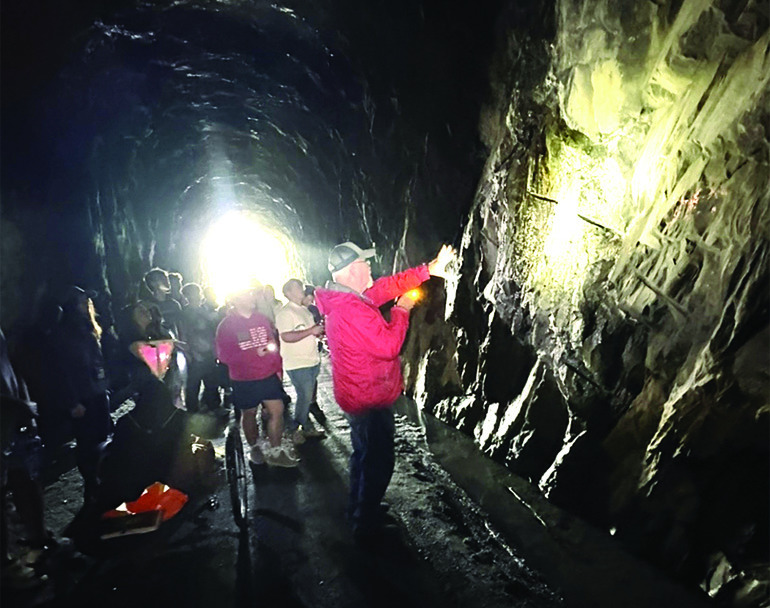
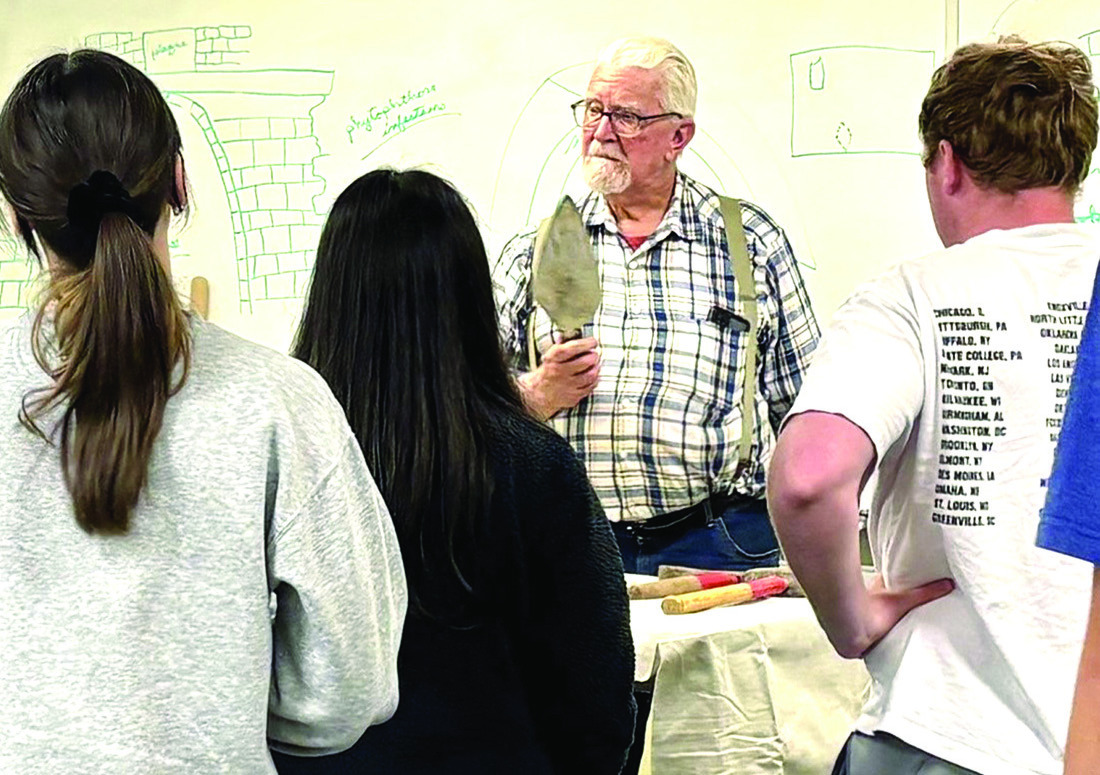
AT LEFT, John Friedrichs points out drill holes near the eastern portal of the Blue Ridge Tunnel. ABOVE, prior to the visit to the tunnel, Friedrichs introduced basic tools of brickwork to students in the Anthropology of American History springterm class. An illustration of the western portal of the Blue Ridge Tunnel is on the board behind Friedrichs.