This area is fortunate to have a number of local farmers, artisans and farmers markets. Lets have a conversation with one farmers market vendor a week and get to know them, learn about their lives, their struggles and why they're market vendors.
Our goal here is to help folks see that there ought to be a place in their lives for the farmers market. It’s not that people should buy all of their food from the market, of course, but to recognize there is merit in knowing that you shook the hand of the farmers who grew the tomatoes in your salad, that you had a good conversation with the person you bought eggs from and all the ingredients in the bread and pastries are familiar and easy to pronounce.
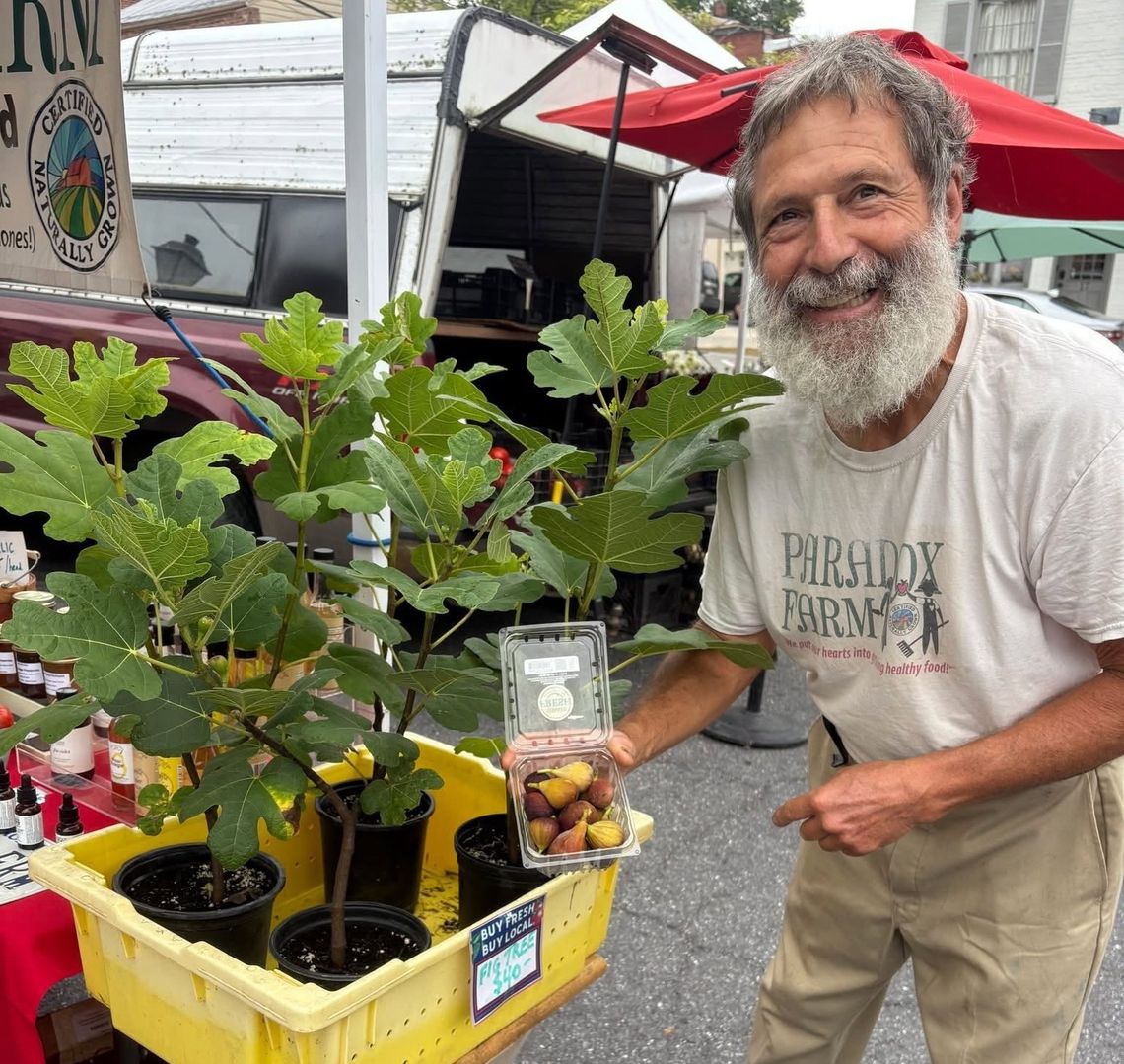
Meet Mitch Wapner of Paradox Farm. Mitch has been a part of the Lexington Farmers Market since it opened in 2002 and is the current market manager. Paradox Farm provides what Mitch calls ‘beyond organic’ produce from his family's farm in Rockbridge County.
You can find Paradox Farm at the Lexington Farmers Market on Wednesdays and the Staunton Farmers Market on Saturdays. The percentage of farm income from market sales is about 75 percent.
Did you always know you wanted to do this?
No. When I was four years old I wanted to be a sanitation engineer in New York City, which at the time was a garbage man. Nothing cooler than riding around on the back of a garbage truck in New York City. But when I was in high school I wanted to be a subsistence farmer and I lived in the 17th floor apartment with no family farm to inherit. So, I knew that that was not an option without something else. I became a veterinarian and married a veterinarian and was able to make enough money to become a farmer. Sold out, bought the farm, literally, and now I'm living the dream.
What made it happen?
I was busy working on being a veterinarian, making money, raising kids and it wasn't until I was able to financially afford being a farmer because, you know, how to make some money farming is to start out with a lot of money. It's kind of like horses. If you want to make money with horses, start out with a lot of money.
My dad died at 55, pancreatic cancer, so I was concerned that I would work all my life like he did and then die without ever having fun. So I decided that at 45 I was going to retire from that area of medicine and I did pretty good. I retired at 46. So, at 46 we sold the practice, bought the farm here and started to live the dream.
Of course, part of the problem with buying a farm above 125 acres was figuring out what to do and I spent the first two years figuring that out. It’s like, do I have an orchard? Do I have a you-pick strawberry farm, you-pick blueberry farm? Do I have a vineyard? You know, do I grow Christmas trees? There's all sorts of things you can do and having just retired from a job I didn't want to have another job, I wanted to have my dream. And so I started growing food for my family. Grow what I like to eat and then the logical thing was, ‘well, I'm growing more than I can eat, so let's sell at the farmers market.’ And that's how the farmers market developed for me. And then I started growing things I didn't like to eat because people at the farmer's market wanted it. I'm not a fan of radishes. I've learned to love okra. I've learned to love arugula but I didn't originally like them.
Can you tell me some of the process of your job – what you make/grow and what your market tasks entail?
I grow everything from asparagus to zucchini. If I could I would just grow figs because I love them and people love them but you can't count on them every season to have a good crop. So, diversity really is the answer. I did pick figs today but I also picked radishes.
Well, there's harvest, it starts on Monday, continues into Tuesday. There's washing, there's packing, there is loading up coolers, there's loading up crates. There's the actual market van which has tables and the canopy and scale and all this other stuff has to be in there and a chair to sit in, weights to hold the canopy down so it doesn't blow away and hurt anybody. So it's a three-day process of getting ready and executing the market, followed by unloading Wednesday afternoon and taking a nap. Basically that kills Monday through Wednesday.
There's basically two goals to the market: One is to give the farmers sustenance and livelihood and reward for their efforts and the other to give the community excellent food at good prices and nourish their health. So it's a win-win between the farmers being supported and the community being supported.
For the farmers it takes a lot of work. I mean, this is hard work; it's a job. Some people think our prices are too cheap, some people think our prices are too expensive and the people who think it's too expensive don't have a clue of how hard it is to grow this food, especially when we're growing it in a health- and nutrition-related factor. I mean, I'm beyond organic, I'm not organic. My sign with us says ‘beyond organic.’ What's beyond organic mean? I said, ‘Well, they've had sun and rain and nothing else. And, yes, that old hole in there, there's an insect inside.'
I was organic certified in 2010 and 2011 and for me it was too costly, too much red tape, so that I've gone with Certified Naturally Grown, which is a grassroots organization, farmers certifying other farmers. So I was just inspected by Joseph Martinez, who has the orchard-making Rockbridge apple cider vinegar, so he was my inspector that came to my farm to make sure that I'm on the up and up, growing the way I'm supposed to.
What are some of the struggles you face with a year-round outdoor market?
The weather is a big one. I mean, we did not intend to be a year-round outdoor market. In fact, our street banner says ‘outdoor/indoor’ right on it. We were indoors in the winter, inside Lex Presbyterian Church up until COVID. When COVID came, got kicked out, I mean everyone got kicked out. But now the COVID is pretty much under control, we're not allowed back, which I wish we were and I wish it was another place.
We've looked, we've tried to find a spot to be indoors and the places we have found that we could do it are either too far away or have too many other drawbacks, as far as like loading and unloading. It's not easy to take all this stuff out. In the outdoor market, we're pulling in with our vehicles and just opening the back hatch and there you are. With an indoor market, you're pulling up on the curb, you're having to unload and get into the building and everyone can't do it at the same door at the same time. There're challenges to being indoors and Lex Pres worked out really well. Hopefully at some point we'll have an indoor market. If not, we'll continue. We've adapted to being outdoors. With climate change, sometimes it's not so bad because our winters are getting milder but then again there've been days in December where we got down to 13 degrees. I had my produce inside the cooler to keep it warm. If we put it on the table, it froze.
One of the other challenges in the winter is the snow and ice. We've had to cancel the market because one of the disadvantages of a farmers market to begin with is that we're on a slope, it's not a level playing field. It's a hill and it's dangerous, especially when there's ice and snow. So we can't afford to have anybody, vendor or customer, slip and fall. We're not gonna do anything to jeopardize anybody. And then it takes time just to clear the parking lot after a snowstorm. Another issue that we're having as a market is parking and lack of it. There's just no place and now that the Southern Inn is bought, they've got that whole parking area closed off so that no one could park there, so that there's really no place for people to park.
What are the rewards?
Oh gosh, ego enhancement. There's a real joy in feeding people quality food, especially people you know. I have developed, and most of the vendors have developed, a customer base that comes back on a regular basis and we know them, they know us, I've got their phone number, I've got their email. In fact, I email a weekly list to my people, saying ‘here's what I've got, you've got first choice. Tell me what you want and I'll put in the bag with your name on it.’ There's definitely a rapport, a camaraderie, an ego enhancement from feeding them. And of course they're helping support my lifestyle of growing the food. I've also organized a CSA here in the county. Back in the day it was Rockbridge Farmers Alliance and now it's just part of Paradox Farm.
What do you wish people knew about going to the farmers market?
Gosh, I wish they knew that ‘it's use it or lose it.’ You know, if they don't support the market, the market will not be there. And then they're going to say, ‘oh gosh, if I had known that I would have supported it,’ but then it's too late. So really, people need to be aware of it and support it. It's use it or lose it.
One way is by going on Facebook and looking at the page every week and seeing what's going on. The best way is showing up. Come to the market, check us out, walk around. I mean there are other markets that are more social than ours, where people come and they socialize and don't buy much. Our market is not like that. Our market is very much a people who are looking to buy good food. It's social that they see their friends who are also buying good food but they're not going to spend an hour-and-a-half to buy five dollars worth of food and then have a social time. They're gonna, you know, spend 20 minutes seeing their friends and getting their food.
Like Staunton, the market has music. We'd like to have music. On the other hand, we don't want people coming to sit and drink coffee and listen to music; we want people to come and purchase food from the vendors. You want to enhance their experience, if music will enhance it, that's great, but you don't want to distract them from what they're there for. I would love to have kids programs and things but again it has to work out where it makes it a benefit to the market, not just something for the kids to do.
I wish there was good parking. I wish there was a level spot. I just wish people would come and support the market. And in return, that we can give you good food. That's the way it works – supporting the agriculture and the agriculture supporting people.