This area is fortunate to have a number of local farmers, artisans and farmers markets. Lets have a conversation with one farmers market vendor a week and get to know them, learn about their lives, their struggles and why they're market vendors.
Our goal here is to help folks see that there ought to be a place in their lives for the farmers market. It’s not that people should buy all of their food from the market, of course, but to recognize there is merit in knowing that you shook the hand of the farmers who grew the tomatoes in your salad, that you had a good conversation with the person you bought eggs from and all the ingredients in the bread and pastries are familiar and easy to pronounce.
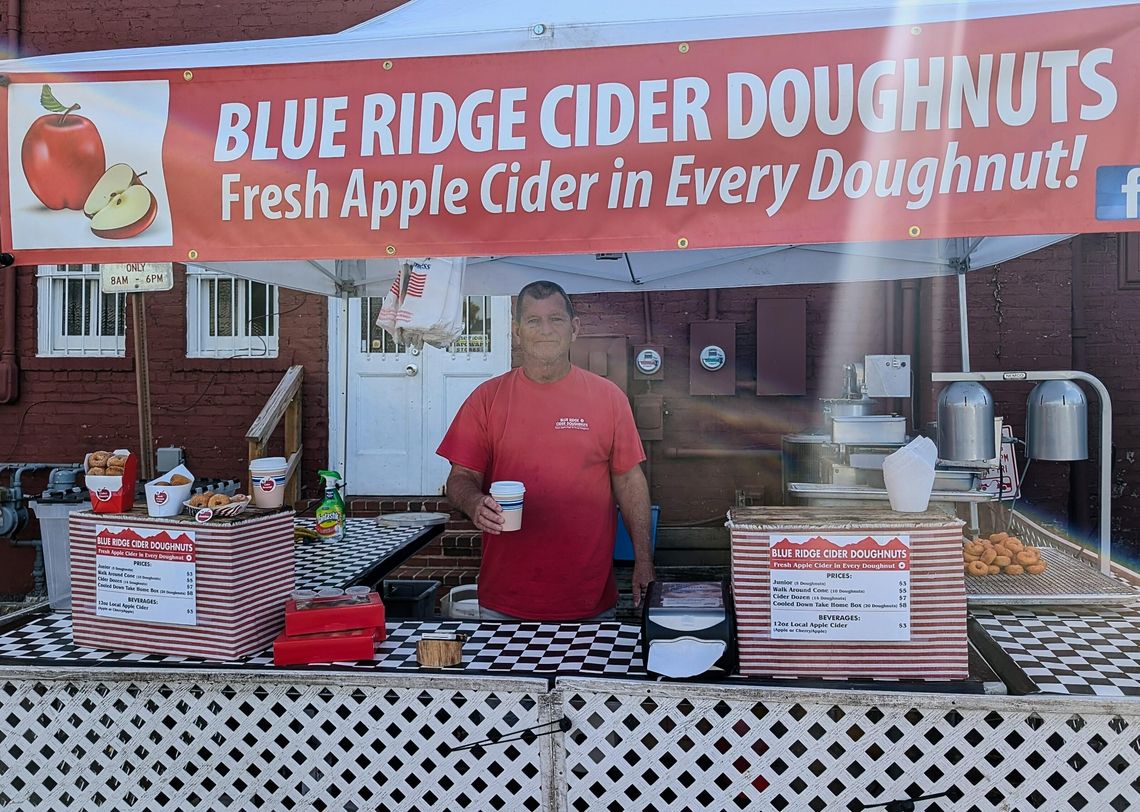
Meet Michael Yerks, owner and operator of Blue Ridge Cider Doughnuts. This is his 11th season at the Lexington Farmers Market, but he has been perfecting his donut game for much longer!
He's a regular vendor at the Lexington and Staunton farmers markets but you can also find his donut stall at events in the area and in places like Buchanan and Wades Mill. The percentage of his livelihood from market sales is 100 percent.
Did you always know you wanted to do this?
Well, I was a chef in Miami, in South Beach. Here in Virginia I helped open Sheridan Livery when it was there; it's not there anymore. When that first opened, I was up here visiting my parents in Glasgow. So while I was up here I decided to go to work. When George Huger took over Southern Inn, I was there to help that a little bit. Up in New York I opened a restaurant for a friend of mine. That's where I'm originally from, New York. The first 29 years I spent there. Then I got tired of it and moved to Florida, went to the culinary school down there.
My father had retired down here about 40 years ago. I've been coming, visiting, you know. When I lived up in New York I would come and visit and spend some time here, come up back and forth from Florida.
What made it happen?
My father had gotten diagnosed with cancer, so I came up. I knew I was going to come up here when he got to be where he couldn't take care of himself anymore. I had been doing the donuts for about nine years down in Florida, in West Palm Beach. So when I came up here, and I was a chef for 20 years before that, I didn't want the hours, you know because I knew I was going to have to take my father to the doctor's appointments and be there for him. So I didn't want these crazy hours, so I figured, 'Let me do the donuts on my own up here and that way I can make my own schedule and, you know, be available for him.'
Actually, a friend of mine and his girlfriend were doing them down in Florida, the local farmers markets down there. He and another guy started up a catering company and they got to be where it was too busy for them to do the donuts as well, so they asked me if I would take over on the weekends. I was doing it on Saturdays and Sundays down there. I enjoyed it and I enjoyed doing it. I remember the first farmers market I did in West Palm Beach and there was just a line. I mean it was crazy and I was like, 'for God's sakes, they are just donuts, you know,' but 20 years later, if I eat one, I'm eating them all day. I try to stay away from that first one. I tell everybody 'one's too many, a thousand is not enough.' John Carlino was the guy and it was actually his mother's recipe. I've tweaked it a little bit here and there.
Can you tell me some of the process of your job – what you make/grow and what your market tasks entail?
Well, I make everything fresh on-site. I don't do anything beforehand. I think people like to see them coming out of the machine. You know, it’s part of the experience, I think. The cider that I use here is from Gross Orchards in Bedford.
It's old hat now. I have two big boxes with wheels that everything for the front of the booth is in one box and everything for the back of the booth is in another box. It all goes into my van and the machine, the donut machine, is actually mounted on a hospital gurney so that it folds right up into the truck. When I first started doing them, we were using a little electric tabletop machine and it was just impossible. It would do two donuts at a time and it was slow and that's one of the reasons why the line was so long because we couldn't keep up with the demand. So we got the machine that I use now and originally we had it on a big box and it would fit right into the booth. The problem was the box was so awkward that I couldn't get it off the truck by myself in the morning, so somebody would have to come just to get that off. So the guy came up with the idea of putting it on the hospital gurney basically because he wanted to sleep in. Which, I don't blame him. And it's a good idea.
What are some of the struggles you face with a year-round outdoor market?
Weather. I mean weather's the main thing. Rain, especially because I have an exposed fryer. Light rain is no big deal but if it's windy and rainy I generally either don't go or I break it down because of safety reasons. The wind starts blowing, the rain gets into the oil and it's just, it's a mess. I mean I have sides for the tents but a lot of times if it's windy out, the sides are actually worse because they catch the wind and move the booth, if it's strong enough. So, I just try to avoid that.
In the summer time, it's actually more difficult, I think, when it's hot because the batter gets hot. So I make smaller batches of batter because it gets hot and then the donuts just don't come out right. In the winter time it's the same kind of deal because the batter gets cold and then they come out as balls, they don't open up right. So, you know, unintended Boston creams. But I just think you adapt and you make smaller batches so that you go through it quicker.
The parking. You know, Washington and Lee built that extension, so that parking lot is gone and that was really the only lot for people to come in and shop. So now it's kind of like, they're all over the place trying to find a place to park. I mean, when I first started I thought about Lexington but I looked at the lot – there’s no way I can set up there. My machine has to be level; otherwise, it's just not going to work and that [lot] was such an incline that I didn't think I could set up safely. The spot that I'm in is kind of a lousy spot but it's the only spot in the lot where I can set up.
What are the rewards?
I enjoy doing it, being outdoors, meeting different people and, you know, excited [about] not being stuck in the kitchen all day. It's nice. I think just the people. I mean, the money's nice but especially when somebody tries them for the first time, the look on their face. And even the people who come back week after week after week, the same people that come back, that's, you know, it's a blessing, I think. When we first started doing them down in Florida, we bought every ingredient we could find, every brand, everything and just made them all and just tried out to see which one would work out the best because I [would] see some people using cheaper ingredients, and, yeah, I'll fool you the first time but you'll never come back. You know what I mean? The quality won't be there. I want people to come back. So we figured out which ones were the best ingredients and that's what I've stuck with. It's a little more expensive but it's a better donut, so in the end it's better.
I haven't raised my prices since I started because I want more people to experience it. And I think that I make up for the price increase on volume because people respect the fact that I haven't raised the prices. Maybe I'll make a little bit less money, but still, I'm not comfortable raising the prices and people keep telling me all the time, 'you need to raise [the prices of] your food.' No, I don't.
What do you wish people knew about going to the farmers market?
Especially the farmers – 99 percent of their work is done behind the scenes. All the growing and everything else, what you see at the market, that's the finished product, that's the easy part. It's the work that goes on behind the scenes; especially this year's been tough. It's been so hot and so dry for the summer time. It was rough for a lot of farmers. It was rough on the markets because the people just weren't coming in because it was too hot. I think most people that come through for the produce, I think they understand that. It's stuff that goes on behind the scenes – paperwork and the licensing and just the work of growing stuff. For me, the market is the easy part. The other stuff that goes on behind the scenes – making sure I have everything, making sure all my paperwork is right, making sure my taxes are up to date, all that other nonsense and licensing, and it's crazy.