Last week, Lexington voters got a chance to hear from several of the candidates who are seeking election as either a candidate for mayor or city councilperson – and in one case, a candidate who is running for both.
David Sigler was given a unique opportunity to answer questions as both a City Council candidate and as a candidate to be the city’s next mayor at a candidates forum hosted by 50 Ways Rockbridge last Tuesday.
He is running in both races due to having filed to run for another term as a member of City Council prior to being appointed interim mayor and deciding to run in the special election for that position. Due to the timing, he is not required to drop out of the City Council race, though he has said that if he were to win both, he would take the position of mayor.

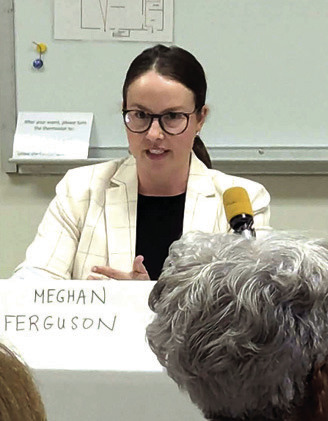
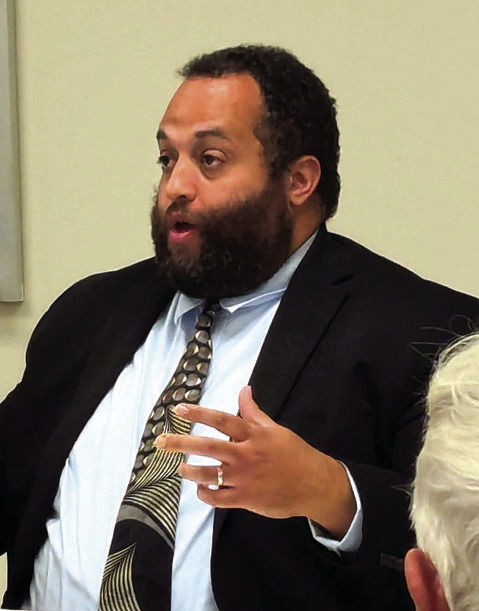
Voters also heard from Nicholas Betts, who is challenging Sigler in the special election for mayor, and Meghan Ferguson, who is also running for one of the three City Council seats available. Amber Ansted, the third City Council candidate who appears on the ballot, did not attend the forum, and while he was in attendance, write-in candidate Will Kirchner did not participate in the forum due to 50 Ways’ policy of limiting the forum to candidates whose names appear on the ballot. -For the mayor race, each candidate was asked three questions. The first inquired of each of them, “What is your leadership philosophy?”
Betts, who is approaching the end of his first term as a city councilman, said that his leadership philosophy centered having conversations with people because “every conversation is important.
“I think it’s important to figure out what people are good at, help them achieve what they’re good at, for their benefit as well as the benefit of the organization,” he said. “Where that comes into play as mayor is looking at who would be a good fit to serve on certain boards and commissions.”
He also highlighted adaptability and “the ability to have difficult conversations” as part of his philosophy that he would bring into play if elected mayor.
For his response, Sigler noted that he has served on Council under the city’s two most recent mayors – Mimi Elrod and Frank Friedman – both of whom had different styles of leadership. Elrod, Sigler said, “led from the front,” and would usually speak first on any issue before Council to let people know where she stood on it. Friedman, on the other hand, took a different approach and stood back, letting others speak their mind and only sharing his opinion “if it was needed.”
For his own approach to leading as mayor, Sigler said his personality “depends on the situation” and whether it requires him to take the lead or let others have the floor.
“The key to the whole thing is trust in the relationship,” he said. “I will be the right leader at the right time and pull the best out of all of my Council colleagues.”
The candidates were next asked how they would go about leading Council on issues if, as mayor, they don’t get a vote on said issue unless there is a tie.
Sigler said that he wasn’t worried about it, noting that he would “still have the opportunity to deliberate and share my opinion,” as well as opportunities to “be a spokesperson for the city” in addition to being able to “break ties when necessary.”
Betts said that one way he would lead without being able to vote on every issue that comes before Council is to have work sessions whenever possible, especially on issues that are more controversial or just need a more detailed discussion than can be achieved during a regular Council meeting. In doing so, he hopes to give everyone serving on Council the chance to weigh in on the issue and to hear from the public when appropriate.
“Whether [the vote] is 6-0 or 5-1 or split and you have to break the tie, you want everybody to be heard,” he said. “You want the public to be heard and you want to make sure that the conversations that were necessary to have were had before the vote was taken. I think the way to lead effectively is to hear everybody out and find where there is common ground and bring people together.”
The topic of split votes came up again for the final question, when candidates were asked about the benefits and drawbacks to Council having a “unified public stance” on any issues they vote on. Both Betts and Sigler acknowledged that having unanimous 6-0 votes was a good thing, but it wasn’t realistic to expect it every time Council voted. They also both felt that some members of Council disagreeing on an issue isn’t necessarily a bad thing.
“If we can find common ground, listen to what the public needs, and make decisions based on a consensus, having a uniform Council is a benefit,” Betts said. “I don’t see much downside, but it’s not possible to get a 6-0 vote every time. If everyone is heard and there is adequate time to discuss it, that’s okay.”
“Disagreement is fine,” Sigler said. “We’ve disagreed many times over my time on Council. And as long as that disagreement ends when the meeting is adjourned, that’s a good thing for the city of Lexington. A vote can be 4-2 or 4-3 or 5-1, but that vote represents the views of the public. That’s important and it’s important that the public knows that they have representatives that hear them. The vote might still be 5-1 and the five will win, but it’s really important that that one person says ‘I heard you all.’ And that’s okay.”
“We’re too educated as a community,” he added. “We have too many points of view. It’s just not reasonable to think we’re going to have 6-0 votes [every time]. … We’re going to have disagreements, and as long as the disagreements end when the gavel hits or by the next meeting, we’re good, the community is good, and we’re stronger for it.” -The forum began with a series of questions for the City Council candidates in attendance. The first question asked the candidates what the biggest challenge facing the city was and how city Council should address it.
Sigler said that the biggest issue the city was facing is one being faced by many people and localities around the country – affordability. For the city, he continued, the issue is showing itself most prominently in an increase in cost for capital projects. He compared the cost of building Waddell Elementary School more than a decade ago to the new Department of Social Services building which is nearly complete and “nowhere near as complicated,” noting that it cost about $250 per square foot to build the school and about $800 per square foot for the DSS building. He also noted that the cost of a firetruck has risen from $800,000 to $2 million.
“That’s hurting our local government just like our citizens are struggling with groceries, gasoline, childcare, everything,” he said. “We’ve got to be good stewards of your dollars. We’re trying to extend our resources longer … [and for] our capital projects, we’re value engineering what we can take out.”
Ferguson pointed to the city’s need to “balance competing priorities” as its biggest challenge, specifically the issues of modernizing the city’s aging infrastructure, paying city and school staff competitive wages as costs are rising, and keeping local taxes manageable as inflation continues to impact day-to- day expenses. She firmly stated that the city “cannot compromise on competitive wages” for its employees, but advocated for exploring more flexible benefit options outside of the Local Choice Network which could allow for some cost-saving measures for healthcare options.
Ferguson acknowledged that delaying updating the city’s infrastructure could be “dangerous and costly,” so not doing it in hopes of saving money isn’t an option.
“We need a proactive capital plan that leverages outside grants and funding without over-burdening our residents,” she said. “By controlling costs and pursuing other funding for infrastructure, we can protect our workforce without placing an unfair burden on Lexington taxpayers.”
When asked to name one thing the city was doing well and one area in which improvement could be made, Sigler gave the same answer for both: communication. He noted that the city made its agendas available six days before meetings (state law only requires a three-day notice of a meeting agenda) and had a weekly newsletter that people could sign up for, among other things. He also acknowledged that sometimes all of those options weren’t enough.
“You can communicate really well nine times out of 10, and it’s that 10th time where a citizen needed to know something and they didn’t get the message,” he said. “They didn’t get the memo. They weren’t on Facebook. They didn’t get the Alert Rockbridge [text message]. And that’s a shortcoming. We don’t have a public information officer, so we cobble together who can do the communication for such a small city, [and] while I’m proud of all that we do, sometimes we can do better.”
Ferguson pointed to the city’s schools as a “bright spot” of something the city does well. As for the issue that she felt the city could do better on, she pointed to the issue of “institutional encroachment” into the city’s historic downtown.
“While I understand that capital is needed to renovate and purchase old buildings, I do think the city can do more to maintain a vibrant downtown where people will want to shop, dine, explore and live. …We are already limited on land and real estate, so it’s vital to protect our downtown.”
The candidates were also asked about the Local Option Sales Tax referendum that is on the ballot for Lexington residents this year. If passed, an additional 1 percent sales tax would be applied within the city for the next five years with the revenue raised from it going toward school renovation and construction projects.
Both Ferguson and Sigler expressed their support for the tax, which would be used to pay for construction at Rockbridge County High School and the proposed recreation center, as well as for upcoming projects at Lylburn Downing Middle School such as replacing the gymnasium floor and work on the roof.
Ferguson noted that the tax, which will generate an estimated $1.3 million annually, will help pay for those projects “without relying solely on local residents as college students and visitors contribute significantly to our local sales tax.” Sigler added that the city won’t get a vote on the costs for the projects at the high school or the rec center and will “just be sent a bill for that” as per the cost-sharing agreement with the county.
Ferguson and Sigler each made reference to what the tax would and wouldn’t be applied to. It won’t be applied to groceries, gasoline, or personal hygiene products, but rather will primarily be applied to business sales, meals, and hotel rentals.
“I don’t rent many hotel rooms in the city of Lexington, so I would be happy to share the pain of this construction with those that do,” Sigler said.
With that said, Sigler did acknowledge that this proposed tax, even if not applied to every sale within the city, was still a tax and could have an impact on city residents given the issues of rising costs.
The candidates were also asked what role diversity, equity, and inclusion (DEI) initiatives played in the city government and if they impacted Council’s decisions.
Both Sigler and Ferguson put particular emphasis on the “equity” part of those initiatives, pointing to the fact that the city manager’s summary of each issue before Council includes items for both the issue’s environmental impact and its equity impact on city residents.
“That forces Council to consider how whatever we are deciding will affect the environment [and] how it will affect others in our community from an equity point of view,” Sigler said. “I really enjoy that staff does that for us.”
“In Lexington, evaluating equity isn’t a political statement – it’s good policy,” Ferguson added. “Equity means recognizing that people in our city start from different places and tailoring solutions for the same outcome [for everyone].”
For examples of ways in which City Council has worked to improve equity for residents, Sigler pointed to the recent purchase of a wheelchair accessible bus for Lexington City Schools with reserve funds and Ferguson highlighted the accessibility of Council meetings through video recording and streaming technology.