Rock Steady Boxing Nonprofit Helping Local Parkinson’s ‘Fighters’
At Rock Steady Boxing in Summit Square Shopping Center, one will find people with Parkinson’s disease in various stages of the progressive neurological disorder, and they are all fighters.
“They are not Parkinson’s patients,” said Elizabeth Apperson who established the Rockbridge affiliate of Rock Steady Boxing. “They become fighters, fighting for their lives, fighting against this disease.”
Rock Steady Boxing got its start after Scott C. Newman of Indianapolis, Ind., was diagnosed with Parkinson’s Disease at the age of 40. Newman chose to literally fight the disease by training with his friend and former Golden Gloves boxer Vince Perez. He soon discovered that this kind of training was helping to manage his symptoms, in particular the tremors that are often associated with the disorder.
Apperson’s inspiration for establishing a Rock Steady Boxing chapter locally was twofold. Her mother’s three siblings and her mother’s father all had Parkinson’s and Apperson has always been a boxing enthusiast.
“I always liked boxing as exercise and then when I learned that the two kind of went hand in hand, I wanted to help people with Parkinson’s.”
Apperson started Rock Steady in June 2024 because the closest one was in Staunton.
“I went up there and met with the director. It is quite the process to get it started. You have to go to Indianapolis and become certified.”
But she says that all the work it took to get the Rockbridge chapter started was worth it. “It is a great program, a phenomenal program.”
Initially the local chapter of Rock Steady Boxing held its classes at Flex Fitness. “They were amazing,” Apperson said. “They were gracious enough to let us use their space for almost two years.”
In its inception in the area, Rock Steady Boxing attracted the attention of Washington and Lee University students looking for volunteer opportunities in the area.
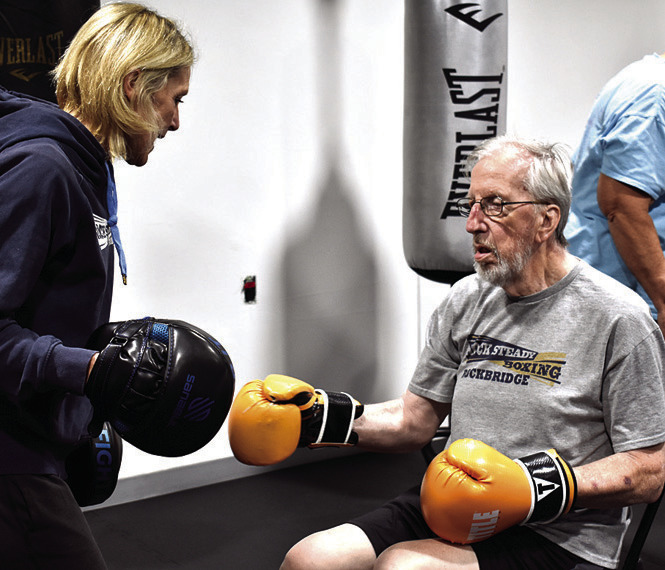
“They have been here from the beginning,” Apperson said. “They jumped on board to help out in the morning or afternoon. They go through assistant coach training, they help them put on their gloves, get their water, help with their balancing, have been very supportive. The university itself has been very supportive in helping find volunteers through community engagement fairs.”
When Rock Steady outgrew Flex Fitness, Apperson looked elsewhere. Luckily space opened up in Summit Square. The ribbon cutting was held in May. It was one of the last ribbon cuttings attended by Mayor Frank Friedman who died in July.
“I felt very honored to meet the mayor,” Apperson said. “He was such a neat guy and was so excited about the mission.”
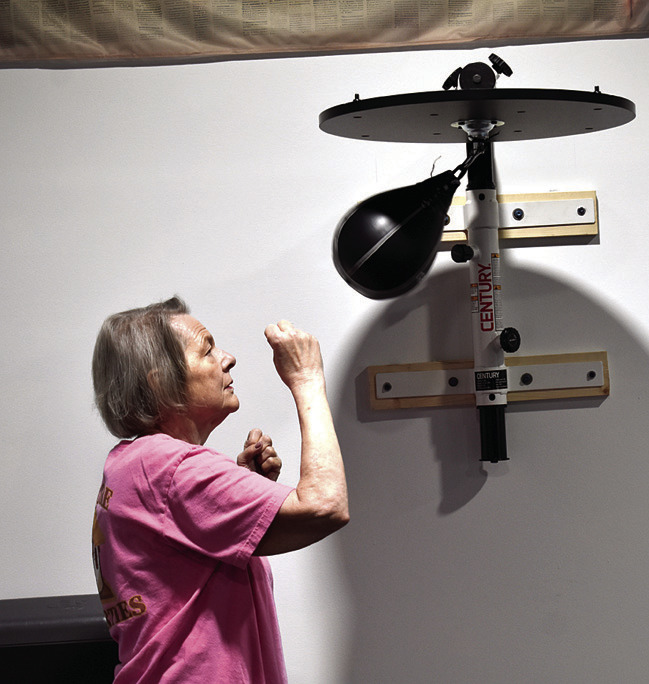
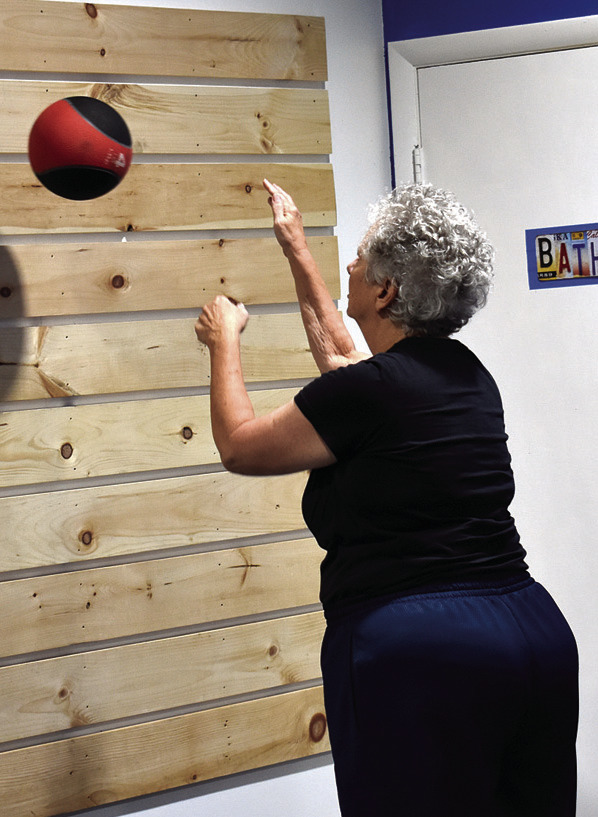
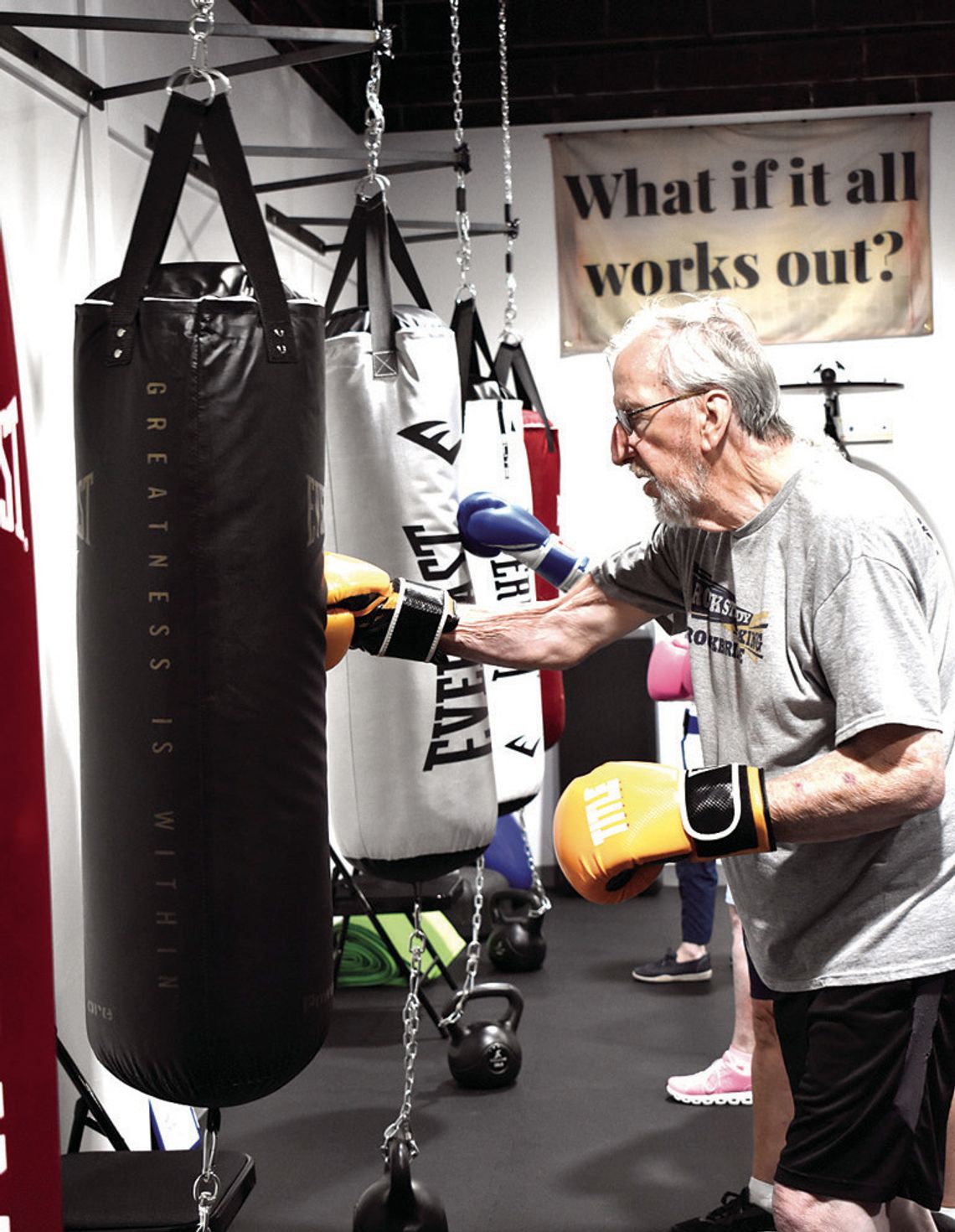
The Rock Steady Boxing studio in Summit Square looks like the kind of place where a boxer would train for a prize fight, with its full complement of punching bags, free weights and boxing gloves. The people using the equipment are involved in a high stake’s match in an invisible ring and their opponent is Parkinson’s.
“When they’re punching a heavy bag, that bag is Parkinson’s,” Apperson said.
The average length of a class is an hour and a half, with a warm-up that includes games like human foosball, in which the fighters use pool noodles to maneuver a beach ball from one end of the room to the other.
The activities are intended to work a lot of muscles, including voice exercises because the voices of people with Parkinson’s soften over time. Apperson encourages the fighters in her classes to shout as forcefully as they can. “It sometimes gets very, very loud,” she said.
There are different workout stations, and each fighter spends one a minute and a half minutes at each station.
Right now classes are being offered for people who are in the earlier stages of Parkinson’s Monday through Friday from 9:30 to 11. Afternoon classes for those with more advanced progression are offered in the afternoon from 1 to 2:30. “These people [in the afternoon classes] are less mobile and are in chairs,” Apperson said. “But we don’t want to label them. They are all fighters.”
Apperson urges people who have been diagnosed with Parkinson’s get into a class as soon as possible. Obtaining a physician’s authorization form is the first step. Once the fighter gets the doctor’s permission, Apperson does an assessment. For about an hour she watches them walk and assesses their balance to determine which class is right for them.
The youngest fighter is 60; the oldest is 91. When Rock Steady Boxing first began offering classes, there was one person enrolled. Now there are 30 fighters in the program.
Those who might be hesitant to become part of the program should know that they are not going to be judged once they walk in the door.
“They can trip or drool or shake and not be self conscious. It is a safe place,” Apperson said. “Everyone who has become part of this program is an instant family, a support network. Nobody’s competing against each other, They’re competing against themselves and their disease. They have more grit than anyone I’ve ever met. They give it all they’ve got. They don’t quit.”