Mount Vernon Historian Challenges Cadets During Convocation
Editor’s note: The following story was written by Marianne Hause, media relations specialist with VMI Public Information & Marketing.
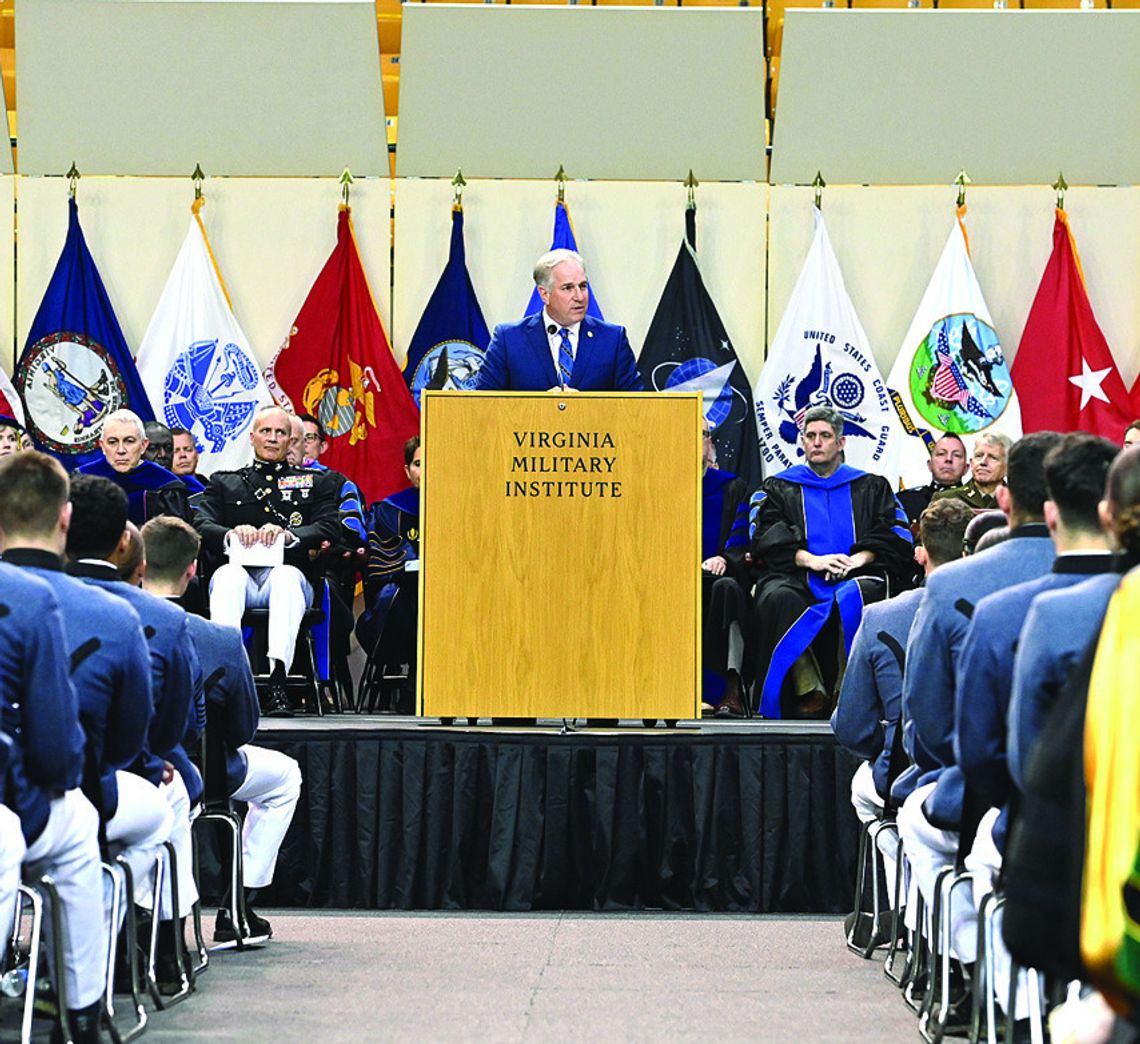
Virginia Military Institute opened its 187th year with a convocation ceremony, an annual tradition used to observe the opening of the academic year, Sept. 2 in Cameron Hall.
Guest speaker Douglas Bradburn, president and CEO of George Washington’s Mount Vernon, addressed the entire Corps of Cadets, members of the academic board, faculty, staff, and guests.
Bradburn opened his talk by asking the cadets what the 250th anniversary of the Declaration of Independence means to them as future leaders of this country, noting that even though 2026 is a year of celebration, there are irritations and challenges unique to the time.
“We are in the midst of a war. We have security challenges and all kinds of new things in cyber and AI that are going to frustrate us all. Partisanship is at an all-time high, some would say.”
Instead of being angry and frustrated, he encouraged his listeners to recognize the incredible story of the nation’s history.
He noted the 200th anniversary of American independence came right after the Watergate scandal, Similarly, at the centennial in 1876, the country was still scarred by civil war. Just 50 years after independence, the presidency had been so contested that it had to be decided in the House of Representatives.
“Then, of course we go back to 1776 itself. The Declaration of Independence is a critical marker in that moment when this nation in rebellion had declared itself free and independent. But it’s a lot easier to declare independence than to win it.”
He described how the army under Gen. George Washington initially suffered major setbacks and defeats, but Washington through the leadership skills he learned and developed, pressed on to victory.
Bradburn noted several lessons for the cadets to glean from Washington’s example of leadership.
The first lesson is to persevere and be resilient. “Winning independence was not inevitable,” he said. “It took extraordinary resilience and perseverance in the face of tremendous failure. Washington’s army would have to fight for seven more years with privation, corruption, foolishness, mistakes, and a cause that became oftentimes unpopular. But they struggled through it. In some ways, perseverance in a higher cause is the highest form of courage. It’s one thing to step into the breach in a moment and show extraordinary valor, but the Continental Army was able to persevere day after day toward a vision to establish the liberty that we often take for granted in this nation.”
The second lesson of Washington’s example is that leadership matters. “People have to step up and take on the challenge of leadership. In our case, we a re fortunate to have had one of the greatest leaders America has ever produced, George Washington, at the helm. He was the man that led the Continental Army, the man without which we would not have had a constitutional convention when we had it, and the U.S. Constitution, as written and ratified, would not have been ratified, and of course he was the first president of the United States.”
To illuminate Washington’s thoughts of being the first president, his sense of the moment, the role he held, and the work he was doing, Bradford read a passage from a letter Washington wrote to Catharine Macaulay Graham, an 18th-century English historian, the night he gave the first State of the Union address, ‘“I walk on untrodden ground. There is scarcely any action whose motives may not be subject of a double interpretation. There is scarcely any part of my conduct which may not hereafter be drawn into precedent.”’ Bradburn noted that Washington knew all eyes were upon him. “He was experiencing incredible pressure. Not thinking about a 24-hour news cycle, but the generational news cycle. He knew what he was there to create.”
The third lesson, and one of the most important values that has made America a free country, according to Bradburn, is civilian control of the military.
“This is a fundamental value that goes back to Washington’s leadership, by the way he built the armed forces 250 years ago,” he said. “He promised when he took his command that he would listen to Congress, that he would listen to civilian authority, and he promised that he would turn that commission in when the job was done. That had rarely been done throughout history. It’s incredibly rare that revolutionary struggles end in anything other than a military dictatorship ... When King George III of England heard that Washington was going back to a private situation at the end of the war, he said, ‘If he does that, he’ll be the greatest man of the age.’ That act of virtue, that selfless walking away from power, he would do again at the end of the presidency. It is why we have two terms for presidents in the United States. You serve as a public servant, then you become a normal citizen again.”
Bradburn closed by quoting Washington’s Circular to the States, ‘“It is yet to be decided whether the Revolution must ultimately be considered as a blessing or a curse: a blessing or a curse, not to the present age alone, for with our fate will the destiny of unborn millions be involved.”’ He then challenged the cadets with a final question, “Is this great experiment going to be handed off to the next generation stronger, intact, better, and more perfect? I think it’s a question still worth asking 250 years later. I look forward to seeing how the Corps of Cadets answers that question. For soon enough, you all will be running the country.” -The convocation was the first as VMI superintendent for Lt. Gen. David Furness, who spoke to the cadets prior to Bradburn’s address.
Furness reminded the Rat Mass embarking on its first academic year of the many avenues VMI provides to pursue an education. “We host conferences, you may attend competitions, experiment in the laboratory, go on field training exercises, and travel abroad.”
He then thanked the alumni and friends of the Institute for their continued support of the VMI Foundation, a key supporter of the programs.
Furness also congratulated the cadets whose hard work earned them the distinction for academic merit, and challenged all cadets to strive for academic excellence.
“Set goals for yourself. Stay focused, and strive to achieve these goals this academic year. Do not ever give up, and remember that excellence is a habit, not a singular act.”