The First 50 Years Of W&L
Washington Academy Moves To Permanent Home
Editor’s note: Welcome to the fifth and final installment of our series on the first half century of Washington and Lee University’s history written by Larry Spurgeon. This final part covers the seminal years from 1797 to 1803.
To paraphrase Charles Dickens, 1797 was the best of times and the worst of times for the trustees of Liberty Hall. Welcome news in January that the academy would receive Washington’s gift of James River stock was dampened by learning the Virginia legislature had repealed the 1782 charter, converting the academy into a public college. Most galling was the appointment of a new 20-person board of visitors that included only two current trustees, James McDowell and Andrew Moore.
The resulting dilemma left the trustees in a state of limbo for most of the year. In October, the office of rector was finally filled with the selection of trustee Dr. Samuel Legrand Campbell. He served only a year as rector, replaced by George Baxter, a 28-yearold alum who would lead the school for three decades.
It was not until November that Liberty Hall submitted a response to the legislature setting out its reasons for opposing the new law. Zachariah Johnston, a Rockbridge representative in the Virginia House of Delegates, was instrumental in persuading the legislature to pass an act two months later that repealed the earlier law and restored the original charter. The one proviso was that the name would still be Washington Academy.
For unknown reasons, the trustees waited more than a year to write Washington to acknowledge the gift. In April 1798 they wrote to the former president, claiming to have not received formal notification of the gift until the previous September – even though they had discussed it eight months before that.
Washington replied graciously in June 1798: “To promote literature in this rising Empire, and to encourage the Arts, have ever been amongst the warmest wishes of my heart. And if the donation which the generosity of the Legislature of the Commonwealth of Virginia has enabled me to bestow on Liberty Hall, now by your politeness called, Washington Academy, is likely to prove a means to accomplish these ends, it will contribute to the gratification of my desires.”
William Graham’s last years were full of troubles. The land he purchased on the Ohio River was hilly and forested. Most of the people he had hoped would relocate and found a community demurred. The men who sold the land sued him in Alexandria and he was compelled to travel there with cash to attempt a resolution. Graham entrusted most of the money to a friend, who loaned it to someone who became insolvent. In May 1799 Graham set out for Alexandria, and while in Richmond died of pleurisy, only 52. Buried in Richmond, his remains were moved to the W&L campus in 1911.
On Dec. 14, 1799, former president George Washington died after a short illness.
The board, students, and a “respectable number of Citizens went in procession” to the meeting house and heard Baxter’s eulogy.
For the next few years Washington Academy struggled to pay its debts and then, at the November 1802 board meeting, two subjects were discussed that would impacts its future. The first was the decision to purchase insurance on the school building from the Mutual Assurance Society of Virginia. Baxter signed the application for a three-story building made of stone and covered with wood, 41 feet long, 33 feet high, valued at $3,333.34.
The board also discussed reports that the Cincinnati Society of Virginia was expected to appropriate funds to “some literary institution.” The Society was founded in 1783 by officers of the revolution to perpetuate friendship and support families of veterans. It was named for the Roman soldier, Lucius Quintius Cincinnatus, who resigned his military commission to return to private life as a farmer. Emulating Cincinnatus, Washington resigned from the army after the Revolutionary War, and became the first president general of the Society.
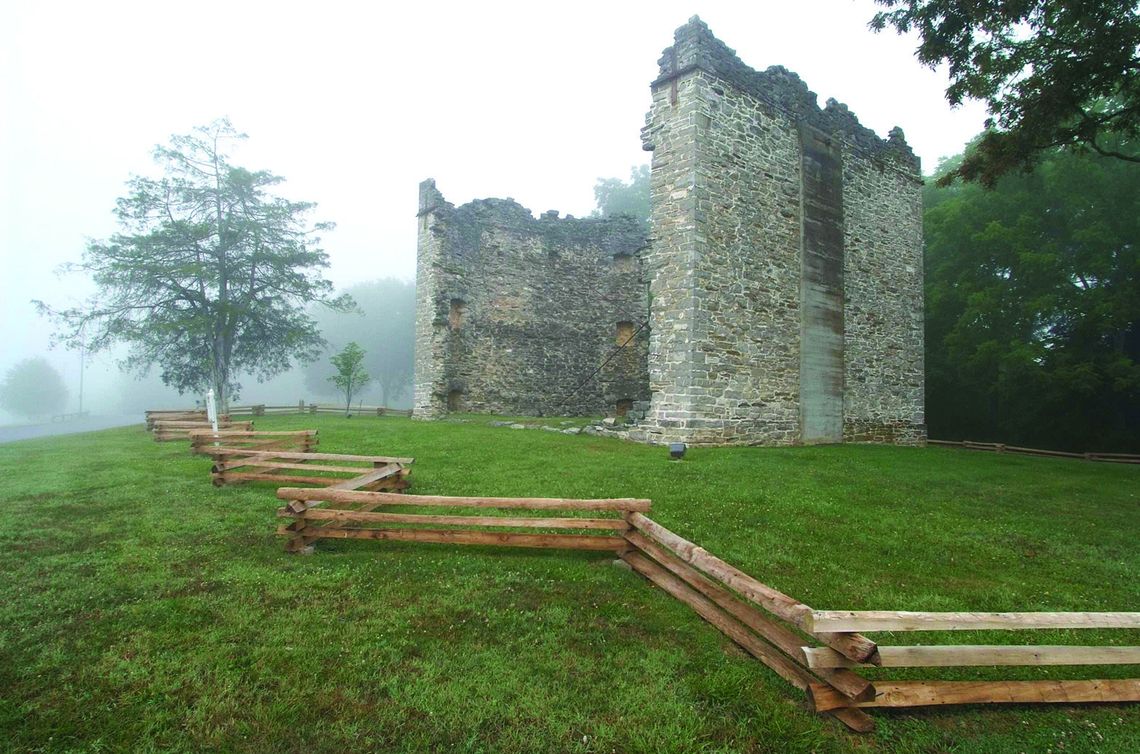
On Jan. 9, 1803. the academic building was destroyed by fire. The ruins still stand, with support, on West Denny Circle. A Charleston newspaper printed a letter that described what happened that night: “The first discovery of the flames was made by one of the students, who perceived a light through a small hole above their heads, in one of the upper apartments. They immediately ascended the stairs, which led to the belfry, but the flames had by this time so far extended within the roof, that all endeavors to suppress them were ineffectual.”
Quick action by students and local residents preserved most of the books and furniture. Academy operations did not terminate – local citizens showed “the most friendly attention towards the students; they received them at their respective homes … The building itself was lately insured.”
At the end of January a committee was instructed to “employ skillful workmen to view the ruins of the Academy.” The committee reported the next day that workmen “were decidedly of
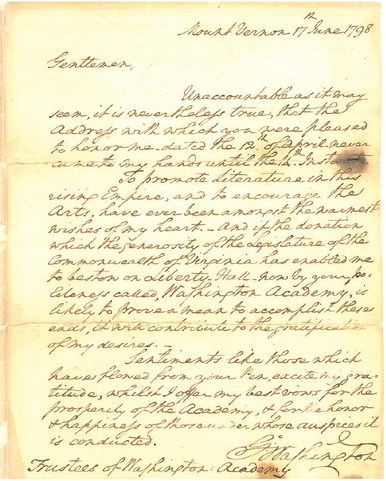
GEORGE WASHINGTON wrote this letter to the trustees of Washington Academy on June 17, 1798, from his home at Mount Vernon. The letter was in response to a belated letter from the trustees acknowledging Washington’s gift of the James River Company stock. “To promote literature in this rising Empire, and to encourage the Arts, have ever been amongst the warmest wishes of my heart,” Washington wrote.
opinion that the ruins cannot be repaired without more expence than profit.”
Blackburn informed the board on Jan. 31 that the Society of the Cincinnati had voted to “appropriate their Funds to the benefit of this Institution.” A newspaper reported the value of the gift as $20,000. The process required approval of the donation by the larger group of Society members, and the gift would be in the form of James River stock and Virginia lands.
The need to replace the school building allowed the trustees to reconsider an earlier idea to relocate the campus closer to Lexington. Four proposals were submitted, and the one accepted by the trustees came from in trustee Andrew Alexander, a swap of his land on Washington Street for the land owned by the academy. Two houses were on Alexander’s land – a cabin and an adjacent frame house his family had lived in. Baxter moved into the frame house, which served as the president’s house for decades. After Robert E. Lee had a new president’s house built on that site the cabin and frame house were disassembled and moved to north Randolph Street, where both can be seen today.
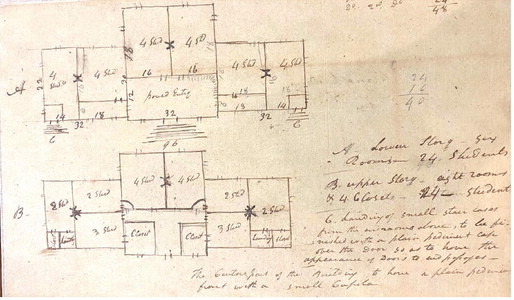
At the same March meeting, five trustees were tasked with contracting to construct three buildings at the new campus site. Two were to be 65 feet by 20 feet, and the third, the steward’s house, was to be 45 feet by 25 feet. The trustees decided to “employ a special messenger to wait on W. Hestings architect,” to request his attendance at a meeting the following week. The plans included a twostory central building to house students and teachers. The committee let out bids and selected two groups for the construction.
And so, after a half century of change in leaders, names, and locations, the academy found its permanent home. Many challenges lay ahead, but slowly and steadily the small academy in the Valley of the Virginia became the W&L we know today. Coda This series began by posing a question: “So, when did W&L start? The overarching question is whether a college – any college – can be a linear descendant of a grammar school. If not, then W&L began in the 1770s, at the earliest, with the establishment of a Presbyterian school temporarily at Mount Pleasant. If so, there is a factual question of whether W&L has a meaningful connection to the early grammar schools.
Using Occam’s Razor – the simpler explanation is preferred – let us turn to three of the earliest chroniclers of W&L’s history, all three intimately familiar with the school. Dr. Samuel Legrand Campbell, born about 1766 near Mount Pleasant, was a student at Augusta Academy. His father Charles became a trustee of that school in 1776, and his mother Sarah was the sister of Dr. Archibald Alexander and Andrew Alexander. Dr. Campbell was a trustee and served as rector after William Graham. In 1838, he authored an article in the Southern Literary Messenger, and in discussing the Mount Pleasant school, declared “Here Washington College drew its first breath.”
Dr. Archibald Alexander attended the academy at William Graham’s farm. In 1843 he addressed the alumni association in Lexington and characterized the Mount Pleasant school as the “germ which sprung this college.” I n a letter to Lyman C. Draper two years later, he credited his greatuncle, Robert Alexander, with establishing the first school in the valley, yet made no connection between that school and Washington College.
Henry Ruffner, classics professor and later president of Washington College, authored a history of the college published in 1857. He too considered the Mount Pleasant school as the “germ from which Washington College was ultimately unfolded.”
Some questions have no clear answer. In the end, what matters is that for a very long time W&L has been a top tier liberal arts university with a prestigious law school, profoundly impacting generations of students, and through them, countless others.