According to a survey by SafeWise published this year, our area is one of the safest places to live in the state of Virginia, with Buena Vista and Lexington ranking in the top ten. The Lexington and Buena Vista police departments and the Rockbridge County sheriff’s office keep our communities safe. These men and women, committed to serving and protecting, put their physical, mental and emotional well-being on the line for us all, but they are more than just their uniforms. These are people, with their own lives and stories. Why did they choose this line of work? What motivates them to keep going? How do they cope with the stress?
And what can we, as citizens, do to help with some of the common issues our local law enforcement officers grapple with to keep our localities the safest places to live in Virginia? In this interview series, we'll look behind the badge to see people, just like you and me, who choose to serve our communities in ways that make us safer and improve our quality of life.
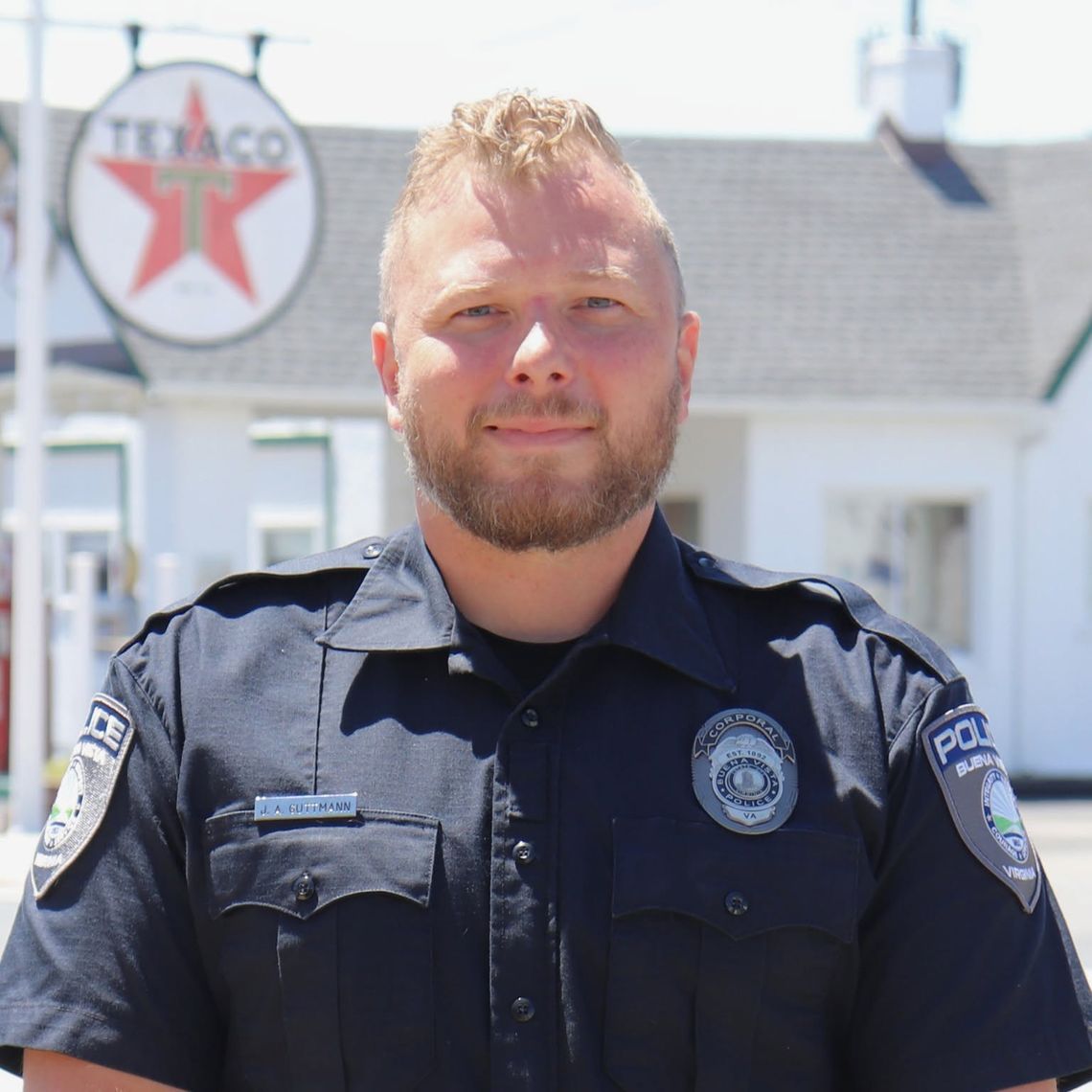
We spoke with Cpl. Josh Guttmann, the community resource officer at the Buena Vista Police Department. He's been in law enforcement for 21 years and is a self-proclaimed foodie who loves a unique pizza flavor. He said wood-fired is a big bonus.
Did you always want to be in law enforcement? If not, what was your original career path?
I have. Honestly my plan all through high school was to get into law enforcement.
What motivated you to become a police officer?
As a child, I was fascinated with history. I've always been a history fan and that was a really popular time, in the 90s and stuff, for like medieval times, Knights of the Round Table, King Arthur. So as a child growing up I was fascinated with knights. In my opinion, my perspective is that law enforcement are modern day knights. We wear shields just like they did back in the old days. Instead of a sword, obviously we carry other tools. So yeah, ever since I was I can't remember what age but since I was a child I wanted to be in law enforcement. First was baseball player. I wanted to be a major league baseball player. That's very hard. That is statistically very, very difficult, so this was my backup option.
Describe your journey from the academy to where you are now?
I went to school in the Atlanta school system. Back 21 years ago, law enforcement didn't have as many openings as they do now. It was a lot harder process to get into. So I moved here, to Virginia, right out of high school because I had my mom that lived in this area and distant family that were in law enforcement. So that was an open door.
I didn't start on patrol. I was a jailer. I started in the Department of Corrections at the age of 20 because they were the only people who would hire me. I worked for the Department of Corrections and then I transitioned to a regional jail down in Dixie Caverns. I was brought in as a transition team. I worked there for several years. I also became an instructor with the academy, in multiple facets. I kind of found my niche, that I enjoyed teaching 'use of force' stuff.
From there I moved to the Roanoke County sheriff's office, where I worked inside the jail. Then I moved over to administration while still doing my instructorships, which is actually what I enjoy doing the most. From there, I went to the law enforcement academy. I met an officer that worked in this department [at the Buena Vista Police Department] at a training and he was telling me about a specialized role that the Buena Vista Police Department just funded, and that was the Community Resource Officer position, and that just kind of fell into a lot of stuff that I enjoyed doing at the time, which was a lot of community policing events, crime prevention training, stuff like that. So I came here, met with the then-Chief Wayne Handley, got offered the position and I made the move.
What has been your favorite position, role or location?
So, I currently love what I'm doing now but my favorite niche that I've had my entire career has been teaching. That is becoming a certified instructor though DCJS (Department of Criminal Justice Services) in 2011. It started with general instructor, because everybody has to have that, but I've always enjoyed martial arts so I became a defensive tactic instructor. I dove headfirst into it. I started training on my own, doing Jiu-Jitsu and Muay Thai, just because if I'm teaching something I need to hold something. I need more than just the basic knowledge. I wanted to become more of an expert in that so I started training on my own, learning on my own but I love to teach that aspect.
Name a few of your daily tasks?
I manage our social media content. It's kind of funny, like you know the old school law enforcement mentality is 'you know we don't use social media' but that is the easiest way to connect with our citizens, the people we serve. It's the easiest way to connect because just about everybody is on social media whether that be Instagram or Facebook. It's a way for us to share updates and safety alerts. Almost daily I have to get on there because it's brand new to me; I'm still learning that kind of stuff. It's way different than normal police work.
We're working on a grant. So grant writing, it's really huge in this area as well because of funding. We don't have the same funding as LA, Richmond, Norfolk, Roanoke; you know [that] have bigger budgets. So grants are like pivotal for us to keep up with modern day policing tactics or equipment. Grant writing is now part of my daily tasks, either checking for grants or updating grants or following up with grants.
Oher than that, it changes. It depends on what is happening. I do a lot of community events. I have to go to meetings with our stakeholders, businesses, other departments and stuff like that to see what's happening in the community. So it varies from day to day. I'm dabbling in a hundred different things which makes it very fun.
In your position, what is the hardest part about the job?
My current capacity would just be trying to take on too much. I feel like there is so much that can be done in our community, so many improvements, more programs and stuff that we can bring to the community to kind of bring us all in together. So I become overwhelmed, personally, with just many different things that we're trying to work on at one time.
What is the best part? What motivates you to keep doing your job?
The same thing. I am constantly learning. I've always thrived in capacities where I have to learn and adapt. When I am stagnant, I get bored very easily and I'll try to create things to bring more stress to myself.
In previous departments that I worked for, I didn't have that freedom. I was pretty much assigned to a job task, even if I completed that job task in a very short amount of time I wasn't punished but I was not encouraged to expand. So if I completed my daily objective in three or four hours of an eight-hour work day, I didn't know what to do with myself with the rest of the time. So I would be like 'I want to go help with this community event' or 'I want to go help in the schools' or 'I want to do this and that' and it was like 'no, you gotta be at your desk.' So part of my current job is watching what the department can offer the citizens, more than just 'hey, don't speed,' 'how can I help you today?' or 'call 9-1-1 for this and that' but now we're building these programs like Triad. Then I come here and I'm the community resource officer and I'm like, 'what exactly is that?' and they're like, 'whatever you want it to be.' So it’s like, 'alright, let’s do this.' It's just constantly grabbing and finding things to work on. I have grown and my professional resume has grown as I have worked my way out of traditional enforcement to more marking and communications.
What do you do to unwind? Do you have any hobbies or unique skills/talents?
Obviously Jiu Jitsu has been a mainstay. I've not been able to train as much as I would love to; family life takes precedence over that kind of stuff. But an oddity which you didn't see but people comment when they come in my office is Legos. I enjoy building Legos with my kids. So I get to be my inner nerd. So yeah, building Legos would be my unique hobby. It’s very non-law enforcement related.
I kind of fell into it. Legos, obviously, have been big forever but as a child I never got into that world. As a child I was a typical sports child: riding bikes, going to play hockey, baseball and basketball, whatever sport the neighborhood kids were playing.
Collecting baseball cards, I still got a whole bunch of them down in the basement. I still enjoying kind of looking at some of the newer modern cards compared to when I grew up … still occasionally buy one for my collection. But Legos, I guess because of the relationship piece when it comes to like, finding a mutual ground with your kids so you can keep those communication lines open as long as you can.
Based on your professional experience, what is a common call type or complaint you handle in your position? What kinds of actions are taken in response? What kind of programs are in place?
I'll cover patrol once in a while, to help with vacations, time offs and stuff. Patrols are the number one foundation of the police department. I will back up the officers on calls whenever I can, for officer safety more than anything.
A common complaint: speeding in our area. We do target enforcement with our radar trailers or targeted patrols where we have an officer actually sit and run radar in those designated areas, just to monitor traffic, especially when we receive multiple complaints about certain areas, certain street, certain block.
In my current capacity we do a lot of stuff to address scams. The police department actually has this scam awareness training that I've taught twice so far in the last year. Triad is going to be a big proponent of that when it comes to elderly scams.
How can we educate the public on their role in crime prevention in our community?
We want the citizens to tell us. Obviously we can't do our job without the citizens so we want them to tell us what they encounter. And when it comes to scams, the shame that comes with it, a lot of people who are scammed, they don't report it to us all the time. They kind of isolate themselves and don't talk to their friends and family about it.
My big push is like, number one, you should call and tell us. Tell your friends and family. Have that open communication because a lot of times, they might not be aware that this is a potential scamming issue. So you can maybe prevent them from ever being scammed by sharing your personal story. It's not the victim's fault; it's never the victims fault. Don't be afraid, there's no shame in telling your story. Just, you know, obviously share your story with the police department so we can do a formal report and get information that we potentially use to prevent or even issue charges on the scammer. Then also tell your friends and family about scams that you're seeing or that you've heard about or that you've encountered so they're more well-informed. More knowledge is power.