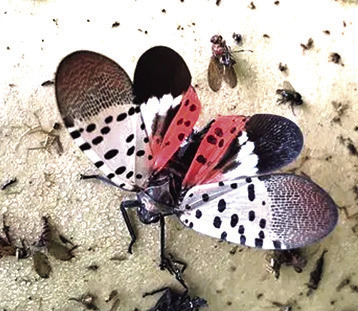
The Spotted Lanternfly invasion is here. Despite efforts to curb its advance, the inevitable wave of this latest non-native invasive species is crashing over Rockbridge this year as it did in Pennsylvania seven years ago and Maryland four years ago. M any folks a re a sking “what can I spray to kill these things?” T he better question is “Should I spray?” and I contend in most cases the answer is a very firm no. The effective sprays are generally contact insecticides and only the SLF that come into direct contact with the chemical will be affected. The sprays are at best marginally effective at adhering to the surfaces so achieving effective protection from SLF requires frequent re-application and even then is only marginally effective.
There are few reports of trees having died from an SLF infestation in Pennsylvania or Maryland, which has been experiencing high levels of SLF for some years. Research by Penn State University showed the rate of deciduous tree growth is only marginally impacted by even very heavy SLF infestations. The exceptions appear to be grape vines and young fruit trees. T hese particular plantings appear to have special appeal to SLF and therefore are more vulnerable.
The contact sprays that can kill SLF have one of these active i ngredients: B ifenthrin, Carbaryl, Zeta-cypermethrin, Malathion, and Tau-fluvalinate + tebuconazole. Insecticides that are listed as certified organic and effective on SLF are Neem oil, Natural pyrethrins, and Insecticidal soap. Insecticides are more effective on the nymph stages of SLF.
From mid-July until early September systemic insecticides such as dinotefuran or imidacloprid can be effective at preventing SLF feeding. These products are applied as a soil drench or trunk spray. Systemic insecticides are absorbed by the tree and circulate in the plant’s vascular system so the insect consumes the insecticide when it bites the plant. Only use systemic insecticides after the treated plant is done flowering for the year in order to protect pollinators. Because of the nature of systemic insecticides there are strict guidelines for their use in fruit-bearing plants.
Spotted Lanternflies are a nuisance. Anyone who has recently parked their car under a shade tree for a few hours may have returned to find the vehicle spattered with a light coating of sticky residue from the sap-sucking SLF perched on the limbs above. B ut our natural predators (birds, predatory insects, other wildlife) will eventually discover SLF is a food source and the population will subside. But, similar to our experience with brown marmorated stinkbugs more than a decade ago, this is a process of years and they never completely go away.
As has been addressed in this column more than once, the best strategy is to remove and destroy the SLF’s favorite tree for nesting and egg-laying: the Ailanthus tree (a.k.a. “Paradise Tree” or “Tree of Heaven”). For more information on Spotted Lanternfly or control of Ailanthus trees, contact the Rockbridge Extension Office at (540) 463-4734, by email at [email protected] or come by the office located on the second floor of the Rockbridge Administrative Building, 150 South Main Street in Lexington.