The First 50 Years Of W&L
Washington’s Gift
Backstory Of Pivotal Moment Spanned Decade
Editor’s note: This week we resume our series on the first half century of Washington and Lee University’s history written by Larry Spurgeon. Part 4 tells the story of George Washington’s gift of James River Company stock to Liberty Hall Academy.
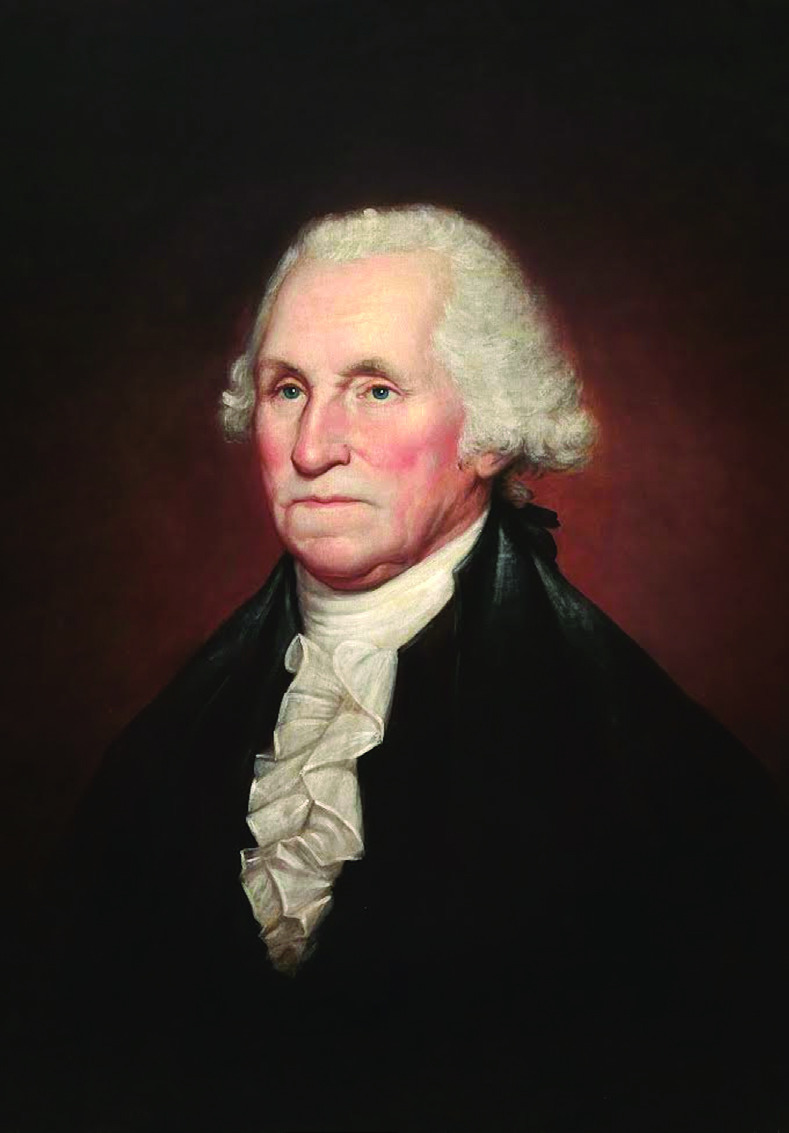
George Washington’s gift, the most significant event in Washington and Lee University’s long history, keeps on giving, not only in direct financial return, but in promotional capital. Justifiably a point of pride, the backstory of how it came about is not well known.
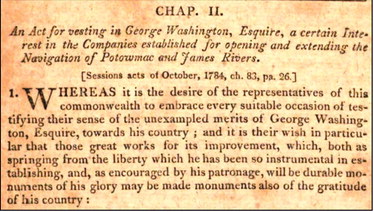
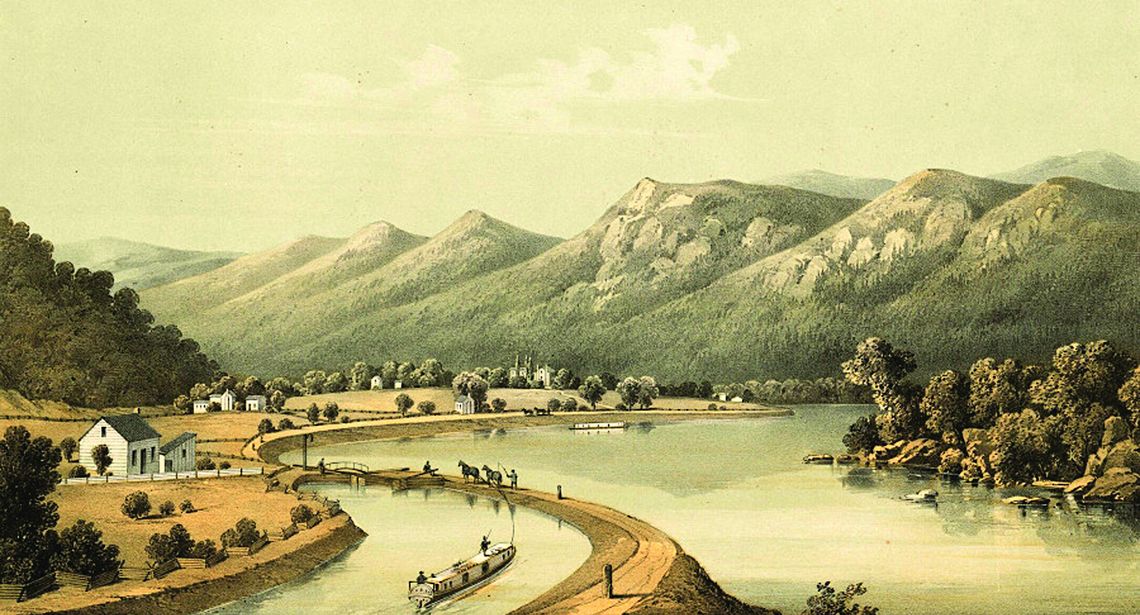
The process spanned more than a decade, beginning in December 1784, when the Virginia legislature chartered two companies to clear and extend navigation of the Potomac and James rivers. Few subjects were closer to Washington’s heart – in fact, he proposed the companies and closely followed the legislative process.
A few weeks later James Madison, a member of the Virginia House of Delegates, drafted a bill to show appreciation to Washington for his long service to the commonwealth. The plan was to award 50 shares of stock in the Potomac River Company and 100 shares in the James River Company. The latter gift alone had a value of $20,000, equivalent to over $650,000 today. Madison’s bill was swiftly approved by both houses.
Ever sensitive to perceptions about his character, Washington worried the stock would be viewed as payback for his efforts in promoting the river companies. Yet, as he explained to Lafayette, he did not know “how to decline it without appearing to slight the favors of my Country – committing an act of disrespect to the Legislature – or having motives of pride.”
Washington decided to place the shares “in trust for the use & benefit of the public,” unless the legislature would agree to fund a school on each river “for the Education & support of the Children of the poor & indigent of this Country,” in particular children of the men “who have fallen in defence of the rights & liberties of it.”
He advised the legislature in October 1785 he would not accept the shares personally, but if the legislature would convert the funds “to objects of a public nature, it will be my study in selecting these.” The legislature repealed the earlier law, and enacted a new one providing the shares, with tolls and profits, would be “appropriated to such objects of a public nature” as Washington directed by deed or will.
Washington had effective control of the shares for the next decade, until midway through his second term as president, because the shares were not productive until then.
In March 1795, Washington wrote Gov. Robert Brooke he had learned a new university was to be established in the “federal city,” a joint effort of Maryland and Virginia, and he believed the Potomac Company shares should go to that university. He presumed the legislature would prefer the James River shares be donated to a Virginia institution.
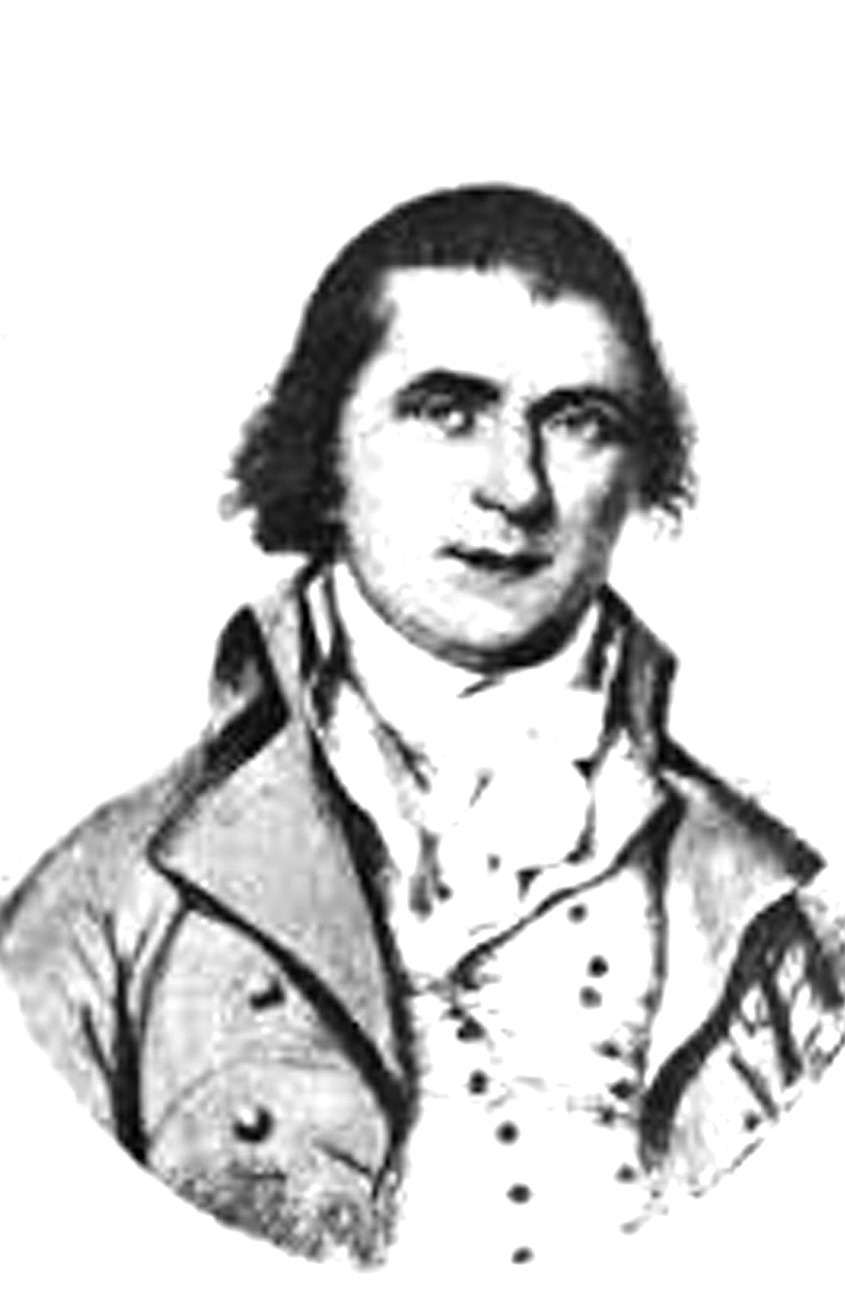
Meanwhile, Liberty Hall was struggling financially, and in October 1795, the trustees determined that “some aid from the public was necessary to preserve it from sinking into an useless condition.” Samuel Houston, Dr. Samuel L. Campbell, and Andrew Moore were named to a committee to draft a petition to the legislature. Moore, a former student of Augusta Academy, was a member of the U.S. House of Representatives.
Finding it politically inexpedient to make the selection due to rivalries among potential recipients, the legislature adopted a resolution in December requesting Washington to select “a Seminary at such place in the upper Country as he may deem most convenient to a majority of the Inhabitants thereof.”
Former Governor Gen. Henry “Light Horse Harry” Lee, the father of Robert E. Lee, advised Washington that “the college ought to be placed at Staunton; there or Lexington certainly – There is no necessity for immediate decision, & of course you will not be in a hurry.” Few people better understood Washington’s methodical decision making.
On Jan. 5, 1796, William Graham informed the trustees of the news, and they agreed to write to Washington about the gift. Two days later a letter posted to Washington explained that in 1776 the trustees established a “Seminary before conducted in these parts under the form of a grammar school.” Despite the obstacles of “a long and dangerous war, and the deceptions of a paper currency,” they were “enabled to preserve the Academy in a state of considerable reputation.” A permanent location for the school buildings was chosen in 1793 “on an eminence about three quarters of a mile from Lexington.”
At least seven locations sought the prize, though most did not yet have a school. Lexington’s main competition was Staunton, an established town with its own academy. Leading that effort was Archibald Stuart, whose father had donated land to the school at Timber Ridge. Stuart attended Liberty Hall be