Go to main contentsGo to main menu
Wednesday, June 17, 2026 at 10:51 AM

“Celebrating Independence, In 1776”

“Celebrating Independence, In 1776”
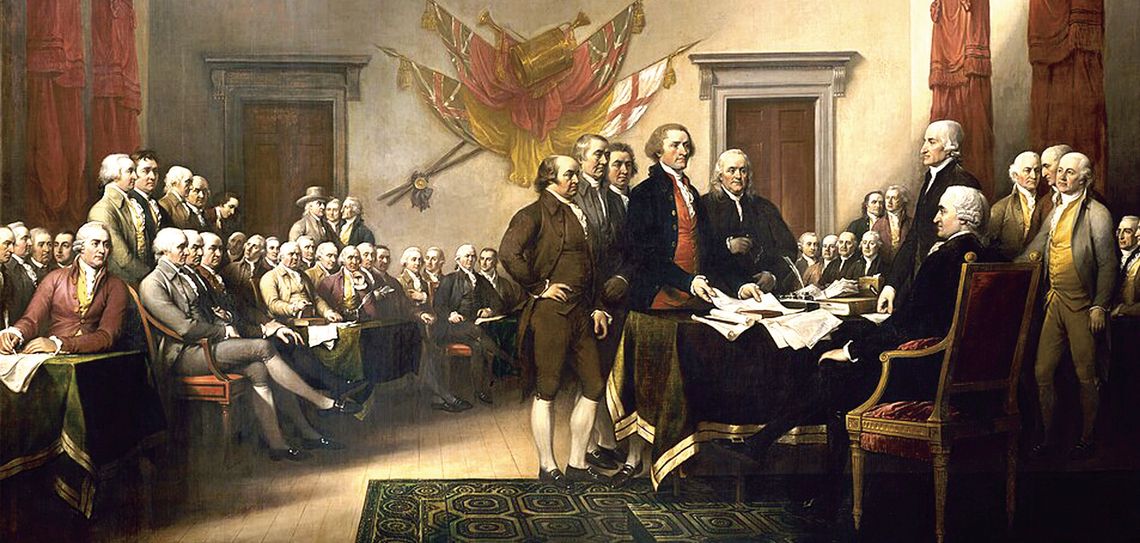
JOHN TRUMBULL’S “The Declaration of Independence” (1819) was one of four massive 12x18-foot canvases, commissioned by Congress, that were jointly installed and still stand in the U.S. Capitol Rotunda, as part of the United States’ first large-scale Jubilee Celebrations, in 1826. (image, Wikimedia Commons)

Revolutionary Moment

Local ‘Oath’ From 1777 Rediscovered

Editor’s note: This is the 10th in a series of “Revolutionary Moments,” authored by Rockbridge Historical Society Executive Director Eric Wilson and other local historians to celebrate the 250th anniversaries of America and Rockbridge, from 2026 to 2028. This article centers on the development and first receptions of the Declaration of Independence in the 1770s, with others to follow on later commemorations of July 4, and the 1976 Bicentennial, in Rockbridge. The News-Gazette and RHS invite you to contribute your own memories, memorabilia, and photographs from the Bicentennial celebration in a community-sourced enterprise, to be shared in a future edition. Contact [email protected] to add yours to that publication. To share your items with the public at Wilson’s June 28 program (see calendar of events) or to discuss prospective donations to RHS’ local history archive, contact Director@RockbridgeHistory. org.

For the past five years, a cultural initiative called “Made By Us” has invited Americans to collectively celebrate “The Civic Season.” The window at hand is framed by the twoweek run of summer holidays and national commemorations that extend from Juneteenth (our most recent federal holiday, observed this coming Friday); through Flag Day observances of the creation of the U.S. Army on June 14, 1775; capped by Independence Day, reaching its “semiquincentennial” anniversary this year, on July 4.

“Made By Us” was launched in 2021 by a coalition of over 400 museums and historic sites (the Rockbridge Historical Society among them) and Youth250: a Gen-Z-driven non-profit led by young adults in their teens and 20s (including student ambassadors here in Lexington.) To echo the description of America’s first 13-star flag, this “new constellation” of gatherings and events fronts both a renewal of core democratic principles, alongside a more forward-looking promise of collective, neighborly commitments at a local level, with national resonance. As Ken Burns routinely emphasizes in his recently released documentary, “The American Revolution,” “US” connects both personally known neighbors and communities (the more familiar “us” we often tacitly identify with), with the comprehensive ties within the U.S., our United States.

In purposeful ways, this commemorative fortnight aims to extend a more singular holiday – not least during the semiquincentennial anniversary of this particular July 4, 2026 – in more reflective and connective ways. But as with most holidays, a central question is not just what to celebrate, and how … b ut w hen. T o r iff o ff J efferson’s own famous phrase in the Declaration of Independence, those dates were not always “self-evident” nor collectively shared.

Declaring Independence, … But When?

From the start, there were other candidates, alternative benchmarks for our national “origin story.” In many ways, July 2 makes even more sense. Indeed, that was long the stated preference of John Adams, in flagging the overtly political act of independence, finally and formally breaking allegiance to the British Empire after two years of debate, dissent, compromise, and increasing complaint. Drafted and revised by a five-person committee (if generally associated more singularly with its principal author, Thomas Jefferson), “The Declaration” itself remains, at core, a speech act, not a constitutional or legally binding document. In effect, it was issued as a sort of coda. Its designated purpose was to explain the unanimous decision just taken to the general public – and the governments of the 13 former colonies now claiming themselves as independent states – framed with an inspiring preamble, and a strikingly pointed list of 27 grievances against King George III.

The Declaration was approved as it stands today on the afternoon of July 4, sharpened by two days of revision of Congress’ official vote to break from Britain. The first printed copies of the document were issued on July 5 (bearing only the signatures of John Hancock and Charles Thomson, the president and secretary of the Continental Congress). Signings by states’ delegates would not broadly begin for another month, on Aug. 2, 1776.

In the meantime, excerpts were quickly and widely relayed to newspapers, first reaching Williamsburg’s Virginia Gazette for a full printing on July 26. And its terms would be heard by nonliterate audiences in a growing wave of public readings and orations delivered at local courthouses and churches. In the Gazette’s preface, Virginia’s new Council directs “the sheriff of each county in the commonwealth to proclaim the same at the door of each courthouse on the first court date after receiving the same.”

Most notably, its first large-scale proclamation came in Philadelphia on July 8, read by Col. John Nixon outside the Pennsylvania State Hall (now Independence Hall). General Washington instructed to have it read aloud to his Continental troops in lower Manhattan the next day. Emily Sneff’s just-released book, “When The Declaration of Independence Was News,” more broadly reveals how this founding document was publicly proclaimed, circulated, and critiqued – not just by American patriots, but across the Caribbean and Atlantic, debated in Parliament, translated into German and French, and shared with Native American allies.

Roads to Revolution

But in important ways, the Continental Congress’ “Declaration” should be seen as a culmination: less an original document than one with grassroots origins that complement its Enlightenment principles. A “Committee of Correspondence” between the colonies had been established in March 1773 to advance more coherent discussion of such matters between states, and many regional differences of opinion. But local citizens and municipalities were also driving the momentum and shaping the rhetoric of liberty, dissolution from Britain, and self-government.

Here in Virginia, on July 18, 1774, a set of resolutions drafted by George Mason would be adopted by protesting landholders at a Fairfax County convention chaired by George Washington. As characterized by Virginia Humanities’ Encyclopedia Virginia, they “rejected the British Parliament’s claim of supreme authority over the American colonies, demanded equal constitutional rights, and called for a united colonial boycott of British goods … the longest, most detailed resolutions written by disaffected Virginians in 1774,” even preceding the colony’s First Virginia Convention that August.

Similar “Resolves,” “Resolutions, and “Oaths” would call scores of men to sign their names in Augusta and Fincastle in January and February 1775, flanking what would become Rockbridge County, halfway through the War for Independence in 1778. Collectively, these local and regional declarations of political purpose, demands for rights, and assertions of liberties were published months before “the shot heard round the world” on the Battle Green of our namesake, Lexington, Mass., April 19, 1775. Their cries rang out a full year and a half before Jefferson, Adams, and Benjamin Franklin finalized the broader Declaration in Philadelphia, with the newly confederated states finally having reached consensus, building on a popular groundswell of opinion, and an accelerating war across the Atlantic seaboard, Canada, and the Caribbean.

AFTER ITS FIRST printing on July 5, 1776, the first public proclamation of the Declaration of Independence was read on July 8 by Col. John Nixon from the Pennsylvania State House, now Independence Hall. (Library of Congress image)

Notably, in our own archives at Washington and Lee University Special Collections, we recently rediscovered a remarkable document, dating to Aug. 30, 1777, the summer before Rockbridge County was chartered, and signed into law by Governor Patrick Henry, Jan. 24, 1778. It leads with a paragraph-long oath severing ties with the king, affirming new allegiances to both Virginia and the United States: “I do swear that I renounce and refuse all allegiance to George the Third King of Great Britain his heirs and successers and that I will be faithfull and bear true allegiance to the commonwealth of Virginia as a free and independent state and that I will not at any time do or cause to be done any matter or things that will be prejudicial or injurious to the freedom and independence thereof or declared by Congress & also that I will discover and make known to sum one justice of the peace for the said state all treasure or traitorous conspiracies which I now or hereafter shall know to be formed against this or any of the Unted States of America so help me God.”

Excerpted in the photograph with this article, 94 area men signed their names to this earnest revolutionary cause, and risk. Their self-subscribed names spool out in three columns, filling out a long page and onto the back, with more being added a few weeks later, in September.

Among them, a range of names long familiar to Rockbridge history and descendant families, including several McCluers, McCorkles, Mc-Nutts, Paxtons, as well as future Revolutionary War veteran and Washington College benefactor John Robinson. Some would have fought with the British during the French and Indian War. Others, surely, had already been called to militia service for the patriot cause, nearly two years now after Virginia’s first battle at Great Bridge.

RHS board members and volunteers are actively working to research the identities and revolutionary roles of those signatories – and the ways in which it may have been locally publicized – while developing a new exhibit on “Revolutionary Rockbridge” for our own semiquincentennial commemorations in 2028.

Rituals of Independence: Fireworks, Orations and Toasts

Virginians have a habit of claiming to be first; tellingly, the official motto of our current VA250 Commission is “America. Made in Virginia.” And while other states and events may make their fair claims of priority, it’s fair to note that the first fireworks celebrating independence were launched in the still-colonial capital of Williamsburg, May 15, 1776, well before the more heralded events in Philadelphia on July 4.

Earlier that day, the Fifth Virginia Convention voted unanimously to send state delegates to the Continental Congress “to declare the United Colonies free and independent states absolved from all allegiance to or dependence upon the crown or parliament of Great Britain.” The formal Congressional resolution would be put to the assembled colonial representatives, formally put forth by Virginian Richard Henry Lee on June 7, followed by a month of deliberations and drafting before its approval on July 2.

In spite of his own advocacy for that earlier national “birthdate” of July 2, John Adams later proposed: “thismemorable epoch in the history of America … will be celebrated, by succeeding generations, as the great anniversary festival. It ought to be commemorated as the day of deliverance by solemn acts of devotion to God Almighty. It ought to be solemnized with pomp and parade, with shows, games, sports, guns, bells, bonfires, and illuminations from one end of this continent to the other from this time forward, forever more.”

Although fireworks wouldn’t catch on as a broadly popular tradition for some years, a range of other celebrations and tributes developed variously in early America, and more globally. In 1801, the newly elected President Jefferson hosted the first July 4 ceremonies at the White House: headlined by the Marine Band, a military parade, and a festival on the north grounds with races, food, and drinks. In his characteristically democratic posture, he opened the Executive Mansion to citizens, military personnel, and a group of Cherokee tribal leaders.

Nationally and internationally, in the late 18th and early 19th century, George Washington’s birthday would increasingly stand as a prime signifier for revolutionary liberty. And the stage was set for America’s first big Jubilee of 1826, with the yearlong “victory tour” of the Marquis de Lafayette in 1824-1825, as communities and veterans themselves rallied to herald the triumphs at Yorktown, even as cycles of revolution, reactionary backlash, and radical violence had torn France and Europe apart in those five decades since.

Famously, July 4, 1826, would cement the ceremonial date into American memory, with the deaths of Jefferson and Adams that same day – joint authors of the Declaration itself – exactly and uncannily 50 years after the date of its adoption. In a letter to Margaret Bayard Smith in March 1801, Jefferson had written. Closer to his death, in 1823, he reflected: “The continued repetition of these commemorations thro’ ages to come, and the faithful preservation, pure and unchanged, of the spirit of that great day which gave them birth, will be themes of unceasing prayer with me.”

I’ll return to the growth of those celebrations in future issues – across the evolving march toward Philadelphia’s Centennial Exposition of 1876, and during the hallmark nationwide Bicentennial celebrations of 1976, which is also the subject of the slideshow program I’ll be presenting at Lexington’s Community Center on June 28 (3 PM, 300 Diamond St.) Together, they offer timely, comparative, and often colorful lenses to reflect on both the means and meanings of our own gatherings, remembrances, and more spirited tributes in this 250th anniversary year.

IN THE WEEKS following its approval, excerpts of the Declaration circulated to newspapers across the newly constituted United States. The first full printing of its text in Virginia came on July 26, 1776, with directions that it should also be read at county courthouses by the local sheriff, on the first court day after receiving the news. (Virginia Gazette, Library of Virginia)

HELD in W&L’s Special Collections archives, with a reproduction now on display at the RHS Museum, this 1777 Oath of Allegiance – to both the commonwealth of Virginia and the United States – was subscribed by 94 men from the area, several months before Rockbridge County would be signed into law, in January 1778. Similar resolutions for independence were proclaimed in Augusta, Fincastle and Fairfax, even before the Virginia Convention and Continental Congress passed their own versions, demonstrating the importance of local commitments and initiative, before and during the early years of the Revolutionary War.


Share
Rate

Subscribe to the N-G Now Newsletter

* indicates required

Intuit Mailchimp