Improvements Follow 2024 Incident At Plant
Recently completed upgrades at the Maury Service Authority’s water treatment plant will serve to prevent another over-chlorination event like the one that occurred almost two years ago.
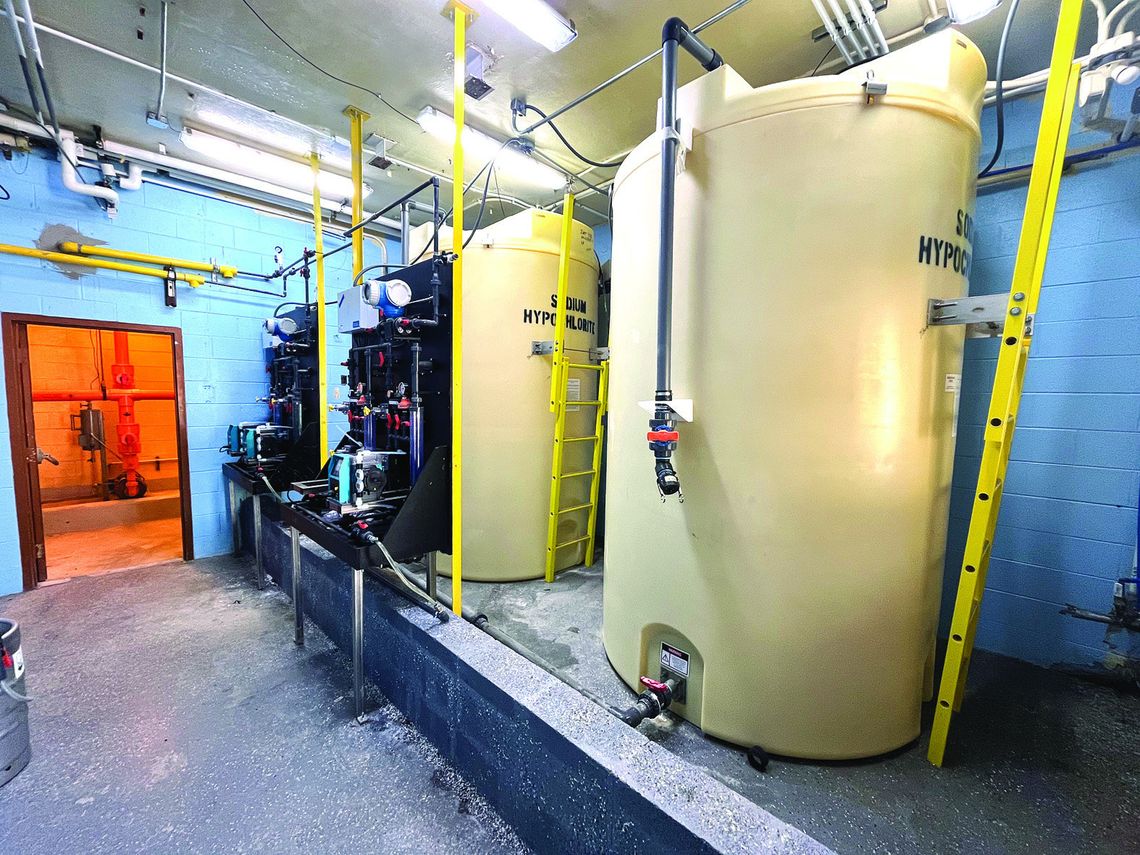
In a press release this spring, MSA Executive Director Jordan Combs announced that new storage tanks had been installed at the plant for the sodium hypochlorite used to treat and decontaminate the water.
Each tank has a 1,500-gallon capacity and is double-walled, which allows for an extra layer of safety. If the interior wall of the tank were to fail, there is a secondary wall surrounding it capable of holding the entire capacity of the tank plus a little extra for good measure. The two tanks are also now in their own separate storage room on the plant’s first floor with a containment wall to prevent any spills that would occur if both walls of either tank failed from flowing into the water system at the plant.
Each tank has its own fill line to prevent overfilling. A typical sodium hypochlorite order for the plant is 1,400 gallons, so one order would fill one tank. Level indicators for each tank will track the amount and assist in deliveries to avoid a rapid overfill like what occurred in June of 2024. There is also a new chemical feed system connected to the tanks which included leak detection. The tanks were installed last year and went online in October of last year.
Additionally, the MSA also upgraded the system that feeds Poly Aluminum Chloride (PACL), a coagulant that is used to remove the particles that cause turbidity to separate from the water for removal. The upgraded system includes two new chemical feed pumps, a flow meter to measure how much PACL is being pumped into the system and new plumbing with leak detection systems. That system was completed and brought online last June.
“I am proud of the MSA team for pulling this project together,” Combs told The News-Gazette in an email. “They are passionate about sustainably providing clean water and care about this community. Josh Fore (MSA water operations manager) and James Perry (MSA operations support manager) really took this project to heart and lead their teams in completing this work. I can’t ask for better leaders and teammates. [They] really knocked this out of the park … [and] the MSA board was very supportive through the whole process.”
Plans to upgrade both systems were in the works before the June 2024 over-chlorination incident, but the incident helped highlight how much the upgrades were needed.
The final cost for the installation of the system was $163,360, well under the estimated $637,380 in the preliminary engineering report completed in 2022. Part of the savings came from elements of the project being completed in-house by MSA staff, combined with “careful financial stewardship” by the MSA over the past seven years which provided “strong financial reserves” that could be utilized to help fund the projects.
The over-chloriniation incident occurred on June 4, 2024, when 2,800 gallons of sodium hypochlorite – double a typical order – was pumped into the plant’s storage tanks, causing the tanks to overflow and the excess chemical getting into the water at the plan.
The contamination resulted in chlorine levels of more than 100 parts per million in water at the plant, well over the 4.0 parts per million permitted by the Virginia Department of Health. Some chlorine remains in the water as it leaves the plant and moves through the system to prevent bacteria from regrowing, and the water that leaves the MSA plant typically has between 1.5 and 2.0 parts per million of chlorine, Combs told The News-Gazette at the time.
The MSA was able to use the water at the Enfield Clearwell and then the Grassy Ridge Tank to keep the water system that supplies Rockbridge County and Lexington operational at full capacity while the water at the plant was dechlorinated to safe levels, a process which took nearly 40 hours to complete. There was no interruption to service for customers during the incident, but Combs told The News-Gazette at the time that “We were getting mighty close to it.”
“I don’t know that I’d categorize it as a catastrophic event, but I do think we did get very close to the point that people were going to lose water pressure and water services, which is a very big deal,” he said. “We didn’t get into any of that. We were able to manage it, and … we were able to avoid that and mitigate it to the point where we didn’t have any of those [issues].”
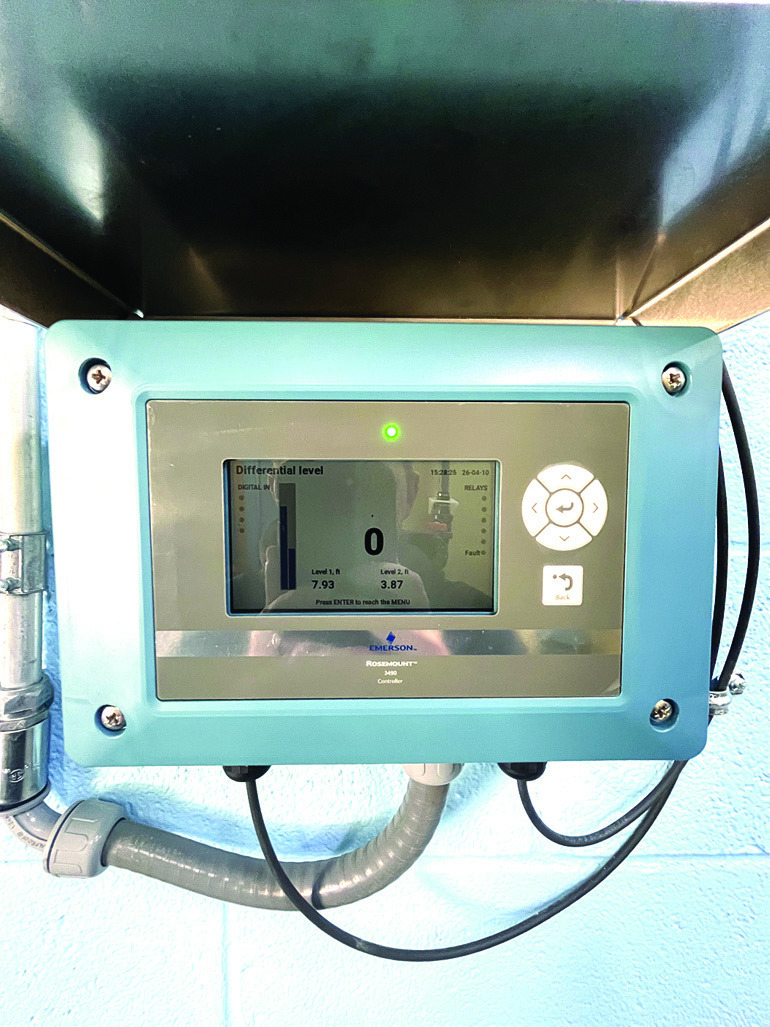
AMONG the upgrades made to the MSA’s chlorination system is a level indicator with an easy-to-read digital display that tracks the levels of each of the two new storage tanks.
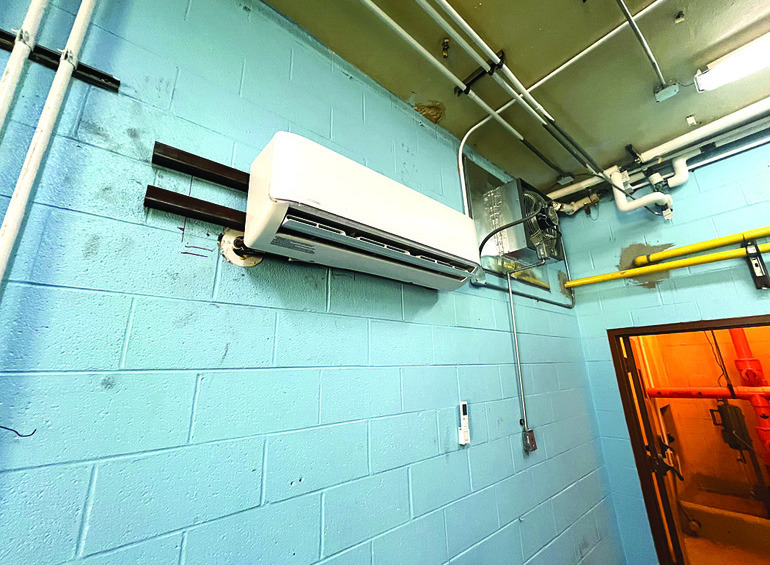
A VENTILATION and temperature control system was also installed in the room to further regulate the system.