RHS Lecture, Film and Book Series, Birthday Party Focus On Founder
Editor’s note: The following article is the eighth in the series of “Revolutionary Moments,” written and edited by Eric Wilson, executive director of the Rockbridge Historical Society and regional cochair of Rockbridge250, commemorating two and a half centuries of local and American histories since the nation’s founding in 1776. This article is co-written with W&L Professor of Politics Brian Alexander.
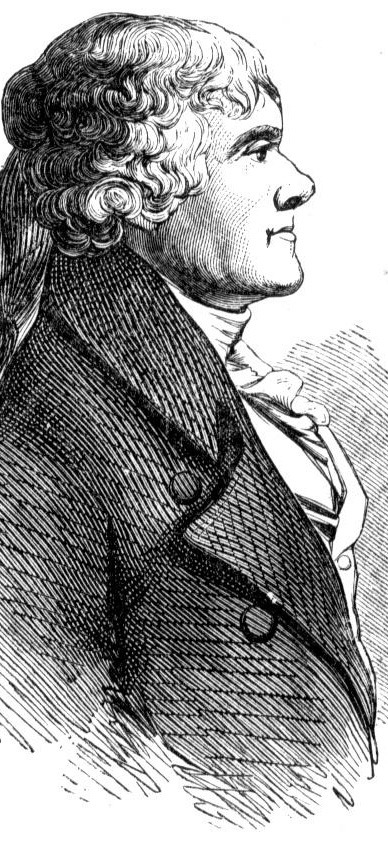
On the heels of Presidents Day, jointly celebrating the birthdays of George Washington and Abraham Lincoln, April 13 turns the clock to Thomas Jefferson, born in 1743.
On July 5, 1774 – just before his political career would skyrocket in Virginia, and nationally – the Albemarle County lawyer would become the first American owner of Natural Bridge. Not incidentally, that iconic landmark would be chosen as a natural namesake for a newly established Rockbridge County, just four years later, during the heart of the American Revolution, whose ideals and urgent cause he would famously declare in Philadelphia on July 4, 1776.
Uncannily, 50 years to the day later, Jefferson would die at Monticello, only a few hours before his fellow “Founder,” turned fierce rival, turned late-in-life friend John Adams jointly “passed on to history,” near Boston.
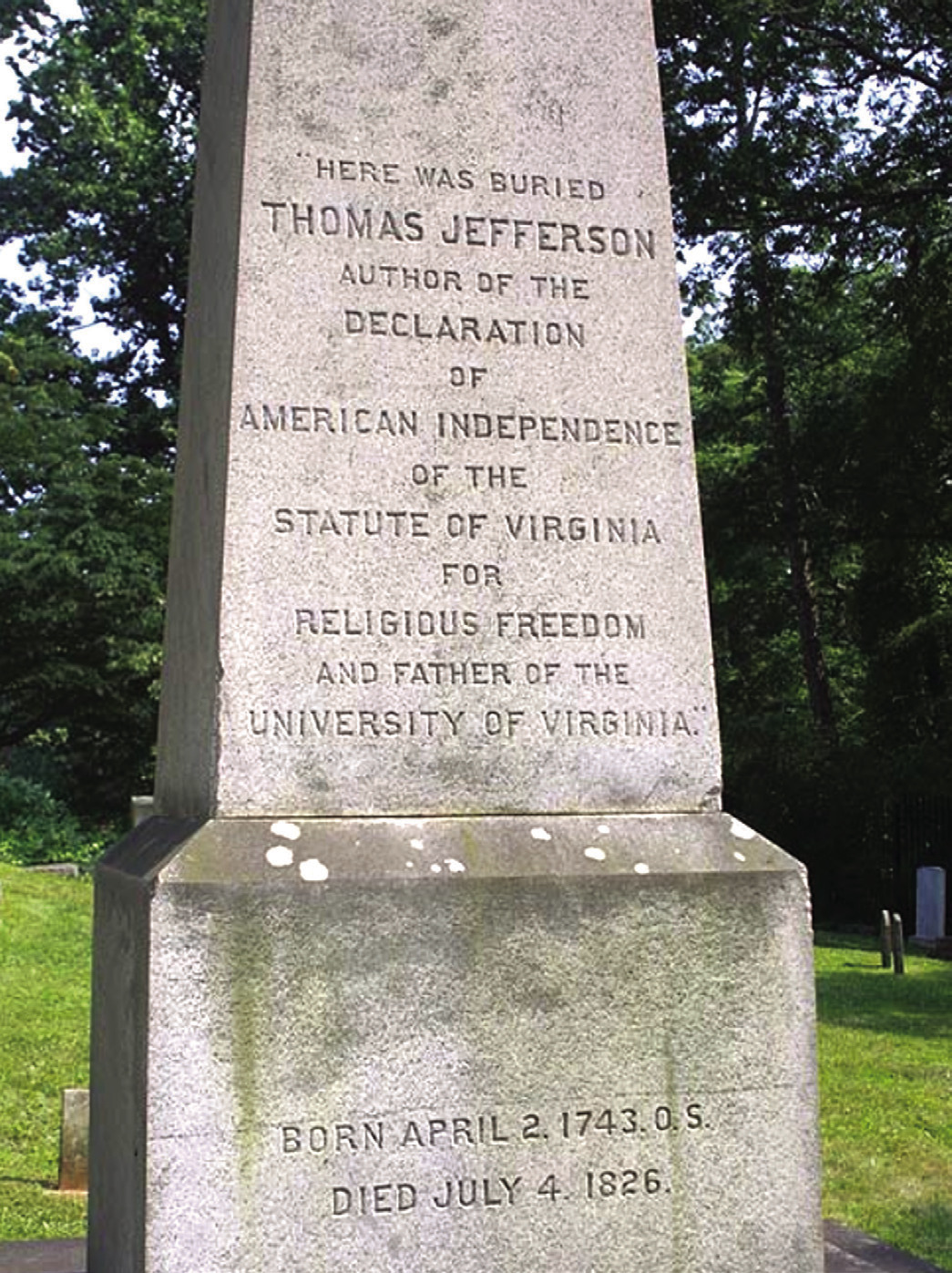
For his gravestone in the cemetery created just below his mountaintop plantation, and enslaved community on Mulberry Row, Jefferson chose not to highlight his notable range of political service. Rather, he directed visitors – and American memory – to reflect on the lasting force of his words. Noted on the classical obelisk: “Author of the Declaration of Independence; of the Virginia Statute of Religious Freedom; and Father of the University of Virginia.
Surprisingly to many, that edifying inscription skipped right past Jefferson’s presidency, inaugurated as the third chief executive of an emerging United States, 225 years ago today, March 4, 1801. Next Wednesday, a special program co-sponsored by the Rockbridge Historical Society, the Rockbridge250: American Revolutions Committee, and the Washington and Lee University Library, will spotlight some of the lesser-known and most celebrated legacies of Jefferson’s writings.
His resonant principles and phrasings continue to influence global ideals and revolutionary manifestos, no less than critical reconsiderations of America’s own priorities and blind spots, two-and-a-half centuries on. Here in Lexington, they also reveal distinctive local histories, calling forth people, places, and institutions that once again connect our small Valley community with the national and international stages of history.
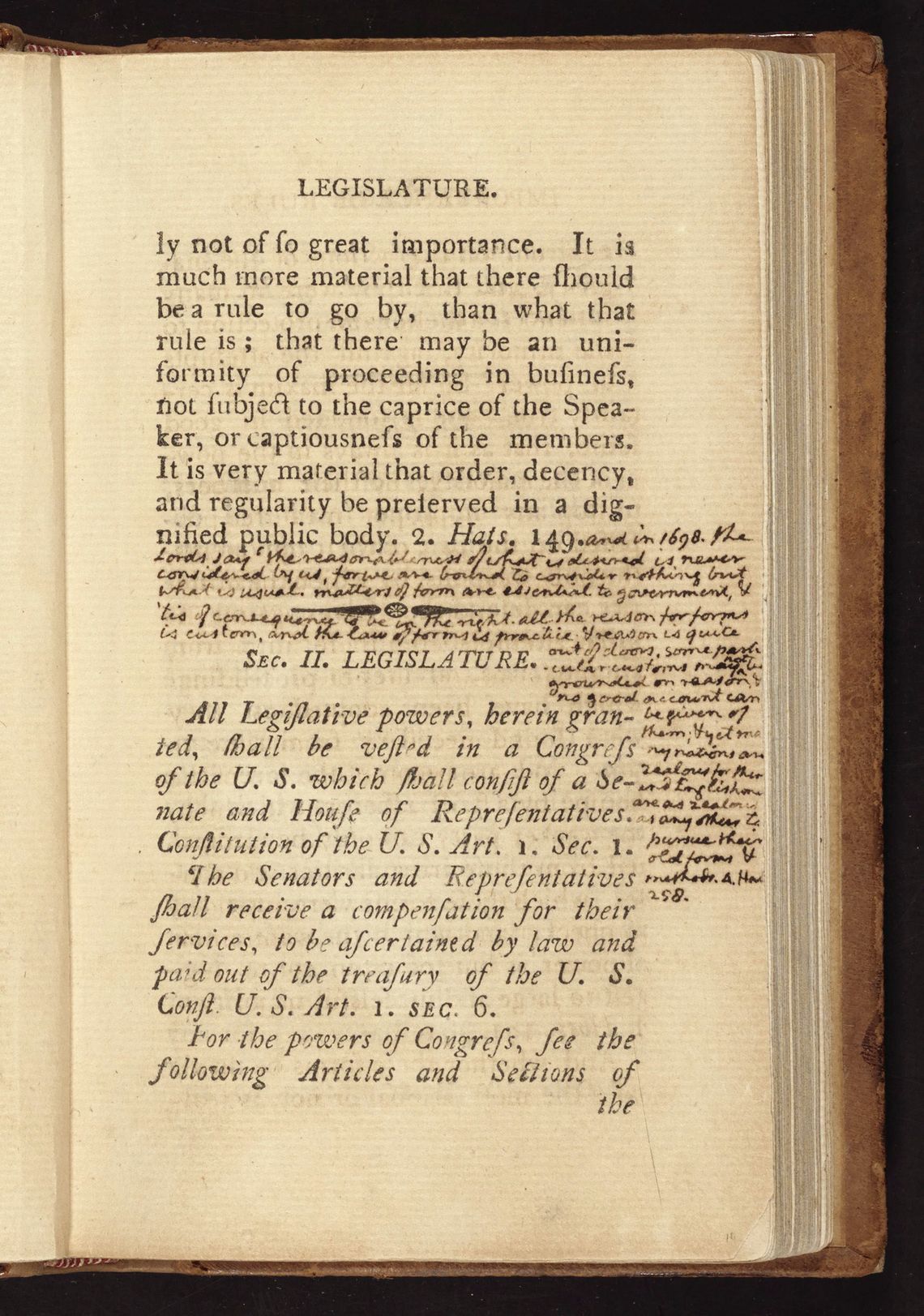
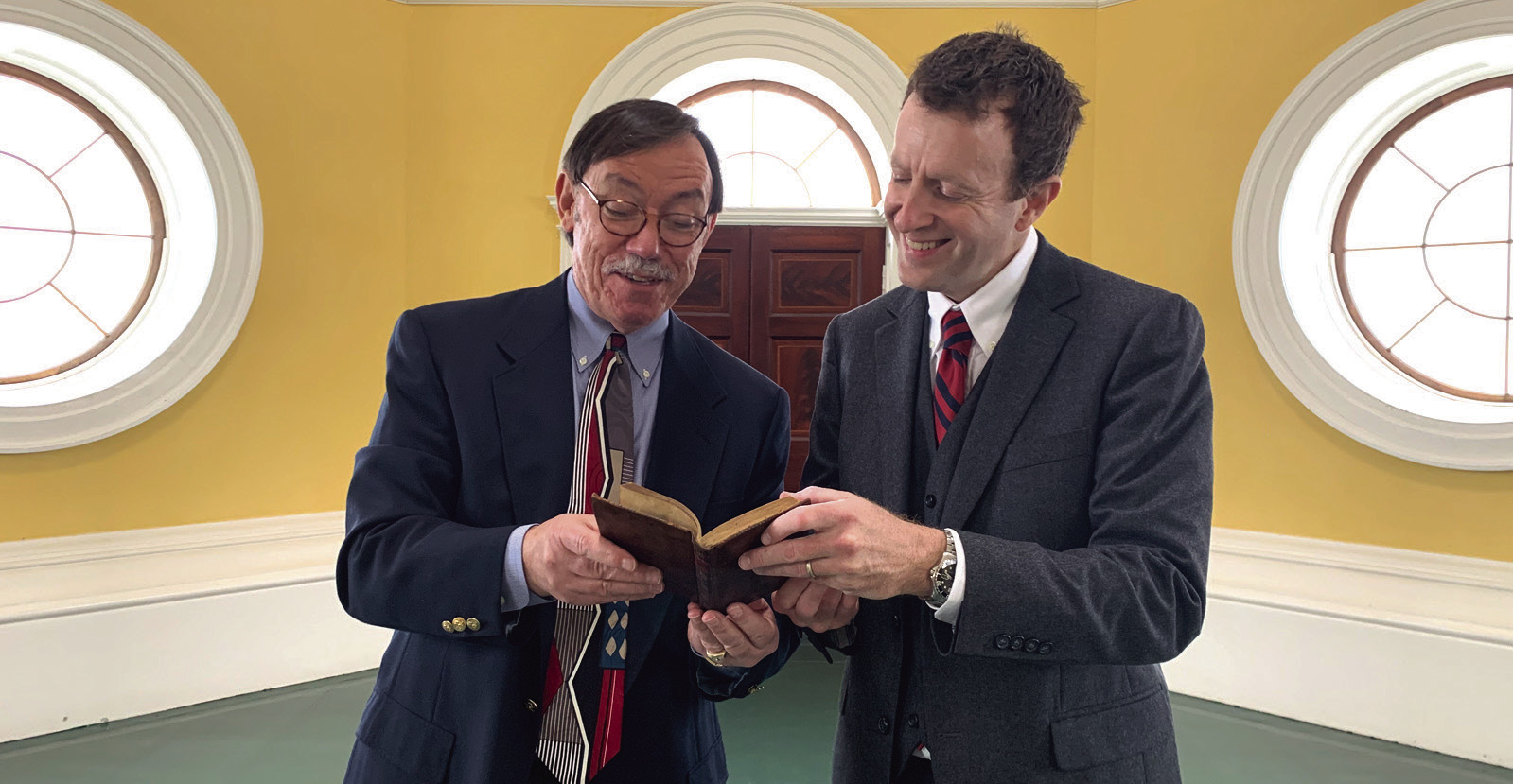
On March 11 at 5 p.m. in Leyburn Library’s Northen Auditorium, W&L professor Brian Alexander will offer a slideshow presentation centered on Jefferson, along with the chance to see a singular copy of “A Manual of Parliamentary Practice” that was annotated in the president’s own hand before its second edition in 1812. This was one of only two books that Jefferson wrote; the other, “Notes on the State of Virginia,” was first published in Paris in 1785, anonymously, while he was serving as U.S. minister to France, following B enjamin Franklin. The free event stands as fitting centerpiece of a four-part series, involving other community partners at the Rockbridge Regional Library System and Natural Bridge State Park. Details follow at the end of this article.
Jefferson Writes, Then Updates, His Congressional Guide
As vice president of the United States, Thomas Jefferson presided over the Senate and recognized the need to improve its procedures. In response, he authored “A Manual of Parliamentary Practice,” first published in 1801. Jefferson’s manual became the foundation for congressional rules and procedures, a distinction it maintains to this day.
Within days of publication of the manual, Jefferson became the nation’s third president, on March 4, 1801. This could have been the end of Jefferson’s work on parliamentary law. A fter a ll, t he r esponsibilities of the presidency loomed before him, including acts which would include the Louisiana Purchase and the Lewis and Clark expeditions. But, Jefferson being Jefferson, the nation’s top public servant did not cease his efforts on parliamentary law.
New research by Alexander shows how Jefferson, while president, continued to read, research, and promote parliamentary law. Ever curious, ever capacious, and ever concerned about the purpose of American government, Jefferson’s efforts included making handwritten notes in three copies of the first edition of his “Manual.”
One of those copies is now preserved in the Washington and Lee University l ibrary. A nd w ith t he guidance of Seth McCormick-Goodhart, public services manager with Special Collections Archives, that volume will be available for viewing a half-hour before and after Alexander’s talk. Signed copies of Alexander’s new book, a comprehensive edition of Jefferson’s Manual, will be on sale at the event. Attendees can also enjoy the opportunity to browse the exhibits in the lobby that mark the 250th anniversary of the college’s library itself, dating back to the first book order made by its first rector, the Rev. William Graham.
Alexander’s talk – and lengthier introduction in his newly published book – shows that Jefferson’s work was based in part on his lifelong commitment to representative, republican (lower-case “r”) government, in which a strong Congress would reflect the will of the people and prevent the tyranny of an overreaching president.
Jefferson’s work on his parliamentary manual became the basis for a second edition, printed with Jefferson’s input, and including the additions he made while serving as president. Jefferson’s “Manual” has been used by the U.S. House and Senate, and legislatures around the country, since it first appeared in 1801. However, the second edition in 1812, published with Jefferson’s direct input, represented his final word on the text.
Alexander reflects on the early and lasting significance of this underappreciated founding document: “Thomas Jefferson wrote the book on parliamentary law not simply as a handy rule book, in the days before one was available. He wrote it to strengthen the American Con- gress, to enable the Article I branch of government in order to better serve its purpose in representing the will of the people, and to act as a check on presidential power.
“His guide is not just a list of rules and procedures,” he continues. “It is an ideological effort in defense of the republican principles most strongly set forth by Jefferson in the Declaration of Independence. A representative government is only as good as its laws and rules. In writing the rules of Congress, Jefferson was writing in defense of the principles of life, liberty, and the pursuit of happiness.”
Professor Alexander’s new publication provided the basis for changes to the 119th “House Rules and Manual,” published by the U.S. House of Representatives in 2025, correcting a two-centuriesold oversight. The edition also includes an extensive introduction detailing the history of the text and tracing the discovery of Jefferson’s revisions.
A Monthlong Series
On Tuesday, March 10, for a grounding prologue to Alexander’s talk, join fellow Rockbridge neighbors for a doubleheader screening of “Jefferson on Film” at 6 p.m. in the Piovano Room of the Rockbridge Regional Library.
For this fourth installment in RHS’ three-year commemorative series of “Revolutionary Films, 1776-2026,” group discussion will respond to selected scenes and episodes from a pair of critically acclaimed documentaries centered on Jefferson: directed by Ken Burns for PBS in 1997, and a six-part miniseries released just last year by the History Channel.
Another book will take center stage on March 25, also in the Piovano Room at 6 p.m., continuing RHS’ complementary monthly series, “Revolutionary Books, 1776-2026.” Indeed, Walter Isaacson’s “The Greatest Sentence Ever Written” – newly released just ahead of the semiquincentennial anniversary of the Declaration of Independence – narrows the spotlight to Jefferson’s most famous, if also most debated, phrasing: “We hold these truths to be self-evident, that all men are created equal, that they are endowed by their Creator with certain unalienable Rights, that among these are Life, Liberty, and the pursuit of Happiness.”
Copies of the Isaacson’s pithy, punchy, yet purposeful close reading (coming in, fittingly, at a sleek 76 pages) can be readily found through local libraries and bookstores, or by contacting RHS at Director@RockbridgeHistory. org.
On April 11, two days before Jefferson’s 283rd birthday, celebrations and new discoveries will be centered at the nearby property he treasured so dearly. Through his 52 years of ownership of Natural Bridge, he’d serially invite friends and international dignitaries to come visit “the most sublime of Nature’s Works.”
Supported by the Friends of Natural Bridge, Rockbridge Area Tourism and Rockbridge250, a sweep of familyfriendly events will be offered that Saturday from 11 a.m. to 3 p.m. A “Jefferson Passport” encourages visitors of all ages to explore a series of ranger presentations and “makerspaces.” Topics and activities span a sweep of interests, from limestone geology to quill pen calligraphy.
You can also learn about Jefferson’s distinctive recipe for ice cream … or another rather more explosive cocktail for rendering saltpetre: used to make gunpowder, sometimes fueled by the guano harvested from Natural Bridge’s many “bat caves.”
Among the range of industry and hospitality that the Bridge has provided through the years was the shot tower that Jefferson engineered atop its heights there during the War of 1812: that first great military test of an emerging American Republic, the same year that Jefferson returned to rewrite the rules of Congress.
All activities on April 11 are free with regular park admission: $9 for adults (those 13 and older) and $6 for children (those 12 and younger).
With the grassroots initiatives of these groups – and a host of other community organizations that have increasingly signaled their interest and engagement – this year’s banner celebrations and historical tributes are being broadly steered by a 14-person Advisory Committee for Rockbridge250. They jointly represent our three localities, along with a range of community leaders in business and media; recreation, education and the arts; as well as veterans and heritage groups.
Visit the state’s flagship website at VA250.org/rockbridge to learn more about its mission and partnerships, cues to local revolutionary histories, and volunteer opportunities. And as we crest toward the summer’s “BigBicentennial+ 50,” browse lexingtonvirginia. com/articles/ va250 to explore resources for your own event planning, marketing, and to forecast the diverse community events already planned through the year, and ahead to Lexington and Rockbridge’s joint 250th birthday in January 2028. -In our own conversations last week, Alexander emphasized the capacity of a small book to bridge national and local legacies: “It is fitting that we pay homage to Jefferson’s efforts in this 250th anniversary of the Declaration, the 225th anniversary of the first publication of his Congressional Manual, and the 200th anniversary of his death in 1826. It’s also a timely and due tribute to the library of Washington and Lee University, celebrating its own 250th birthday this year, and the tremendous archival riches we are so fortunate to have and to treasure.”