After The CCC Camp A Juvenile Correctional Facility For 45 Years, Today An Artists’ Mecca
Editor’s note: This is the second of a two-part series about the history of the former Civilian Conservation Corps property in Arnolds Valley. This part focuses primarily on the 45 years that the Natural Bridge Juvenile Correctional Center was there, then concludes with the property’s current use as the Thunder BRidge arts center.
During the 18th and 19th centuries Virginia had no separate correctional facilities for juveniles. Youth offenders were often incarcerated at the state penitentiary in Richmond along with adult offenders.
Then, in the early 1920s, in response to a growing concern about this arrangement for the juvenile offenders, four private facilities were established in the commonwealth and later managed by it. During the 1960s Virginia met its need for additional juvenile facilities, caused by the increased number of inmates, by leasing the Natural Bridge property. The Natural Bridge complex was particularly suitable because its cottagelike layout was very much like other juvenile facilities in the state.
Established In 1964
The Natural Bridge Juvenile Correctional Center (NBJCC) was located on 100 acres in Arnolds Valley. The facility was established by the now defunct Department of Welfare and Institutions, in January of 1964, and served to “correct” boys and young men 15-20 years of age who were status offenders with lesser criminal offenses. The licensed capacity of the NBJCC was 71 residents.
To be more clear on the types of offenders, statusoffending behavior is “often a sign of underlying personal, familial, community, and systemic issues, similar to the risk factors that underlie general offending. Sometimes these underlying issues contribute to delinquency later in life, putting youths at a higher risk for drug use, victimization, engagement in risky behavior and overall increased potential for physical and mental health issues… .”
The NBJCC was set up to help these young men avoid these types of issues and return back to society better equipped to handle themselves appropriately. The mission statement of the NBJCC was, “… to enhance public safety by providing a learning environment which holds residents accountable for past and present behaviors and affords programmatic opportunities to reform socially, educationally and psychologically.”
Having served as the CCC camp in the 1930s, the facility was well-established. It consisted of four living units, a spacious dining hall with a large fireplace and a wellequipped kitchen, administrative buildings, a gymnasium, educational and vocational buildings, and many other outbuildings.
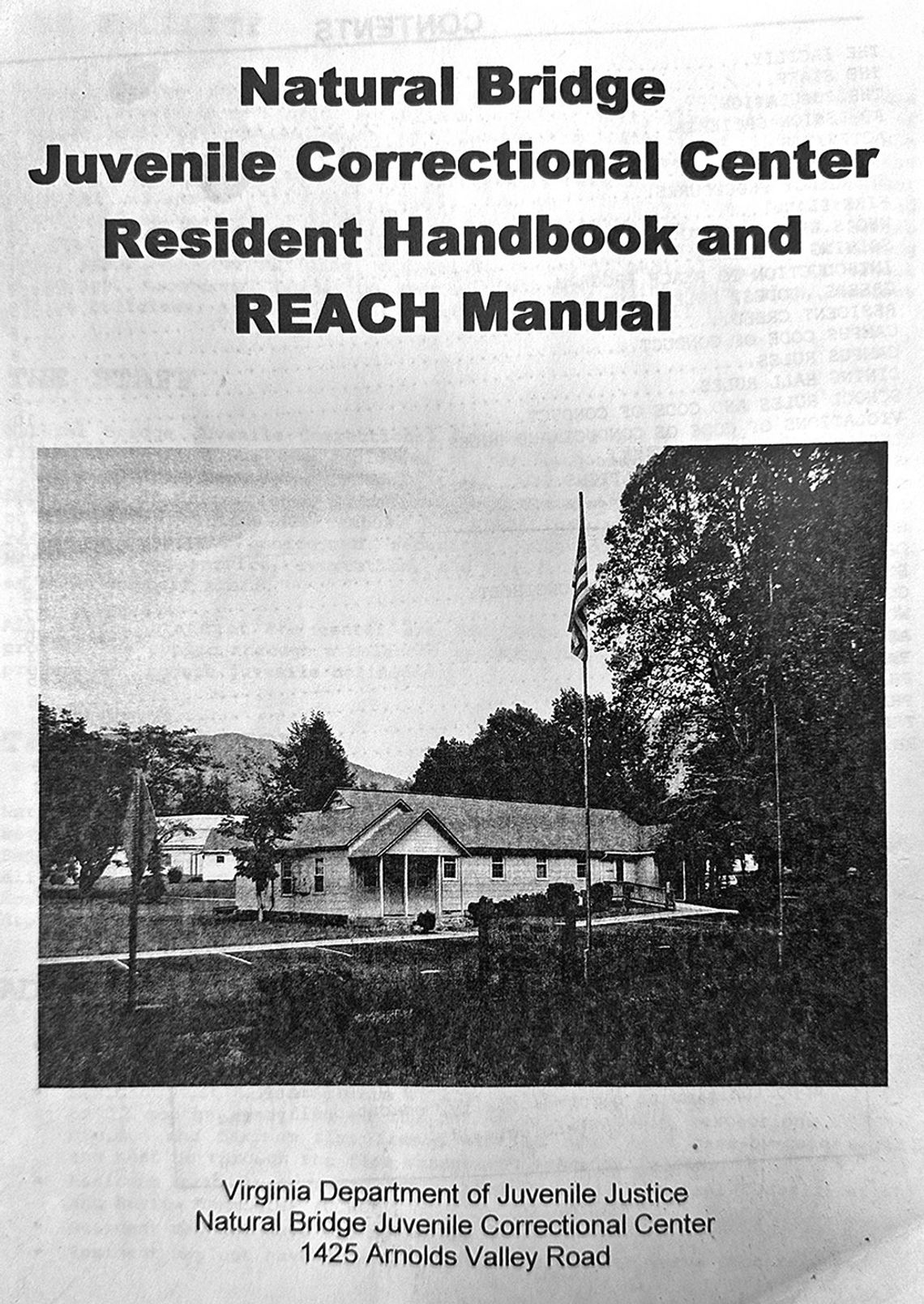
According to the NBJCC Handbook and Manual, the camp had a staff of around 100 with the majority being employees of the Virginia Department of Juvenile Justice (DJJ). Twenty-one of the staff worked in an educational capacity to run the Thunder Ridge High School on the NBJCC campus. Other staff included administrators, food service, recreation, security, nursing and counseling.
Activities Plentiful
The list of activities at NBJCC was plentiful and varied. Examples included individual counseling, mental health services, medical and dental services, work/ education release programs, preparing for a GED, physical fitness training and career technical programs which included building management, auto repair and maintenance, woodworking and bench carpentry.
At times a public health nurse was brought in to discuss with the boys sexuality and sexually transmitted diseases. One such nurse, Nancy Mason, had this to say about her experience doing just that: “I am escorted down a woodland path on a cool autumn evening to a cabin at Camp New Hope on the campus of the Natural Bridge Juvenile Corrections Center, also known locally as the Natural Bridge Learning Center. Camp New Hope is an outdoor experience for eight to 10 adolescent boys who participate in building their cabin living quarters, chopping wood for heat and cooking their own meals, in the hope there will be character development and healing from living in a natural setting. The camp atmosphere was also meant to develop relationships, self-esteem, responsible decision making, as well as skills in caring for oneself and others. I am lugging a backpack filled with educational materials on adolescent sexuality, contraception, sexually transmitted infections and cookies (for dessert). My escort is a counselor working with the adolescents in the Camp New Hope cabin living experience.
“I worked as a public health nurse and was responsible for family planning programs promoting pregnancy prevention and healthy pregnancy planning, including sexually transmitted infection programs. I had been invited to Camp New Hope to participate in an informal discussion with the resident adolescents at the camp. These young boys had expressed interest in learning more information about sexual relationships, contraception and sexually transmitted infection risk.
“Not to say that I wasn’t somewhat anxious. This was going to be an informative discussion with adolescent boys about, well, let’s say sensitive subjects, after dinner by candlelight, or rather a kerosene lantern for light. However, the experience at Camp New Hope stands out as one of the highlights of teaching in a community setting.”
Rules Emphasized
Residents usually spent anywhere from six months to a year at NBJCC. During this time if there was one thing relentlessly focused on it was the REACH Program — Responsibility, Empowerment, Achievement, Changes, Hope. Apparently, although the goals existed, the REACH Program wasn’t formalized as such until the later years of operation. It was also used in most of the other Virginia juvenile correctional systems.
The residents, at every turn, were reminded of creeds, codes, rules and affirmations. According to the NBJCC manual, “Our small community within the facility serves to mirror the larger community each resident will need to face when released. The ability to cooperate, coordinate, organize, and exist, appropriately, within this program provides staff with the information to convey to the community about you in monthly progress reports. The benefits of doing well … will help to confirm the preparation you make to return to the community and to live a productive and positive life.”
The creed adhered to, hopefully, by the residents, included things like being responsible for their own behavior, not to lie, cheat or steal, and to work hard to improve their minds and strengthen their bodies. The code of conduct included things like following directions, completing task, and presenting a neat, clean appearance at all times. The school rules set forward were lengthy, too. They could be applicable to any student in any classroom, anywhere, at any time. For example, no sleeping in class, no disruptive behavior and completing assignments quietly.
Of course, there were violations, and they were outlined in the manual. Major offenses included things like escape, rape and other sexual miscon-
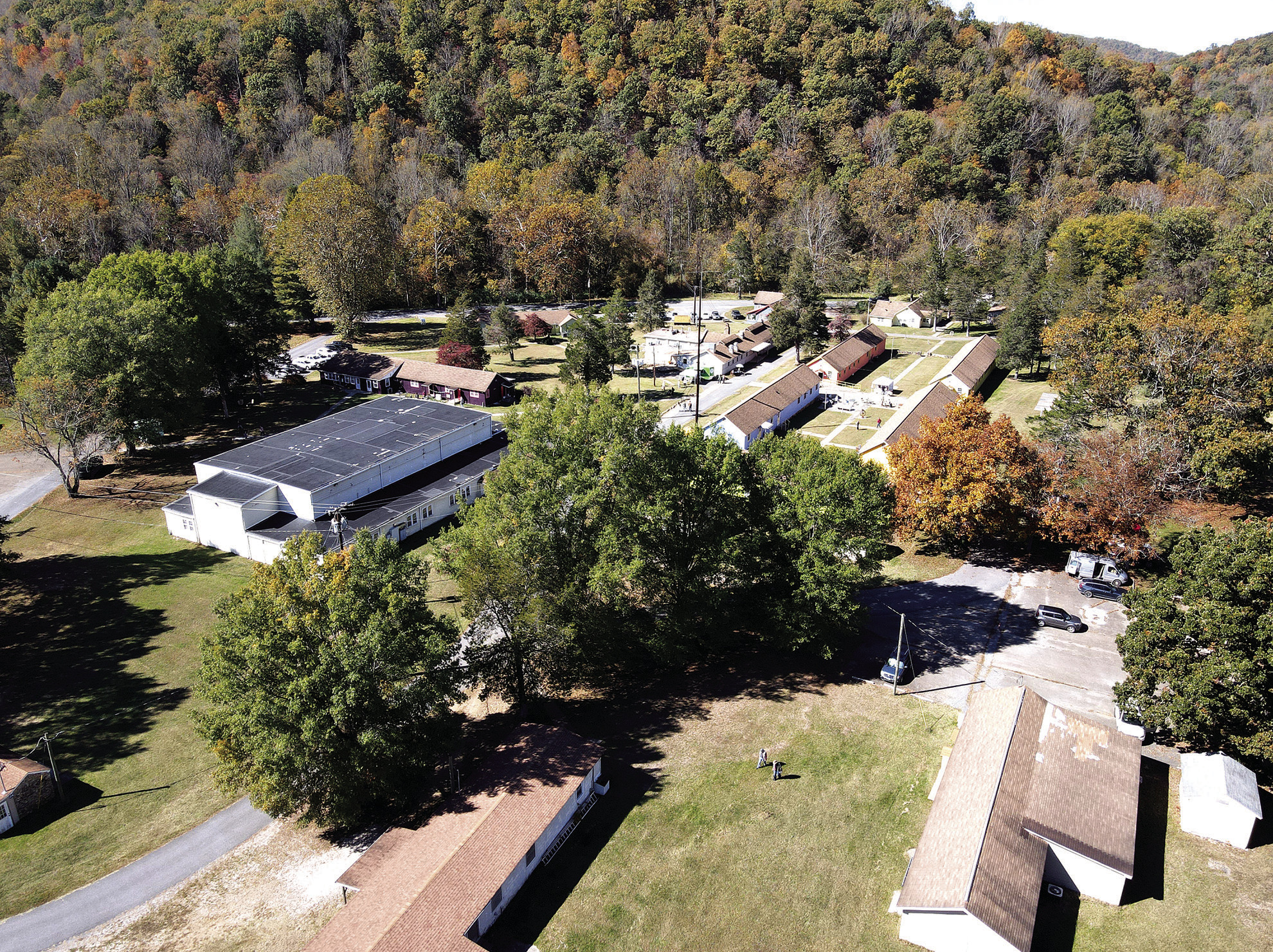
THIS AERIAL VIEW of the former CCC camp, now the Thunder BRidge arts center, was taken with a drone camera this past fall. (Anne McClung photo)

THIS COLORFUL PICTURE is the artwork of James Pannabecker, who collects cancelled postage stamps from all over the world, cuts them up and forms the pieces into art.
duct, having firearms of any type, illegal drugs, assault on staff, and threat to institutional security. Any of these major offenses were punishable by campus confinement, loss of visitation, possible criminal charges, and added days/months to length of stay.
Moderate violations included things like fighting, verbal threats, vandalism, stealing and abusive language. Some of the sanctions for these offenses were program restrictions, campus confinement, loss of canteen or restitution. From old records, there were hundreds of these minor violations occurring at any given time.
There didn’t seem to have been extreme infractions such as the one committed by the infamous Charles Manson back in 1951 when the property served as a federal reformatory.
Manson was sent to the National Training School For Boys, having committed multiple armed robberies and other crimes. His youth was spent in survival mode having no family, save a mother who was always in trouble with the law herself. He was in and out of correctional facilities, escaping whenever he could.
While at the NTSB he manipulated and connived the powers that be and got himself sent to the Federal Reformatory at Natural Bridge. (This was before the NBJCC was established.) He wasn’t there for long, however. He was caught raping another boy at knifepoint and immediately transferred to the Federal Reformatory in Petersburg. He later became a notorious cult leader who was eventually convicted of murder in 1971 and sentenced to life in prison, where he died in 2017.
On a more positive side, the NBJCC provided many rewards and recognition for good behavior, especially behavior that included adhering to the tenants of the REACH program.
Each housing unit elected presidents and leaders, all of whom worked under the housing unit manager employed by the DJJ. This manager worked with the residents to ensure the effective and efficient operation of the unit. Community meetings were held at least twice a day in each unit and included all residents of that unit. The morning meeting basically set the tone for the day. The evening meeting brought closure to the day with discussions on how the day transpired.
As stated in the manual, “These meetings were extremely important to ensure that residents have the opportunity to voice their concerns, encourage each other toward positive contribution and unit involvement and to be given some awareness of how their unacceptable behavior affect those living around them.”
Workers Reminisce
A former teacher at the center, Rusty Ford, who taught social skills needed to live in society, said he was very impressed with the staff, especially those in the vocational skills. According to him there was a staff member, Joe Conner, who taught woodworking and had one student whose IQ was quite low but could do beautiful woodwork. His name was Jesse and Joe brought out the very best in him.
As can be imagined, the staff dealt with all manner of personalities. For example, Ford described two completely different instances. He was talking to a resident about living on his own and how to be successful at that and the resident replied, “I don’t need to know but three numbers when I get out of here. 3-5-7.” As in, 357 Magnum. Sure enough, two months after his release he and his buddies robbed and killed a drug dealer.
On the more humorous side, Ford was commenting to one of his students that his work wasn’t getting done and he was falling behind. This resident’s response was, “Yeah, I kind of feel my learning disability kicking in a lot right now.”
Joe Conner, who worked there for 30 years, tells a story of one of the boys who went AWOL. He said many of them tried to run away but the terrain and area was so rough and remote, they gave up fairly quickly, and were actually glad to be back when caught. When a resident was missing, the neighbors would be alerted.
One day a fellow down the road called the center to say he had captured a runaway and to come get him. When the security staff got there, the boy was flat on the floor and the caller was sitting in a rocking chair with a shotgun pointed at him. When the security officers entered the room the guy put the gun down and told the boy he could get up. The boy was happy to be taken back to the center.
The stories and events at NBJCC are endless. They are poignant, entertaining and educational. From all indications the staff and administration were not happy to see it shuttered. Each person interviewed was dismayed at its closure and that their pleas to the powers that be were rebuffed.
Barry Green had worked himself up to director of the Department of Juvenile Justice and was the director when NBJCC closed. When asked why the facility closed, he, like most of the staff, was very sorry to see it shuttered. He said it was a wonderful place and it was well staffed with a lot of good people who worked so well with the juveniles.
But he said the closure was mostly due to budgeting and partly due to the fact that at the time, the move to put these light offenders into community- based programs had begun. Therefore, there was a reduction in the number of residents.
At present, only one facility remains and that’s the Bon Air Correctional Facility located south of Richmond.
Dismayed Over Closing
As evidenced in the Journal of Correctional Education, Vol. 47 Issue 1, 1996, it seems that the NBJCC was a very successful endeavor and many of the staff, including teachers and administrators were dismayed at its shuttering. During 1993, a study, using data from 200 residents who were released that year, revealed: “Information was collected from parole officers six months after each student’s release. Results revealed that 33 percent of the youths were employed, 33 percent had enrolled in an educational program, and 76 percent had experienced no further court involvement. Earning a vocational certificate, GED, or both increased the student’s chances of gaining employment.”
Amelia Roberson, of Salem, an English instructor at NBJCC, wrote: “This closing is extremely disconcerting as Natural Bridge is Virginia’s only minimum-security complex available to those youths who have earned the privilege of attending.
“Residents are mentored by caring, highly qualified teachers, counselors and adults, and in return, are held to a high standard of personal accountability.”
Joe Hawes, longtime teacher and administrator, was particularly sad to see the facility close. He remarked, “I was the last man out when the center closed. I was there for 41 years. I was upset that it closed because in my humble opinion we were among the learning centers, the best they had in terms of their recidivism and in terms of our ability to advance scores. I was the principal of the GED program and we had the highest GED pass rate in all Virginia’s state agencies. We had SOL scores that Rockbridge County would have killed for.”
Other Uses Considered
After the 2009 closure there was a bill (Budget Bill-HB30) introduced that said: “The Department of Juvenile Justice, with the assistance of the Department of General Services, the Department of Historic Resources, and the Virginia Economic Development Partnership shall work with the county of Rockbridge and other appropriate local entities to address the future use of the property comprising the Natural Bridge Juvenile Correctional Center. A report outlining potential options for re-use and redevelopment of this property shall be provided to the governor, the secretaries of public safety, administration, natural resources, and commerce and trade, and the chairmen of the Senate Finance and House Appropriations Committees, by Oct. 1, 2010.”
The Department of Historic Resources was of the opinion that the NBJCC has maintained more of the characteristics (housing, walkways, etc.) than any other former CCC camp in the United States. Thus they were very interested in what was to become of the property.
There were several meetings of the stakeholders on what to do with the property when it closed. The top six possibilities discussed by the Department of Juvenile Justice were: 1. Reopen Natural Bridge Juvenile Correctional Center and Camp New Hope, reopening in phases as a transition program; 2. Use as a camp site by the Department of Conservation and Recreation; 3. Use for recreational purposes such as hunting, managed by the Department of Game and Inland Fisheries; 4. Market property as a historic resource (CCC Camp) for private, income producing uses, consistent with its character that could tap available incentives; 5. Use as a staging site for Virginia Department of Emergency Management; 6. Explore use by the Department of Military Affairs for the National Guard;
Thunder BRidge: An Artists’ Mecca None of these options really ever panned out. The place stood dormant for many years before Karen and James Pannabecker and their son, Adam, bought it in 2021. They had an appreciation for the place’s history and location and wanted to put life back into it.
They renamed the complex Thunder BRidge, because that nomenclature was used in various ways throughout its history.
The Pannabeckers have created an artists’ mecca — a place for visual artists, musicians, writers, and other creative talents to come together and have studios in many of the original CCC structures. Additionally they have turned what was once Camp New Hope into a campground with primitive camp sites, tent sites, RV sites and two log cabins. Campers have use of a pavilion with a dining area, water, bathrooms, showers, electricity and internet service.
The Pannabeckers want to preserve the old facility’s historic integrity and yet provide a place for artists to come together. They are artists themselves. She takes pieces of scrap metal, much of it from old machinery, and welds them together to make beautiful sculptures. And he has an unusual gift of collecting cancelled postal stamps from all over the world and cutting them up to make the most amazing pictures.
Thunder BRidge has an open house each fall for the public to come visit the property and to take in the art which is displayed by the artists. Food trucks, music, play readers complement the venue. Folks are encouraged to tour the colorful buildings and take in the many and varied creations as well as stroll around the property and enjoy the beautiful environs. Visits to these open houses on a fall afternoon are well worth it.
Thus a new chapter begins in the shadows of Thunder Ridge in Arnolds Valley.