Rescuers, Police Using Technology For Searches, Training
Rockbridge area first responders are getting a bit of aerial assistance with some of their operations thanks to a drone program run by the Rockbridge Regional Public Safety Communications Center.
“Everybody’s liked it, and all of the agencies have been appreciative of it,” Curtis Berry, executive director for the communications center, told The News-Gazette in a recent interview. “It’s become real handy.”
The communications center got its first drone about two-and-a-half years ago, with its primary purpose being for use within the center’s emergency communications operations.
The initial use of the drone, Berry explained, was to check on the equipment atop the radio towers used for emergency communication, rather than hiring someone to climb the tower to check the equipment.
Soon after acquiring the first drone, however, Berry said that local first responders began requesting use of the drones to assist with various operations, such as search and rescues.
Late last year, the communications center formally codified the program, developing standard operating procedures for its small Unmanned Aircraft System (sUAS) in assisting first responders.
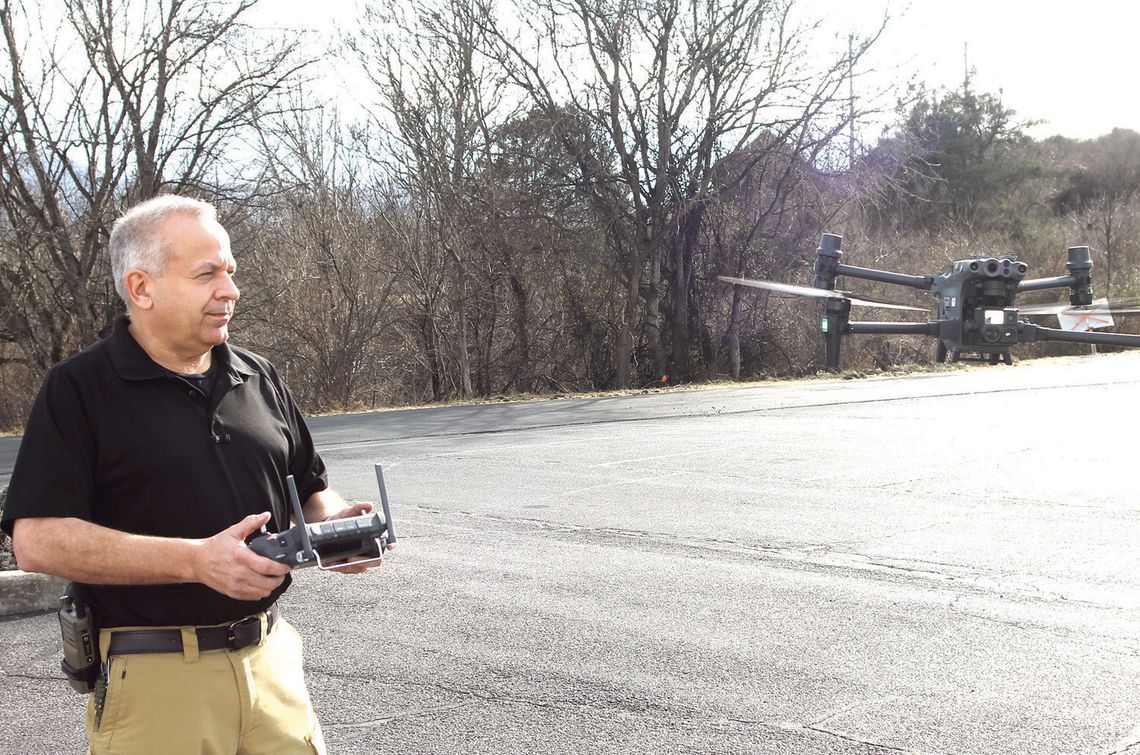
Currently, the communications center has three drones that it utilizes for its internal use and in assisting local first responders. For larger-scale operations, they can use either an Autel 640 T, which was the first model they purchased, and a larger DJI Matrice 30T drone, both of which have thermal imaging capabilities to assist with searches. They also have a DJI Avata 2 drone, a smaller model that can be utilized in navigating tight spaces, such as searching for a suspect that has barricaded themselves in a home.
Operating the drones requires an FAA license, which two individuals with the communications center have received to allow them to operate the drones.
In 2025, the drones logged 30 hours of flight time over 157 flights, both in assisting first responders and in working on the communications center’s equipment.
Search and rescues have been the primary reason that the drones have been requested by first responders, as getting an aerial view of the area being searched can help narrow down the search area or even locate the individual being sought.
They’ve also been utilized to help locate suspects who have fled.
In early January, the Rockbridge County Sheriff’s Office used the drones to help search for a teenager who had fled from custody of West Virginia Social Services while being transferred to a facility in Virginia Beach, locating her using the thermal imaging on the drones before pulling up the regular camera to confirm the identification.
The drones were also utilized in the search for a missing man in Fairfield a few days later, helping clear areas deputies couldn’t see clearly from the ground and allowing them to focus their efforts more effectively.
“You can knock out a lot of things just by putting a drone in the air,” said one of the program’s pilots, who wished to remain anonymous due to the nature of his work with the program.
Law enforcement agencies aren’t the only ones taking advantage of the drones – firefighters have also made use of them in assessing scenes. At a brush fire on Spring Valley Road in March 2024, for example, the drones were used to give firefighters an aerial view of the area and allow them to effectively direct their resources to putting out the fire.
Part of the advantage of having a local drone program, Berry said, is that it allows first responders to get eyes in the sky quickly, especially in search and rescue situations where time is of the essence. Prior to the availability of the drones, if aerial support was needed for an operation, a request had to be made to the Virginia State Police for use of a helicopter, which could take time to arrive on scene, provided it wasn’t already in use elsewhere.
“The best use [of the drones] is how quick we can get there and get this up and offer a great aerial view of things,” Berry said. “It just saves a lot of manpower [in] searching areas and clearing areas.”
Additionally, firefighters can use video of a fire scene for training purposes by providing a view of the operation during the fire that could be reviewed.
“Nobody really records how they conducted themselves during a structure fire,” the pilot said. “After the fact, they can see where everything was laid out and if there might be some improvements that could be made. There is a lot of training value in that.”
While the drones do have cameras and recordings are sometimes made in their assisting first responders, both Berry and the pilot emphasized that the drones are not being used to spy on people.
The operating procedures for the program explicitly prohibit the use of the drones to conduct “random surveillance activities” or to “harass, intimidate or discriminate against any individual group.” It also prohibits targeting people based on “perceived characteristics” such as their race, religion, sexual orientation or gender identity.
They further reiterated that the drones’ primary function is still for maintaining the communications center’s equipment, and the flights made in that capacity aren’t recorded.