Firefighters From Throughout Region Kept Blaze From Spreading
On the morning of July 18, 2000, Robert Foresman was headed up Interstate 81 toward his job in Roanoke when a dispatch call stopped him in his tracks.
At issue was a possible structure fire. The address: Lexington Presbyterian Church.
Foresman turned his car around and drove straight back toward downtown Lexington.
“I looked up and I saw nothing but a column of black smoke,” he said. “And I knew it was serious at that point.”
Twenty-five years later, the former Lexington fire chief still remembers almost every minute of what became one of the most dramatic firefighting days in local memory — a day when over 100 firefighters and EMS personnel from across the region responded to a fire that gutted one of the city’s most historic buildings.
“It was one of the worst days in the history of Lexington,” Foresman said. “One of the most historic churches goes up in flames, and it being right in the center of downtown. But it was also one of the best, in terms of how the community came together.”
The fire started in the attic; specifically, in the open space between the sanctuary ceiling and the church’s steep gabled roof. By the time Foresman arrived and joined Assistant Chief Chad Connor on scene, flames had already taken hold of the structure.
“Very quickly, we realized that the entire attic was completely on fire,” Foresman said. “We were breaking windows just trying to get the fire to vent. We had firefighters on the roof, but it started to go soft and spongy underneath their feet. We had to pull them off.”
Foresman called central dispatch and requested a countywide alarm, and firefighters from every department responded.
“About 45 minutes later, I called dispatch and requested help from neighboring counties,” he said. Units from Augusta, Alleghany and Botetourt arrived. Additional aerial trucks were dispatched.
Crews made a trench cut between the sanctuary and Murray Hall, trying to stop the fire from spreading farther.
“There was an old auto parts store next door — where Brew Ridge Taps is now,” Foresman said. “It had oily rags in storage upstairs, and we were very concerned about that building catching too.”
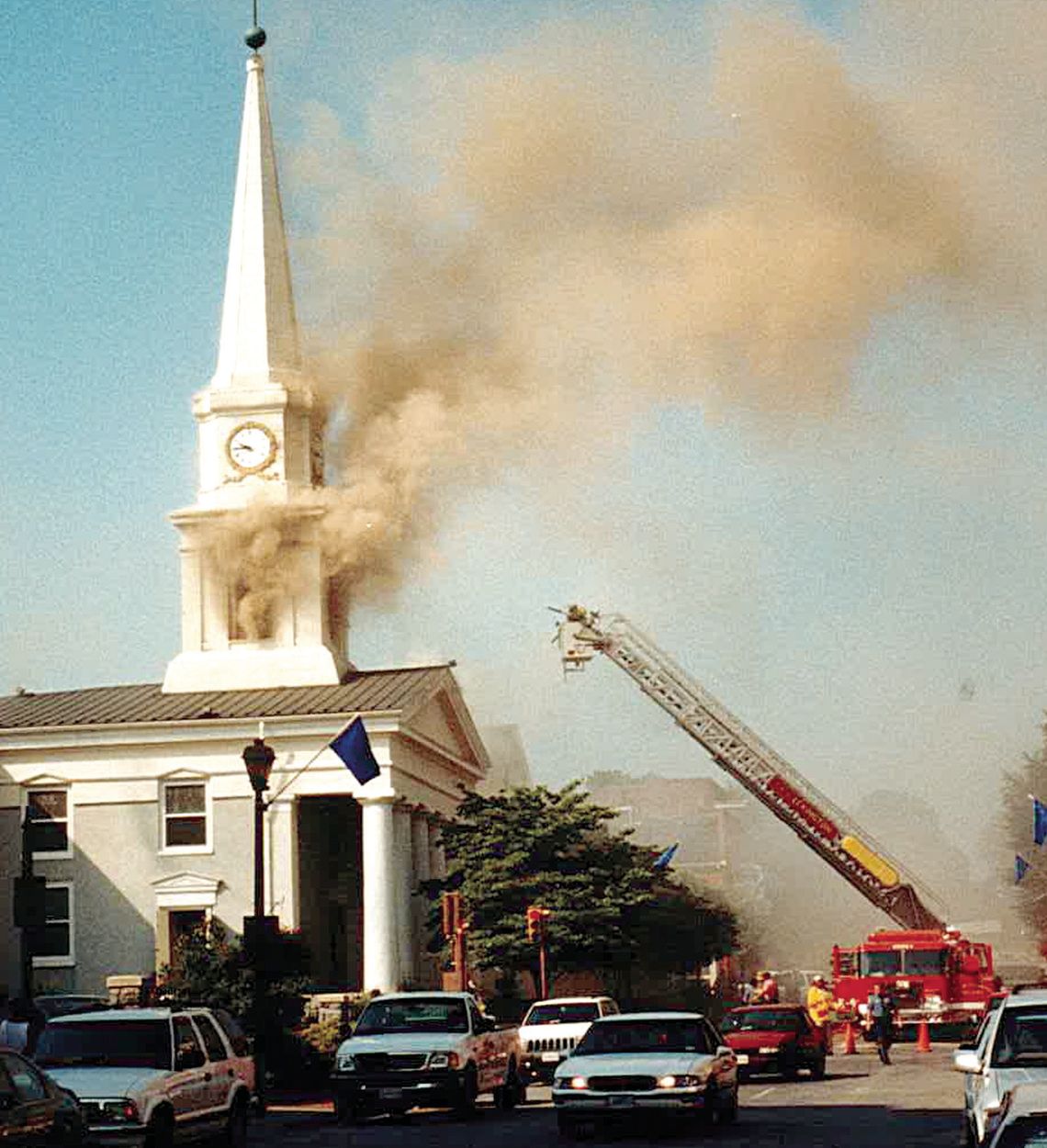
The fire burned fast and hot, funneling upward. The steeple, Foresman said, acted “like a chimney.” Flames rushed through it, and the clock, long a visual landmark on Main Street, froze at 9:48 a.m. before melting away.
The top third of the steeple collapsed into the courtyard. The sanctuary roof caved in. And still, firefighters stayed on scene into the night, battling flare-ups and hot spots. In total, Foresman estimates they used between 350,000 and 400,000 gallons of water.
“One of our guys, Trent Roberts, was injured pretty badly,” he said. “A shard of glass fell and sliced through his glove and into his hand while he was ventilating a window.”
Another firefighter dislocated his shoulder. Dozens more pushed through the heat and exhaustion, rotating in shifts. “We were trying to get every resource we could on scene,” Foresman said. “We even contacted DuPont Chemical in Waynesboro and Shenandoah Valley Airport to see if they could supply additional firefighting foam.”
Despite the scale of destruction, there were no fatalities and no life-threatening injuries. Foresman credits that outcome to the coordination between agencies, the support of city officials and most of all, the community itself.
“It was hot as blue blazes, and people were exhausted,” he said. “But everybody stepped up.”
Restaurants and businesses brought food. Towels soaked in cold water were passed around to cool off first responders. Ministers from other churches came to comfort the congregation. Historians showed up to help preserve museum artifacts. City officials offered whatever support was needed.
“There were people doing things I didn’t even have to ask them to do,” Foresman said. “They just did it.”
Even the national media, Foresman recalled, approached the story with rare compassion.
“That day, it was all love,” he said. “They didn’t try to turn words around. They understood it was emotional for everybody — for us, for the citizens. I’m so grateful for that.”
Foresman remembers standing on the corner near the bank, talking with a career fire chief from Augusta County.
“I said, ‘Chief, what else can we do?’ And he looked at me and said, ‘Robert, I wouldn’t change a thing. Y’all are doing everything right.’ Coming from someone like him, a career chief — all of us being volunteers at the time — that meant a lot.”
While the sanctuary was destroyed, much of the structure remained intact.
“The walls were still standing. The foundation was still there,” Foresman said.
A few days later, a repairman from Cincinnati arrived to work on Lexington’s damaged aerial truck. He was a career firefighter himself.
“He told me, ‘Chief, on fires like this, we usually end up making parking lots out of them. But you guys … y’all did a tremendous job.’” In the days and weeks that followed, cleanup and recovery began. Librarians from Washington and Lee University salvaged hundreds of soaked hymnals and sheet music from the choir room, wrapping them in freezer paper and moving them to cold storage in Buena Vista. Volunteers sifted through debris. Preservationists studied architectural blueprints. City staff coordinated access with insurance officials.
Eventually, Lexington Presbyterian Church rose again.
But the fire changed more than just the building. If anything, it strengthened alreadytight bonds among local institutions.
“We had a ceremony,” Foresman said, “and initially we said ‘we’re not going to present anything to anybody,’ but the more I thought about it — it was ‘no, we’re going to do something.’ So on behalf of all the fire departments, we presented a plaque to the church for their strength and generosity. I think that plaque still hangs in the church today.”
Today, Foresman works in emergency management, but that day still lives vividly in his memory.
“It doesn’t seem like it’s been 25 years,” he said. “I’m just so freaking proud of everybody. Whether it was a firefighter from Alleghany or a volunteer from town, it was never about me. It was always about the collective.”
If he could, he said, he’d bring every responder back together just to shake their hands.
“You know, the lights and sirens — that’s the sexy part of a disaster. But it’s the recovery where real resilience happens. And the fact that building still stands … it’s a testament to this community.”
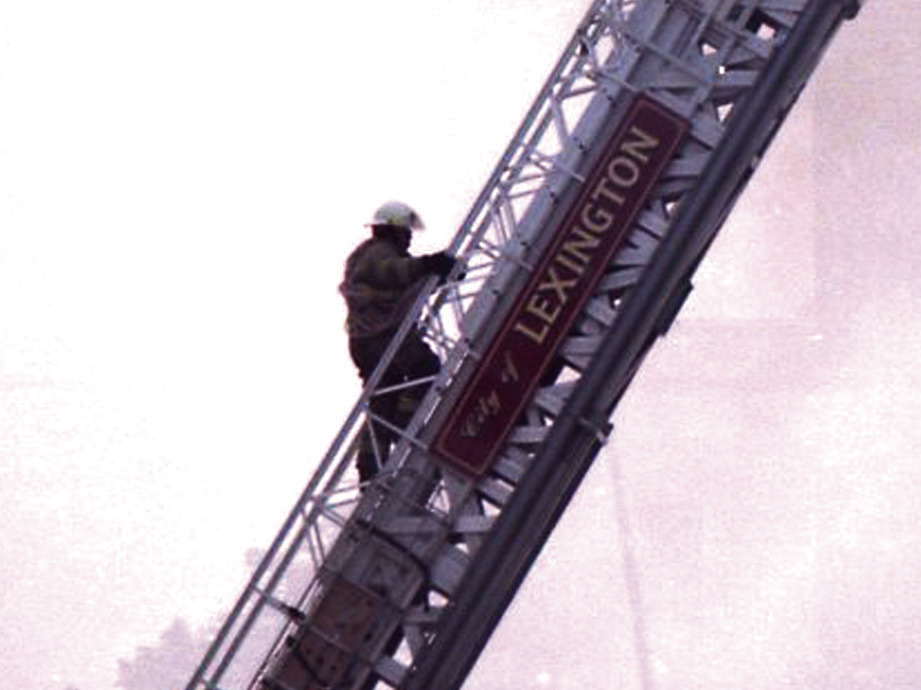
FIREFIGHTERS employed ladder trucks to battle the fire that started in the attic of the Lexington Presbyterian Church on the morning of July 18, 2000. (N-G file photos)
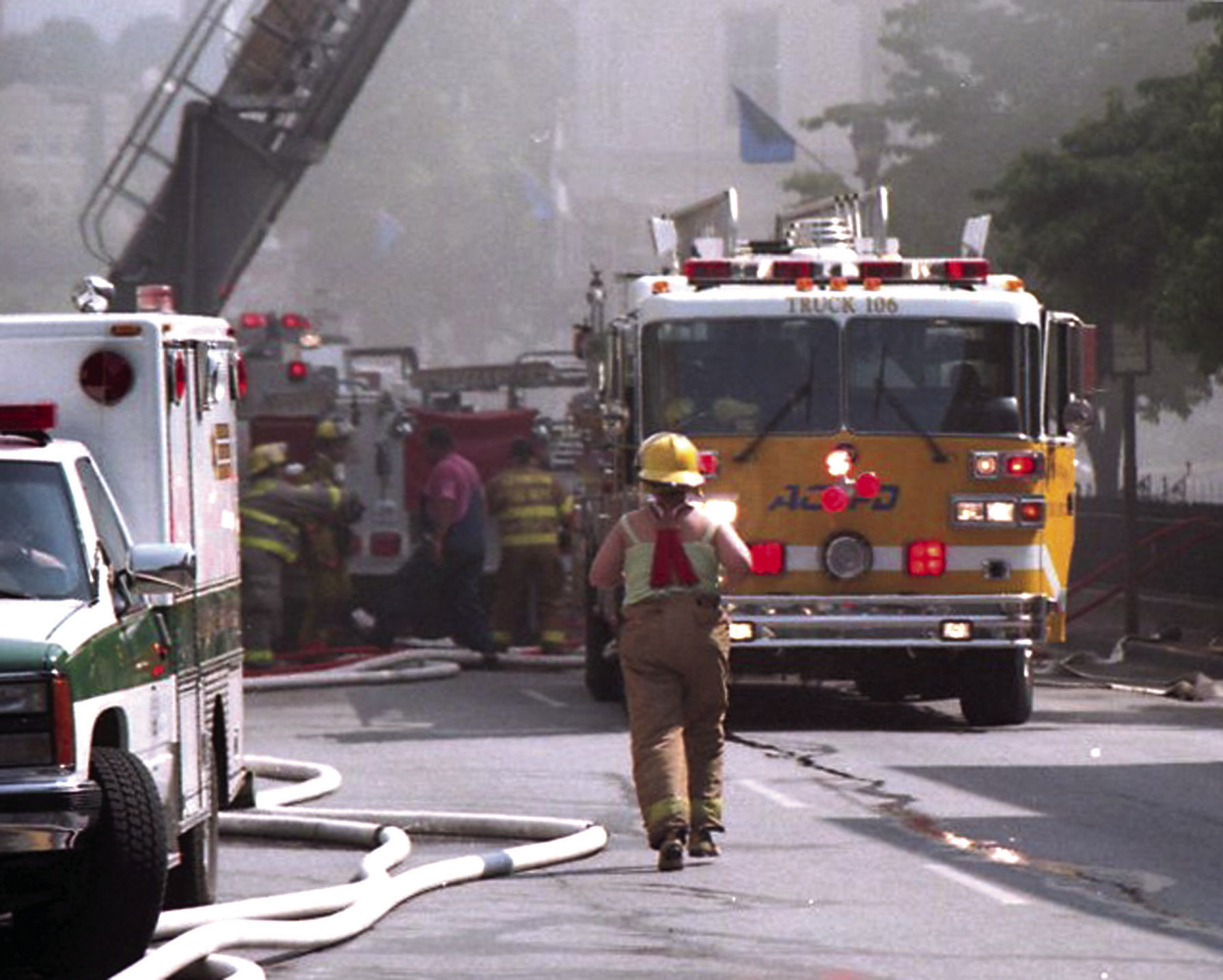
FIRE and rescue crews from throughout the Rockbridge area, along with firefighters from neighboring counties, responded to the fire at the Lexington Presbyterian Church. Crews also had to battle hot weather conditions that day. (N-G file photo)
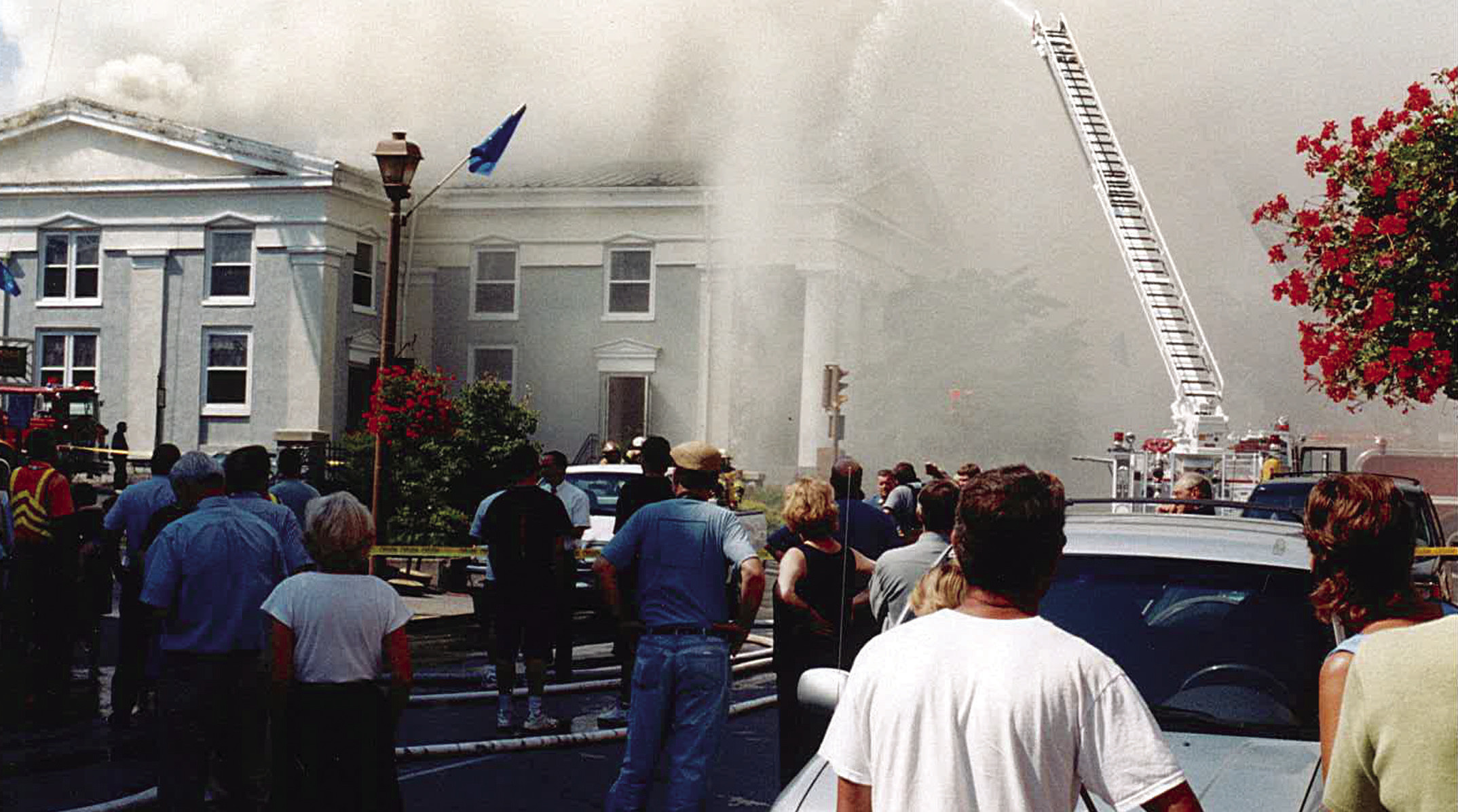
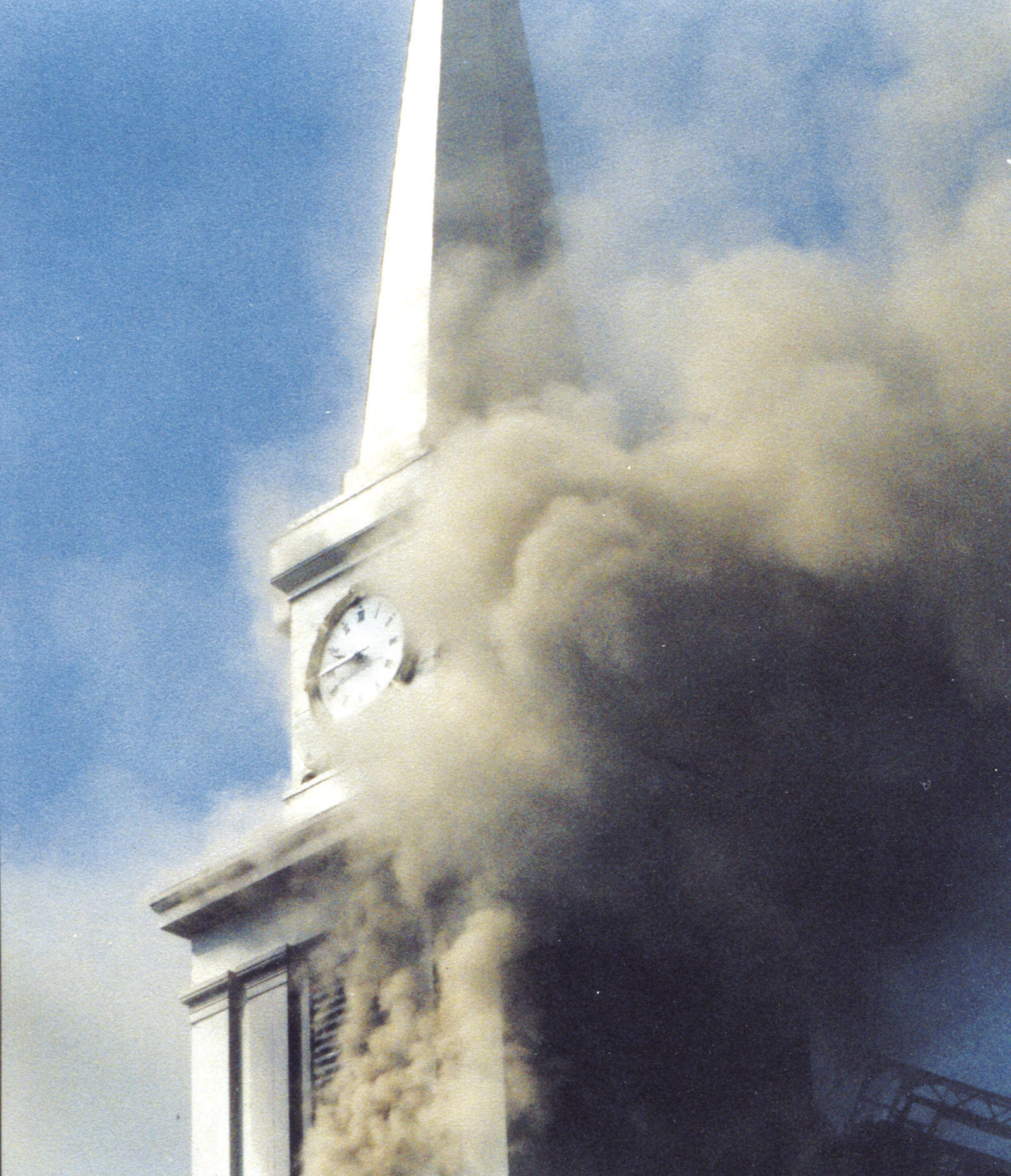
A LARGE CROWD gathered on city streets to watch the firefighting efforts at the Lexington Presbyterian Church. The roof of the sanctuary would eventually cave in and the topof the steeple would collapse. (N-G file photos)